Saint
Cuthbert of Lindisfarne
Bishop of Lindisfarne
Monk, hermit, and bishop in Northumbria, associated with the monasteries of Melrose and Lindisfarne, who died in 687.
Life
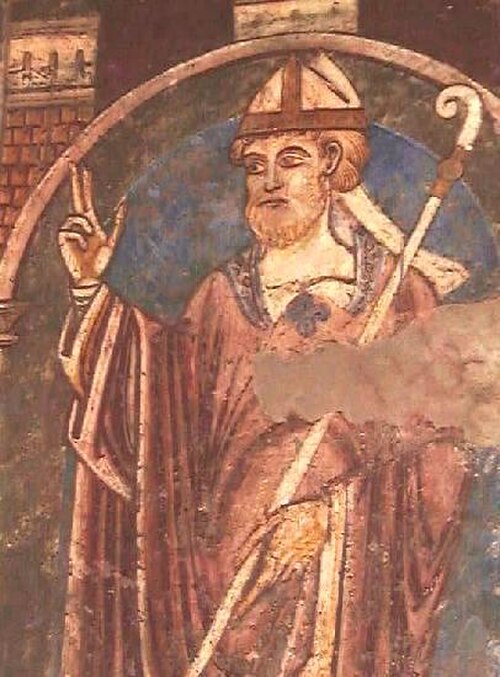
Saint Cuthbert of Lindisfarne, hierarch, was a monk, hermit and bishop in Northumbria, in the English Church of Celtic tradition, connected with the monasteries of Melrose and Lindisfarne. He died on 20 March 687. He is patron of Northumbria, and his veneration, lively in the Middle Ages, gathered around his tomb in Durham Cathedral. He is commemorated on 20 March by the Catholic, Anglican and Orthodox Churches, and on 4 September by the Church in Wales and the Catholic Church; the Russian Orthodox Church also commemorates him on the third Sunday after Pentecost, at the Synaxis of the Saints of Britain and Ireland.
Youth
He was born around 634-635, perhaps in a noble family, at Dunbar in Northumbria, in the days when Oswald had called Irish monks from Iona to found Lindisfarne. He grew up near Lauderdale, close to the monastery of Melrose, a daughter-house of Lindisfarne. As a boy he tended sheep on the nearby hills. One night in 651 he saw the soul of Saint Aidan carried to heaven by angels and learned later that Aidan had died that night; then he resolved to become a monk. He seems to have first done some military service. He entered the new monastery of Melrose, under Abbot Boisil, and after Boisil’s death, in 661, succeeded him as prior.
Monk and bishop
His fame for piety, diligence and obedience grew. When King Alchfrith founded the monastery of Ripon, Cuthbert became guest master under Eata; when Wilfrid was given the monastery, Eata and Cuthbert returned to Melrose. In an illness that struck the monastery, in 664, the prior died and Cuthbert, who had recovered, was put in his place. He spent much time among the people, ministering to their spiritual needs, making missionary journeys and preaching, especially in remote villages. After the Synod of Whitby in 664 he accepted the Roman customs without difficulty, though raised in the Celtic tradition, and his former abbot Eata called him to introduce them at Lindisfarne, where he was prior around 665. He was austere with himself, but attracted by kindness and generosity to the poor, and knew how to impress kings and nobles. When he could he lived as a hermit, though still receiving visitors. In 684 he was chosen bishop of Hexham and then, in 685, of Lindisfarne, much against his will. Toward the end of 686 he resigned and returned to his hermitage in the Farne Islands, feeling that death was near. He was about fifty. Lives from near his time tell of many miracles that accompanied even his beginnings. He was, according to some sources, a second cousin of King Aldfrith.
Relics
He was buried at Lindisfarne; later, because of Viking raids, his remains were taken inland to the church at Chester-le-Street. In 1104, when his tomb was opened, the Gospel of John was found beside the body, called the “Gospel of Cuthbert”, and the relics were buried again in Durham Cathedral. A disciple of his was Saint Ethilwald of Lindisfarne.
Commemorated the same day March 20
 PhotineMartyr · The Samaritan WomanMar 20
 Alexandra of AmisusMartyr · Martyr of AmisusMar 20
 Claudia of AmisusMartyrMar 20
 Euphrosynus of SinozerskVenerable Martyr · Founder of Sinozersk HermitageMar 20
- Myron of CreteNew MartyrMar 20
- Theodora of CappadociaMartyrMar 20
- Abramius of SinozeroVenerable MartyrMar 20
- Aedhan of Cluain MaelainSaintMar 20
- Anatolia of RomeMartyrMar 20
- Aquila the EparchMartyrMar 20
- Basil of SinozeroVenerable MartyrMar 20
- Basil SokolovHieromartyr · The deaconMar 20