
Martyr
Photine
The Samaritan Woman
The woman who spoke with Christ at Jacob's well and believed in Him, a martyr according to tradition.
Life
Saint Photine, the Samaritan Woman, is the woman from Samaria with whom the Lord spoke at Jacob's well, as told in the fourth chapter of the Gospel of John. The Church calls her equal to the apostles and Great Martyr. According to tradition she preached Christ in Africa and at Rome and was put to death under Nero around the year 66. The Greek and Romanian Churches keep her memory on 26 February, the Slavic Menaion on 20 March, and the whole Church on the fifth Sunday after Pascha, the Sunday of the Samaritan Woman.
At Jacob's well
On his way from Judea to Galilee, Jesus came to a city of Samaria called Sychar, near the field that Jacob had given to his son Joseph, where Jacob's well was. Tired from the road, He sat by the well at about the sixth hour, while His disciples had gone into the city to buy food. A Samaritan woman came to draw water, and He asked her for a drink. She was astonished, because Jews did not share things in common with Samaritans.
The Lord told her that if she knew the gift of God and who was asking her for a drink, she would have asked Him and He would have given her living water. Whoever drinks of that water will never thirst, for it will become in him a spring welling up to eternal life. He then showed her that He knew her life, that she had had five husbands and that the man she now had was not her husband. She said that she saw He was a prophet and asked where God should be worshipped, on Mount Gerizim or at Jerusalem. He answered that the hour was coming, and had come, when true worshippers would worship the Father in spirit and truth, since God is spirit. When she said that she knew the Messiah was coming, Jesus said: "I who speak to you am he."
She left her water jar, went into the city and told the people to come and see a man who had told her everything she had done, and asked whether this could be the Christ. Many Samaritans believed because of her word. They asked Jesus to stay, and He stayed two days. They said to her afterwards that they no longer believed because of what she had said, but because they had heard Him themselves, and knew that He was the Saviour of the world.
The tradition of her life
The Gospel does not give her name. The Church says that she was baptized among the first women of Samaria and was named Photine, "the enlightened one." She then devoted herself to preaching the Gospel in Africa, and lived at Carthage with her younger son Joses. Her elder son Victor was a soldier and commander at Attalia in Asia Minor.
According to the synaxarion, the official Sebastian met Victor and urged him to obey the emperor and keep his faith in secret. Victor refused, and Sebastian, struck blind for three days, came to believe in Christ, was baptized and recovered his sight. Nero heard of it and ordered the Christians to be brought to Rome. The Lord appeared to them and encouraged them, and gave Victor the name Photinus, the enlightened. Photine, who had been told of her sufferings, came from Carthage to Rome with her five sisters, Anatole, Photo, Photis, Paraskeve and Kyriake, and joined the confessors.
Before Nero all the confessors refused to deny Christ. Their fingers were crushed on an anvil, but they felt no pain and their hands were unharmed. Sebastian, Photinus and Joses were blinded and imprisoned, and Photine and her sisters were placed in the palace under the care of Nero's daughter Domnina. Photine brought Domnina and her servants to Christ, and also a magician who had brought poisoned food.
Three years later it was reported that the blinded men had recovered their sight and that the prison had become a place of light and fragrance, where people came to hear them. Nero had them crucified and beaten. When servants came to see whether they were alive, they were struck blind, and an angel of the Lord freed the martyrs and healed them. They in turn restored the servants' sight, and the servants were baptized. Nero then had the skin removed from Photine and had her thrown into a well. Sebastian, Photinus and Joses suffered cruel torments, and the sisters were tortured and beheaded. Photis was torn apart between two trees. Photine was taken from the well and held in prison for twenty days. When Nero asked her again to sacrifice, she refused him, and he had her thrown into the well once more, where she gave up her spirit to God about the year 66.
These details come from the synaxarion tradition, not from the New Testament, and the historical basis is uncertain.
Veneration
The Church reads the Gospel of the Samaritan Woman on the fifth Sunday after Pascha, and sings of the woman who left her water jar and found the spring of life. Her head is kept at the monastery of Grigoriou on Mount Athos, and parts of her relics are at the monasteries of Iviron and Pantokrator on Athos and in other monasteries. In Constantinople two churches were dedicated to her, and healings of eye diseases were reported there.
Commemorated the same day March 20
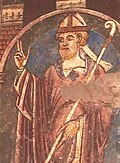 Cuthbert of LindisfarneSaint · Bishop of LindisfarneMar 20
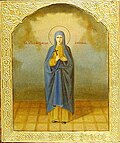 Alexandra of AmisusMartyr · Martyr of AmisusMar 20
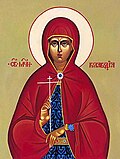 Claudia of AmisusMartyrMar 20
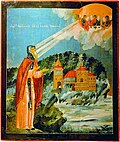 Euphrosynus of SinozerskVenerable Martyr · Founder of Sinozersk HermitageMar 20
- Myron of CreteNew MartyrMar 20
- Theodora of CappadociaMartyrMar 20
- Abramius of SinozeroVenerable MartyrMar 20
- Aedhan of Cluain MaelainSaintMar 20
- Anatolia of RomeMartyrMar 20
- Aquila the EparchMartyrMar 20
- Basil of SinozeroVenerable MartyrMar 20
- Basil SokolovHieromartyr · The deaconMar 20