Venerable Martyr
Cyprian Nelidov
A monastic martyr of the Russian Church, who died in 1934.
Life
Holy Venerable Martyr Cyprian Nelidov, a hieromonk, was born on 14 July 1901 in Kazan, in the family of the physician Alexei Pavlovich Nelidov, a nobleman by birth, and his wife Vera Alexeevna. At baptism he was named Constantine. His parents separated soon after his birth: his father moved to Nizhny Novgorod and later, in Soviet times, worked as a doctor at an OGPU clinic, while his mother went to Zhitomir. Constantine grew up in Nizhny Novgorod, in the house of Alexandra Barsova, the stepmother of Vera Alexeevna.
After school he served in the army as a private from 1920 to 1924, and on his return he gave himself wholly to the service of the Church. In 1925 Metropolitan Sergius (Stragorodsky) of Nizhny Novgorod tonsured him a monk with the name Cyprian and ordained him hieromonk. From 1928 he served at the Kazan church in Kyzyl-Orda, in Kazakhstan.
At the beginning of 1932 Metropolitan Sergius called him to Moscow, to the chancery of the Holy Synod, and in August of that year Father Cyprian was appointed rector of the church of Saint John the Theologian in Bogoslovsky Lane. He spent most of his time at the Synod chancery and in the church, and he lived in the home of the Moscow architect Vitaly Ivanovich Dolganov, where the host's mother, Elizabeth Fotievna, his sisters Faina and Valentina, and Bishop Barnabas (Belyaev), who was without a see, also lived.
On 15 March 1933 the OGPU arrested Bishop Barnabas, Hieromonk Cyprian and the sisters Faina and Valentina Dolganova. Father Cyprian was questioned at once at the Lubyanka and then taken to Butyrka prison. He said that at the tea gatherings in that house people spoke of their impressions and of how each had lived, and that politics was not discussed. On 8 April he was called again and, asked whether he admitted guilt, he answered that he did not.
On 23 April the investigation ended. The accused were charged with creating an illegal monastery in the Dolganov apartment and with exerting a religious influence on young people. On 10 May 1933 the Special Council of the OGPU Collegium sentenced Bishop Barnabas and Hieromonk Cyprian to three years in a labour camp, and the two sisters to three years of exile in the Northern Region. Father Cyprian was sent to a camp in the Altai, on the building of the Biysk road.
An Orthodox laywoman from Moscow who was in the same camp remembered him as a bright person, always calm, who looked like a hero full of strength and health. At first he was given earthwork, then made a storekeeper. Here troubles began: for his honesty, which was unwelcome to those around him, he was slandered and sent to a punishment camp among the most hardened thieves and bandits. The camp lay in a gloomy place between mountains, in the Korkuchi gorge, where the sun did not reach. Father Cyprian endured much there, surrounded by coarseness and licence, but he overcame all of it with meekness. Serving as attendant in the tent of those unruly men, he did not oppose them or reproach them, but tried to serve them, and he loved them. One of them recalled him later with tears. His death made a strong impression on the prisoners, even on the thieves, who saw in him the image of a true disciple of Christ.
Hieromonk Cyprian reposed on 16 June 1934 in the camp infirmary and was buried in the Korkuchi gorge, in a separate grave that is now unknown.
The saint is commemorated on 16 June, the day of his death, and on 7 February with the Synaxis of the New Martyrs and Confessors of Russia, then on 5 September with the Synaxis of the Moscow Saints and on 26 September with the Synaxis of the Altai Saints, all in the new style.
Commemorated the same day June 3
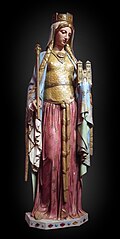 ClotildeRight-Believing · Queen of the FranksJun 3
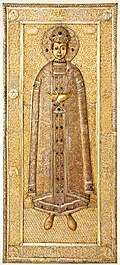 Demetrius of UglichPassion-Bearer · Tsarevich of UglichJun 3
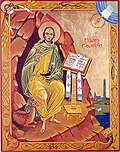 Kevin of GlendaloughVenerable · Founder of Glendalough AbbeyJun 3
- Achillas of AlexandriaSaint · Patriarch of AlexandriaJun 3
 Amphilochius of GlushitsaVenerable · Disciple of Dionysius of GlushitsaJun 3
 Dorotheos ProiosSaintJun 3
 Olivia of AnagniSaintJun 3
- Agapit of MarkushevoVenerable MartyrJun 3
- Joseph of ThessalonikiSaint · Metropolitan of ThessalonikiJun 3
- Cornelius of PadanVenerable · Founder of a hermitageJun 3
- Gregory of DerkosSaint · Hierarch of DerkosJun 3
- Adalbert of ComoSaintJun 3