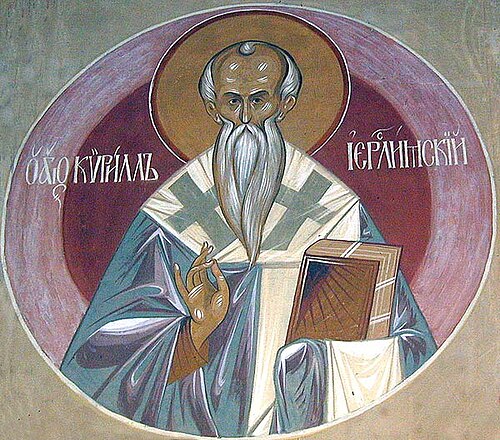
Saint
Cyril of Jerusalem
Archbishop of Jerusalem
Bishop of Jerusalem after 350, author of the Catechetical Lectures for those preparing for Baptism.
Life
Saint Cyril of Jerusalem was bishop of Jerusalem after 350, a teacher of the Church and the author of the Catechetical Lectures, addressed to those preparing for Baptism. He was exiled several times, because of the enmity of Bishop Acacius of Caesarea and the policies of certain emperors. The Orthodox Church commemorates him on 18 March.
Early life
He was born at Jerusalem or near the city, between 313 and 317, in the time of Constantine the Great. Little is known of his life before his episcopate. It is said that he was well versed both in the writings of the Fathers and of the Greek philosophers, and, according to some sources, he entered monastic life early. He was ordained deacon by Bishop Macarius of Jerusalem, around 335, and priest by Bishop Maximus eight years later. Maximus entrusted him with the instruction of the catechumens, those preparing for Baptism. Cyril gave them orally; twenty-seven of his lectures survive. At the end of 350 or in 351 he succeeded Maximus in the see of Jerusalem.
His ministry and exiles
Relations between Metropolitan Acacius of Caesarea and Cyril worsened. Jerusalem then depended on Caesarea, which Cyril did not like. Orthodox historians show Acacius as an Arian, and for this reason place his opposition to Cyril. Sozomen suggests that Acacius's jealousy of the importance given to the see of Jerusalem by the Council of Nicaea and of the rise of Jerusalem as a holy place and a place of pilgrimage also counted. Acacius charged Cyril with selling church property. It is said that it concerned vessels sold to feed the poor in time of famine. He was deposed and exiled three times, at first, after a synod in 358, to Tarsus, in Cilicia. The Council of Seleucia the following year removed Acacius, and Cyril returned. Exiled again in 360, he was recalled in the time of Julian the Apostate, then again sent into exile under Valens, and returned for good in the time of Theodosius, in 378, when he lived on in peace.
The sign of the Cross and the Lectures
On the day of Pentecost in 351 there appeared, according to tradition, in the sky over Jerusalem a sign of the Cross, brighter than the sun, which stretched from Golgotha to the Mount of Olives and lasted several hours. Cyril wrote to the emperor Constantius about this sign, and the event strengthened the Orthodox faith. Cyril left important writings on the preparation of catechumens and on the order of the Liturgy of his day, the so-called Catecheses. The pilgrim Egeria describes him as a preacher and man of the services.
Repose
Cyril took part in the Second Ecumenical Council at Constantinople, in 381, and fell asleep in 386 or 387, having been bishop for many years, many of them in exile. He is honoured as a saint by the Orthodox, Catholic, Oriental and Anglican Churches. In 1883 he was declared a Doctor of the Church by Pope Leo XIII. He is not to be confused with Cyril of Alexandria.
Commemorated the same day March 18
 Edward the MartyrPassion-Bearer · King of EnglandMar 18
 Aninas of ChalcedonVenerableMar 18
- Eucarpius of NicomediaMartyrMar 18
- Trophimus of NicomediaMartyrMar 18
- Vasa of PskovVenerableMar 18
- CaemhanSaintMar 18
- Coman son of ErnanSaintMar 18
- ConalSaintMar 18
- CyrilFool-for-ChristMar 18
- Cyril of AstrakhanVenerableMar 18
- Daniel of EgyptVenerableMar 18
- Demetrius RozanovHieromartyrMar 18