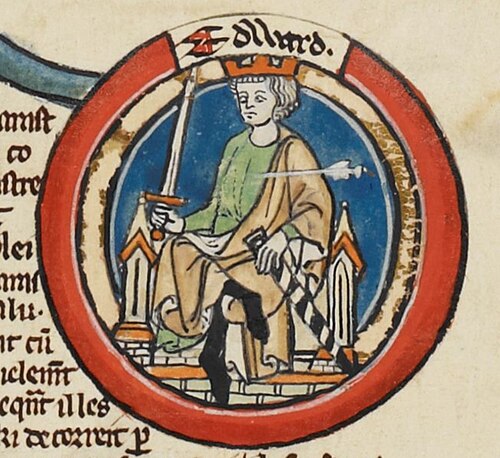
Passion-Bearer
Edward the Martyr
King of England
King of England from 975 to 978, killed in 978 after a dispute over the throne.
Life
The Holy Martyr Edward the Martyr was king of England from 975 to 978, killed one March evening in circumstances that remain unclear. He has been venerated as a saint in England since the last years of the tenth century, that is, before the separation of East and West. The Orthodox Church commemorates him on 18 March as a martyr and passion-bearer.
Youth and accession
He was born around 962, the eldest son of King Edgar. The name of his mother is not given in sources of his own time; most historians today think she was Æthelflæd, Edgar's first wife. He received his religious teaching from Bishop Sideman of Crediton.
Edgar died on 8 July 975, and the throne was disputed between the supporters of Edward and those of his younger half-brother Æthelred, later called the Unready. Edward was about thirteen and Æthelred between six and nine, so the two were rather banners of rival parties. On Edward's side stood Archbishop Dunstan, Oswald and Æthelwine, and on Æthelred's side his mother, Queen Ælfthryth, and Bishop Æthelwold of Winchester. The quarrel was soon settled: Edward was chosen king and crowned by Dunstan at Kingston, and Æthelred received the lands traditionally given to the king's sons.
His reign
Edgar had strongly supported the monastic reform and had made nobles and clergy hand over many lands to the monasteries. After his death the nobles sought to recover their estates, mostly by lawsuits, sometimes by force. The greatest leaders, Ælfhere of Mercia and Æthelwine, were enemies, though it did not come to war. The Anglo-Saxon Chronicle also mentions a famine in 976.
The sources of his own time do not paint him as a saint. The life of Saint Oswald, written by Byrhtferth around the year 1000, says that he was quick to anger and beat his men, above all those of his own household. Historians today therefore think that his veneration rests not on the deeds of his life but on the manner of his death. He did not die defending the faith, but as an anointed king, killed though innocent.
The murder
On the evening of 18 March 978, Edward rode to the court of Queen Ælfthryth at Corfe in Dorset. The oldest account, by Byrhtferth, says that armed men surrounded him, one seized his right hand as if for a welcoming kiss, and another gave him the death blow. The king fell from his horse, and his body was carried to the house of a poor man and covered with a cheap blanket. A later account says that his foot was caught in the stirrup and the horse dragged him.
The writers of that time do not say who ordered the killing. Almost all those after the Norman Conquest blame Ælfthryth, and some historians today agree, while others do not. Another view is that the killers were the men of Æthelred, who may have acted without orders. For the people of that age the killing of an anointed king was a grave sin.
Relics and veneration
The body was buried in haste and without honour at Wareham. After nearly a year the ealdorman Ælfhere came with a great train, had the body taken up, found it whole, and carried it with great ceremony to the nuns' abbey at Shaftesbury. The late account of the Passion adds that the body had been hidden in a marsh and was revealed by a pillar of fire; the Orthodox lives of today speak of a heavenly light over the tomb and of relics untouched by corruption. The chroniclers say that miracles took place at the tomb.
Veneration grew quickly. King Æthelred supported it, and in 1001 he gave the nunnery Bradford on Avon to "his saint, my brother Edward", whom the Lord had magnified by many miracles. A law of his time orders the day of the martyrdom, 18 March, to be kept throughout England. Of twenty-five calendars from before 1100, eighteen have Edward on this date. The town of Shaftesbury was for a time called "Edwardsstowe", the holy place of Edward. After the Norman Conquest Archbishop Lanfranc doubted some Anglo-Saxon saints, but the veneration of Edward remained. The calendar of the Church of England, in the Book of Common Prayer of 1662, still has 18 March.
The relics in our time
Shaftesbury Abbey was dissolved in 1539. Between 1930 and 1932 John Wilson-Claridge dug in the ruins and said he had found the bones of Edward. They were examined in 1963, with the conclusion that they belong to a young man of seventeen to nineteen with marks of blows, while another specialist held that they are those of an older man. No Western church accepted the bones on the conditions set by the finder. In 1980 the Russian Orthodox Church Outside of Russia agreed to receive them, and in 1988 a ruling of the English High Court allowed them to remain at the church of Saint Edward the Martyr at Brookwood, near Woking. Historians doubt that they are truly the bones of the king. Orthodox believers venerate them there as the relics of the saint.
Commemorated the same day March 18
 Cyril of JerusalemSaint · Archbishop of JerusalemMar 18
 Aninas of ChalcedonVenerableMar 18
- Eucarpius of NicomediaMartyrMar 18
- Trophimus of NicomediaMartyrMar 18
- Vasa of PskovVenerableMar 18
- CaemhanSaintMar 18
- Coman son of ErnanSaintMar 18
- ConalSaintMar 18
- CyrilFool-for-ChristMar 18
- Cyril of AstrakhanVenerableMar 18
- Daniel of EgyptVenerableMar 18
- Demetrius RozanovHieromartyrMar 18