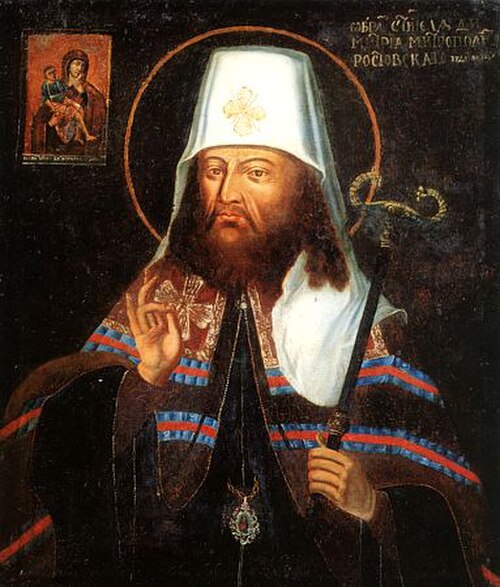
Saint
Demetrius of Rostov
Metropolitan of Rostov
Metropolitan of Rostov, preacher and spiritual writer, author of the Lives of the Saints, who died in 1709.
- Feast
- September 21old style October 4
- Reposed
- 170918th century
- Place
- Rostov Veliky
- Order
- Hierarchs
Life
Saint Demetrius of Rostov (born Daniil Savvich Tuptalo) was Metropolitan of Rostov and Yaroslavl, a preacher, educator and great church writer of Russia. He was born near Kiev in 1651 and fell asleep in the Lord in 1709. The Church remembers him above all for his vast cycle of lives of the saints, read by generations in the Slavic world, and for his care to enlighten the people through school and sermon.
Early life and calling
He was born on 11 December 1651 in the market town of Makarov in the Kiev region, to the Cossack captain Savva Tuptalo, a benefactor of St Cyril's Monastery in Kiev, and his wife Maria Mikhailovna. The family soon moved to Kiev, where he studied at the Brotherhood College, later the Kiev-Mohyla Academy. On 9 July 1668 he was tonsured at St Cyril's Monastery and received the name Demetrius, after the Holy Great Martyr Demetrius of Thessalonica.
He was ordained hierodeacon in 1669 and hieromonk in 1675. Appointed preacher at Chernihiv beside Archbishop Lazar Baranovych, he became known across Ukraine through his sermons. Later he travelled among the monasteries of Ukraine and Lithuania, spent time at Slutsk and Vilnius, and kept a diary in Polish during these years. From the Chernihiv period comes his earliest surviving book, The Fleece Watered with Dew, printed in 1680.
Abbot and labourer on the Lives
From 1679 he lived at Baturyn, near Hetman Ivan Samoylovych. In 1681 he became abbot of the Transfiguration Monastery at Maksakiv and then of St Nicholas Monastery at Baturyn. In 1684, at the invitation of Varlaam Yasynsky, he came to the Kiev Caves Lavra, where he was given the obedience of gathering and writing the lives of the saints. In the following years he lived in the skete of the Baturyn monastery in order to complete the work. In 1697 he was raised to archimandrite and appointed to the Dormition Monastery at Yelets, and in 1699 to the monastery at Novgorod-Seversky.
Ministry
By order of Tsar Peter I he was consecrated in 1701 Metropolitan of Tobolsk and all Siberia. Because of illness he stayed nearly a year in Moscow and was then transferred in 1702 to the see of Rostov. On arriving, after a service of intercession in the Conception church of St Jacob's Monastery, he chose that monastery as his burial place, although the bishops of Rostov were usually buried in the Dormition cathedral.
As a shepherd he strove to educate the people and to correct their ways, contending against ignorance, drunkenness, the Old Believer schism and Catholic influence. In 1702 he opened at Rostov a Slavonic-Greek-Latin school which in time taught about two hundred pupils, not only priests' sons. It offered grammar, Latin and ancient Greek, chant, rhetoric and the art of verse. He also founded a small theatre for plays of his own.
Writings
His best known work is the Lives of the Saints (the Chetii Minei), on which he laboured for more than twenty years and which he completed at Rostov in 1705; it appeared in four volumes, in 1689, 1690, 1700 and 1705. He also wrote the Spiritual Alphabet, collections of teaching for the people, apologetic and polemical works, chronicles, spiritual songs and verse dramas. The Rostov Mysteries of 1705 are attributed to him, though scholars debate the matter. His penitential psalms circulated widely, even in the Balkans.
Repose and veneration
He fell asleep in the Lord on 28 October 1709 and was buried at St Jacob's Monastery in Rostov, which his followers rebuilt as a place of pilgrimage. His relics were found incorrupt on 21 September 1752. In 1757 he was numbered among the saints and hierarchs, the first canonization of the Synodal period. A fortress on the Don, from which the city of Rostov-on-Don grew, was named after him. The Church keeps his feast on 28 October and commemorates the discovery of his relics on 21 September.
Commemorated the same day September 21
 JonahProphet · The ProphetSep 21
 Quadratus of AthensApostle · Bishop of AthensSep 21
 Castor of AptSaint · Bishop of AptSep 21
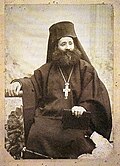 Plato AivazidisHieromartyr · Archimandrite and theologianSep 21
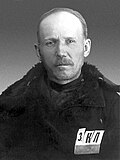 Basil KondratyevMartyrSep 21
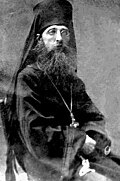 Mavriky PoletaevVenerable Martyr · ArchimandriteSep 21
- Jerome of the CavesVenerable · Recluse of the Kyiv Caves LavraSep 21
- Daniel of ShuzhgoraVenerable · Founder of a monasterySep 21
- Acacius of SitiaSaint · Bishop of SitiaSep 21
- Aedhan son of OissinSaintSep 21
- Alexander BelyakovHieromartyrSep 21
- Alexander FedoseevHieromartyrSep 21