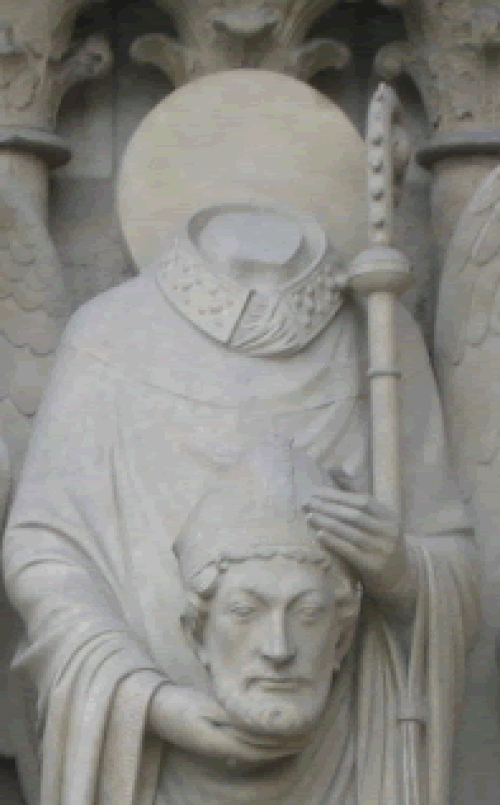
Hieromartyr
Denis of Paris
Bishop of Paris
Bishop of Paris in the third century, killed for his faith with his companions Rusticus and Eleutherius.
Life
Saint Denis of Paris (Dionysius) was, according to tradition, the first bishop of Paris, in the third century. He was put to death for his faith in Christ together with his companions Rusticus and Eleutherius. He is the patron of France and of Paris. The Orthodox Church commemorates him on 9 October as a saint of the undivided Church.
Mission in Gaul
The earliest detailed account, the Passion of Saints Dionysius, Rusticus and Eleutherius, was written around 600 and is legendary. It shows nonetheless that Denis was sent from Italy to preach the Gospel in Gaul in the third century, as one of the seven missionary bishops of whom Saint Gregory of Tours also tells. He became the first bishop of Paris, then called Lutetia. The small Christian community there had been almost scattered by persecution. With Rusticus and Eleutherius, who are said to have been inseparable from him, he settled on the Île de la Cité in the Seine.
Martyrdom
The three preached with such success that the pagan priests feared losing their followers. At their urging the Roman governor arrested them. After a long imprisonment, Denis and his two clergy were beheaded on the highest hill of Paris, later called Montmartre, the Mount of Martyrs. According to the account in the Golden Legend, the bishop picked up his head and walked several miles, preaching repentance, to the place where he was buried. This is a late legend. The sources differ on the date of the martyrdom: it is more likely to have been under the persecution of Decius around 250, while the Orthodox Church in America gives 258. The names Rusticus and Eleutherius are not historically proven.
Veneration
His veneration began soon after his death. The bodies of the three were buried at the place of martyrdom, where according to the Life of Saint Genevieve a shrine stood before the end of the fifth century. Genevieve began the building of a basilica, helped by the people of Paris. King Dagobert I built the first royal basilica, and around it grew the town of Saint-Denis. The place became the burial site of the kings of France. Abbot Suger moved the relics under the high altar of the rebuilt basilica between 1140 and 1144. Saint Denis became the patron of the French people, and the war-cry "Montjoie, Saint Denis" long belonged to the French armies.
Confusion with the Areopagite
From the ninth century onward, the life of Denis of Paris was often confused with that of Saint Dionysius the Areopagite, converted by the Apostle Paul and first bishop of Athens. Around 814 Louis the Pious brought to France writings attributed to the Areopagite, and from then on French legends treated the two as one man. Scholars, and the Orthodox Church in America, now regard the identification as an error: Denis of Paris is commemorated on 9 October and the Areopagite on 3 October.
Commemorated the same day October 9
 AbrahamRighteous · The PatriarchOct 9
 LotRighteous · The RighteousOct 9
 James, son of AlphaeusApostle · The ApostleOct 9
 Demetrius of AlexandriaSaint · Patriarch of AlexandriaOct 9
 Gunther of BohemiaVenerable · Bavarian hermit and envoyOct 9
 Theodofrid of CorbieVenerable · Abbot of Corbie AbbeyOct 9
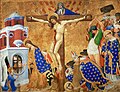 Eleutherius of ParisHieromartyr · Deacon of ParisOct 9
 Gemine of CasventumVenerable · Hermit of SpoletoOct 9
- AedhanSaintOct 9
- Andronicus of AntiochVenerableOct 9
- Athanasia of TabennisiVenerableOct 9
- Constantine AksyonovHieromartyrOct 9