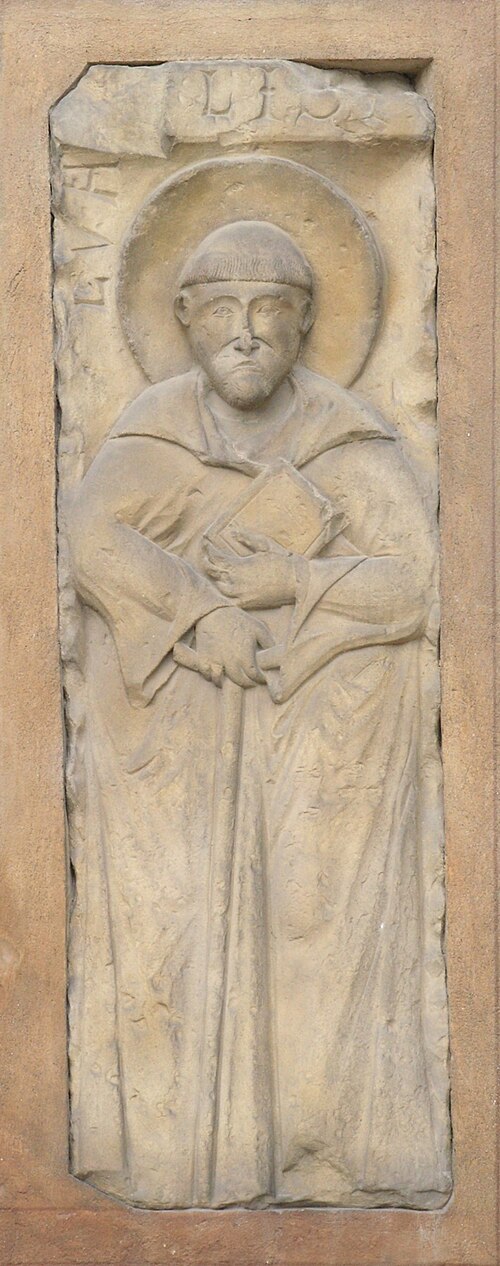
Venerable
Gunther of Bohemia
Bavarian hermit and envoy
Bavarian hermit and diplomat, who died in 1045 and played an important part in the early history of Bohemia and Hungary.
- Feast
- October 9old style October 22
- Reposed
- 104511th century
- Place
- Prášily
- Order
- Venerables
Life
Saint Gunther was a Bavarian hermit and envoy, born around 955, who lived in the Bavarian Forest and in Bohemia and fell asleep in 1045. He had an important role in the early history of Bohemia and Hungary through good relations with their rulers. He is venerated in the Czech Republic, Germany and Hungary. He is commemorated on 9 October, in the Roman Martyrology of 2004. He was not officially canonized.
He was born into a noble family related to the imperial Ottonian dynasty and to the Hungarian Árpáds, son of a count of Thuringia, and on his mother's side grandson of the Hungarian grand prince Géza. He spent the first part of his life at court, in worldly pleasures and intrigues. In 1005, at fifty, he was converted by Gotthard of Hildesheim, abbot of Hersfeld, later bishop of Hildesheim, and resolved to enter the monastic life to atone for his faults. With the consent of his heirs he left all his goods to Hersfeld Abbey, keeping the right to endow the monastery of Göllingen. In 1006 he went on pilgrimage to Rome, and the following year made his vows as a lay brother at Niederaltaich Abbey before Abbot Gotthard. He helped to civilize the region by clearing forests and sowing fields. Soon he urgently asked to govern Göllingen, but fell ill and could not agree with the monks, and the affairs of the monastery fell into a perilous state. By Gotthard's gentle counsel and severe reprimands his ambitions were quieted, and he returned to his humble state at Niederaltaich.
In 1008 he withdrew to a wild, steep place near Lalling in the Bavarian Forest to live as a hermit. In 1011 he went farther north in the forest with a few companions and settled at Rinchnach, where he built cells and a church of Saint John the Baptist, then a Benedictine monastery. It is said that he received the gift of infused knowledge and was a powerful preacher, though lacking ordinary ecclesiastical learning and perhaps unable to read or write. His biographer Wolfher, who knew him well, relates that his sermons on his patron, Saint John the Baptist, drew tears from all. He often visited his relative the king of Hungary, from whom he obtained large sums for the poor and whom he urged to build churches and monasteries. In 1029 the emperor Conrad II endowed Rinchnach. In his old age the rulers of the Empire, Bohemia, Hungary and Poland respected him. This allowed him to mediate in 1040 in the conflict between Duke Bretislaus I of Bohemia and King Henry III. He was probably present at the German defeat at Brůdek on 22 or 23 August 1040 and led the delegation that negotiated with Bretislaus at Chlumec.
He fell asleep at about ninety, in the hermitage on Mount Březník, now in Prášily in southwestern Bohemia, on 9 or 10 October 1045, in the arms of Duke Bretislaus and Bishop Šebíř of Prague. He was buried at Břevnov Monastery, but his remains were destroyed by the Hussites in 1420. Saint Gunther's Way, a walking route, runs from Niederalteich Abbey through Rinchnach and Guntherstein into Bohemia to the village of Dobrá Voda, where stands the only church in the world dedicated to him, built between 1706 and 1734 and renovated in 1995.
Commemorated the same day October 9
 AbrahamRighteous · The PatriarchOct 9
 LotRighteous · The RighteousOct 9
 James, son of AlphaeusApostle · The ApostleOct 9
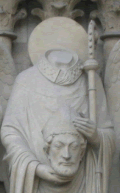 Denis of ParisHieromartyr · Bishop of ParisOct 9
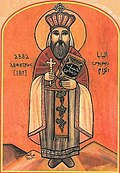 Demetrius of AlexandriaSaint · Patriarch of AlexandriaOct 9
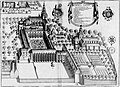 Theodofrid of CorbieVenerable · Abbot of Corbie AbbeyOct 9
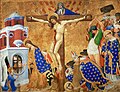 Eleutherius of ParisHieromartyr · Deacon of ParisOct 9
 Gemine of CasventumVenerable · Hermit of SpoletoOct 9
- AedhanSaintOct 9
- Andronicus of AntiochVenerableOct 9
- Athanasia of TabennisiVenerableOct 9
- Constantine AksyonovHieromartyrOct 9