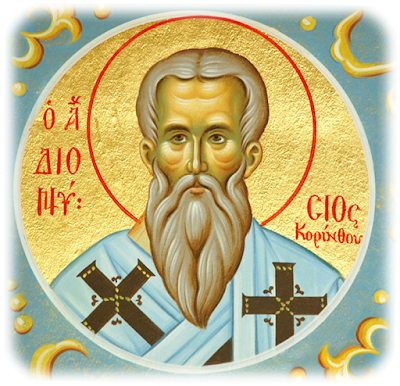
Saint
Dionysius of Corinth
Bishop of Corinth
Bishop of Corinth around 171, remembered on 8 April.
- Feast
- November 29old style December 12
- Reposed
- 1712nd century
- Place
- Corinth
- Order
- Hierarchs
Life
Saint Dionysius of Corinth was bishop of Corinth around the year 171, a notable Christian writer, known from his letters to the Churches of his time. He is remembered on 29 November in the Orthodox Church, and in the Catholic Church on 8 April and 22 March.
His date is established by the fact that he wrote to Pope Soter. Eusebius, in the Chronicle, places him in the eleventh year of the emperor Marcus Aurelius (171). He is known only through Eusebius and through Jerome, who devotes chapter 27 of “On Illustrious Men” to him. He was famed for eloquence and diligence. Eusebius knew a collection of seven letters of his to Churches, together with a letter to him from Pinytus, bishop of Knossos, and a private letter of spiritual counsel to a woman named Chrysophora.
Among his letters were one to the Lacedaemonians, teaching orthodoxy and urging peace and unity; one to the Athenians, strengthening their faith and urging them to live by the Gospel, since they were not far from apostasy, speaking of the recent death of their bishop, Publius, in the persecution of Marcus Aurelius, and recalling that Dionysius the Areopagite was the first bishop of Athens, as well as Quadratus; one to the Nicomedians against Marcion; one to Gortyna and the other dioceses of Crete, praising Bishop Philip for his labours and warning of the errors of heretics; one to the church of Amastris, in Pontus, written at the request of Bacchylides and Elpistus, in which he interpreted Scripture, mentioned Bishop Palmas and gave much counsel on marriage and virginity, and urged the kind reception of those who had fallen into sin or heresy, if they repented; and one to Pinytus, bishop of Knossos, asking him not to lay the burden of celibacy too heavily on the brethren, but to take into account the weakness of many. Pinytus replied, after courteous words, that he hoped Dionysius would send stronger food next time, so that his people might not grow up on the milk of babes.
The most important is the seventh letter, to the Romans, addressed to Bishop Soter, the only one of which fragments survive. Pope Soter had sent alms and a letter to the Corinthians, and Dionysius replied praising the custom of the Christians of Rome of doing good to the brethren in many ways, of sending alms to many Churches in different cities, of relieving the need of those who ask for help and of coming to the aid of the brethren in the mines, following the ancient custom of the Romans, which Soter had not only kept but increased, giving to the brethren from his abundance and comforting with blessed words the brethren who came to him, as a father his children. He also wrote that by this instruction the Romans and Corinthians, the planting of Peter and Paul, were mingled together, for both came to our Corinth and planted it. His letters have vanished, apart from a small fragment of the letter to the Romans, quoted by Eusebius.
Neither Eusebius nor Jerome writes anything about his martyrdom; the first reports of it appear only from the eleventh century, in the Greek writers George Kedrenos and Michael Glykas, and in the Western martyrologies there is none. The Serbian source says that he suffered for Christ in the year 171, at Corinth. The first mention of his relics is from the beginning of the thirteenth century: Peter of Capua brought them to Rome after the Fourth Crusade, and Pope Innocent III gave them to the prior of the abbey of Saint-Denis, Emeric, who had come to the Lateran Council. On 24 March 1216 they were solemnly placed in the abbey church, in the apse, before the altar. The pope identified the relics with those of Dionysius the Areopagite, following an old error of the Venerable Bede, who had taken Dionysius the Areopagite and Dionysius of Corinth to be the same person; Abelard refuted this error before 1142.
Commemorated the same day November 29
 Illuminata of TodiMartyr · Martyr of UmbriaNov 29
 Mardarije UskokovićSaint · Bishop of America and CanadaNov 29
 Nectarius the ObedientVenerable · Monk of the Kiev CavesNov 29
- Pitirim of EgyptVenerableNov 29
 Saturninus of ToulouseHieromartyr · Bishop of ToulouseNov 29
- Aethelwine of AthelneyRight-BelievingNov 29
- Baedan son of BreacanSaintNov 29
- Blaise and DemetriusMartyrNov 29
 Brendan of BirrVenerable · Abbot of BirrNov 29
- CiananSaintNov 29
- FiadhnatSaintNov 29
- Gulstan of RhuysVenerableNov 29