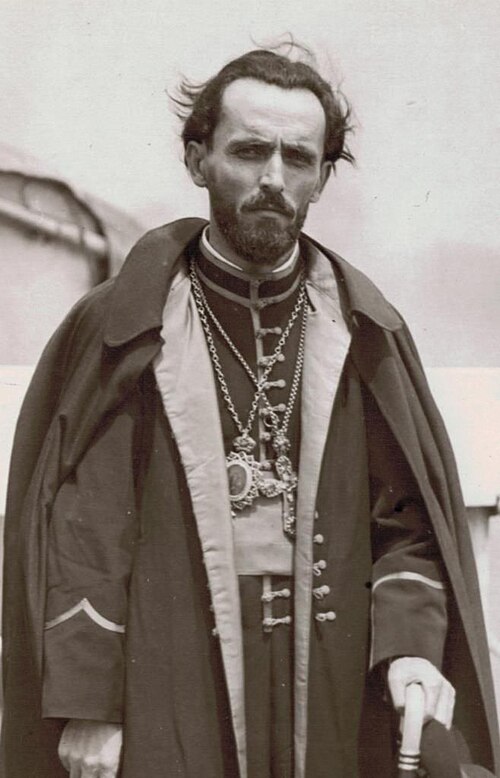
Saint
Mardarije Uskoković
Bishop of America and Canada
First Serbian Orthodox bishop of America and Canada, who died in 1935 and was later canonized.
- Feast
- November 29old style December 12
- Reposed
- 193520th century
- Place
- Ann Arbor
- Order
- Hierarchs
Life
Saint Mardarije (Uskoković) was the first Serbian Orthodox bishop of America and Canada and the founder of the Monastery of Saint Sava at Libertyville, near Chicago. A Montenegrin by birth, he studied and served for twelve years in Russia, including three years in Chișinău, and then organised the church life of the Serbs of North America. He reposed in 1935, and in 2015 the Serbian Orthodox Church numbered him among the saints as Saint Mardarije of Lješanska, Libertyville and All America.
Family and childhood
He was born on 22 December 1889 in the village of Kornet in the Lješanska nahija near Podgorica, in Montenegro. His father, Petar (Pero), was a tribal captain and the respected head of the district, and his mother, Jelena (Jela), came from the well-known Božović family. According to local tradition the family's ancestors had come to the region from Corinth, from which the village of Kornet may have taken its name. At his baptism in the little village church of Saint George he received the name Ivan.
Coming from a notable family, he was sent to school: he attended primary school in Rijeka Crnojevića and the gymnasium in Cetinje. He felt the call to monastic life early. At the age of eleven he asked Metropolitan Mitrofan Ban of Montenegro to tonsure him, but did not receive his blessing. He then left for Belgrade, travelling by ship from Kotor to Rijeka and from there by train.
Monastic tonsure
Metropolitan Dimitrije of Serbia granted his request. In 1905 he walked to the Monastery of Studenica, where he was tonsured a monk on 19 March 1906 with the name Mardarije and ordained deacon. He stayed at Studenica for a year and a half and then left for Moscow to continue his education.
Years in Russia and Chișinău
He spent the next twelve years in the Russian Empire. The first eight months he lived at the Serbian metochion in Moscow, where he became known in high society. In September 1907, at the age of seventeen, he entered the seminary in Zhytomyr, in Volhynia. After two years he transferred at his own request to the Chișinău Theological Seminary. In 1908 he was ordained hieromonk, and in 1912 he received the rank of syncellus and finished the seminary with the highest marks.
In Chișinău he cared for the children of poor parents and won the people's love by his sermons and good works. He founded an association to fight child mortality and within a few weeks collected several thousand roubles. He disliked the lavish receptions of the aristocracy. When he left the city for good after three years, the faithful gave him a gold cross and icons, and he was seen off not only by the Orthodox but also by Jews, Armenians and people of other faiths, something without precedent in the history of the Russian Church.
Petersburg and the war years
Also in 1912 he became protosyncellus of the Metropolitanate of Montenegro and entered the Saint Petersburg Theological Academy. For five years he lived as a hieromonk in the Alexander Nevsky Lavra. During his studies he visited the best-known Russian monasteries as well as Constantinople, Mount Athos, Athens and Thessaloniki. He himself wrote that on the day Austria-Hungary declared war on Serbia in 1914 he was celebrating the Liturgy in Jerusalem at the Church of the Holy Sepulchre, and he saw God's will in the fact that a Serb from Montenegro was serving at Golgotha just as his country was attacked.
Although he still had a year of study left, he set out for Serbia to be with his people. He reached Niš on the first Sunday of August 1914 (Belgrade was under siege) and presented himself to Metropolitan Dimitrije, who judged that he would be more useful back in Russia. On his return he gave a series of lectures on the unity of the Slavic peoples. He was vice-president of the Russian-Montenegrin Charitable Society and, as a delegate of the Russian committee for the care of Slavic prisoners, visited in the summer of 1915 the prisoner-of-war camps on the Volga, in the Urals, the Caucasus and Siberia, encouraging the prisoners of Slavic origin.
In 1916 he graduated from the Petrograd Academy as a candidate of theology; in the same city he also studied church law at the Faculty of Law, and he taught at Professor Gribovsky's Slavic gymnasium. His popularity in the salons of the capital also brought him trouble. After his visits to the camps the General Staff suspected him of serving Austrian interests, but inquiries did not confirm the suspicion. Grigory Rasputin disliked him and slandered him several times; at his insistence Hieromonk Mardarije was appointed on 17 August 1916 to teach homiletics at the Alexander Seminary in Ardon, in the Caucasus. Enrolled as an auditor at Petrograd University, he arrived there only on 10 January 1917. In 1917 he was elected a delegate of the Don Cossacks to the Local Council of the Russian Church, which elected Saint Tikhon patriarch.
The mission in America
On 3 July 1917 the Holy Synod of the Russian Church appointed him head of the Serbian Mission in America and raised him to the rank of archimandrite. He reached North America by way of Siberia and Vladivostok, and there he spent the most important part of his life. In Chicago he was vice-president of the Russian People's University and taught the history of the Slavic states there.
On 28 February 1919, at the Second All-American Council of the Russian Church in Cleveland, Bishop Alexander (Nemolovsky) proposed Archimandrite Mardarije as bishop for the Serbian parishes of North America (and Archimandrite Fan Noli for the Albanian parishes). The council approved, on condition that the Serbian Church agreed. Mardarije did not want to be consecrated without the blessing of his own Church, and he asked that the Serbian Church in America be given its own ordering.
Abbot of Rakovica
He went to Belgrade, where Patriarch Dimitrije appointed him abbot of the Monastery of Rakovica and head of the first monastic school in Serbia. He spent three years there and lectured in the hall of the Serbian Academy, at the university, in gymnasiums and at the Faculty of Theology. Because America was so far from Belgrade, he asked the Synod to provide a bishop for the American-Canadian diocese. On 18 October 1923 the Synod appointed Bishop Nikolaj Velimirović as administrator, and at the end of 1923 Mardarije, who had assisted him, was himself given the administration of the diocese.
Founder of Libertyville
Back in America he was recognised as bishop by 28 of the 29 Serbian priests there. He founded the diocesan paper “The Serbian Church”. For $15,000 he bought a ten-acre property at Libertyville near Chicago and built the Monastery of Saint Sava there, helped among others by the scientist Mihajlo Pupin. In his will he asked that the bishops of the Serbian Church in America be enthroned there.
On 5 December 1925 the Holy Assembly of Bishops of the Serbian Orthodox Church, meeting at Sremski Karlovci, unanimously elected him Bishop of America and Canada. He was consecrated on Palm Sunday, 25 April 1926, in the cathedral of Belgrade by Patriarch Dimitrije, and returned to the United States on 8 May 1927.
On 29-30 May 1927, at the Monastery of Saint Sava, he presided over the first Great Serbian National Assembly, which decided to set up a provisional diocesan council of 23 members, convened by the bishop every four months, and a diocesan fund for the bishop, the council and the Serbian schools. On 1 September 1927 he presided over the first Church-National Assembly, with three delegates from each parish, five from each of the unions “Srbobran-Sloga”, “Sloboda” and “Srbadija” and one from each Serbian society; it adopted the diocesan statute and elected the diocesan council.
He also left writings: “The Quiet Corner of Christ”, an anthology of sermons and “A Vow to the Russian People”.
Repose
He suffered from tuberculosis. He reposed on 12 December 1935 in the hospital at Ann Arbor, Michigan, at only forty-five, and was buried on 18 December at the Monastery of Saint Sava in Libertyville, which he had built.
Glorification
In October 2014 a book appeared, “The Lives of Bishop Mardarije of Libertyville and Archimandrite Sebastian of Jackson”, written to renew the memory of these Christlike men. The Holy Assembly of Bishops of the Serbian Orthodox Church, meeting from 14 to 29 May 2015, numbered him among the saints, with his feast on 12 December (29 November in the Old Style). On 5 September 2015 Patriarch Irinej of Serbia celebrated the service of glorification in the United States.
In May 2017, in preparation for his liturgical glorification, his relics were uncovered after 82 years in the ground and found entirely incorrupt. On 6 October 2017 the Holy Synod of the Russian Orthodox Church also added him to the calendar of the Russian Church. His relics are venerated at Libertyville, and a portion of them is kept in the Greek church of the Prophet Elijah in Frankfurt.
Commemorated the same day November 29
 Dionysius of CorinthSaint · Bishop of CorinthNov 29
 Illuminata of TodiMartyr · Martyr of UmbriaNov 29
 Nectarius the ObedientVenerable · Monk of the Kiev CavesNov 29
- Pitirim of EgyptVenerableNov 29
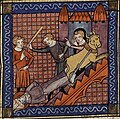 Saturninus of ToulouseHieromartyr · Bishop of ToulouseNov 29
- Aethelwine of AthelneyRight-BelievingNov 29
- Baedan son of BreacanSaintNov 29
- Blaise and DemetriusMartyrNov 29
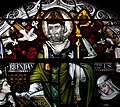 Brendan of BirrVenerable · Abbot of BirrNov 29
- CiananSaintNov 29
- FiadhnatSaintNov 29
- Gulstan of RhuysVenerableNov 29