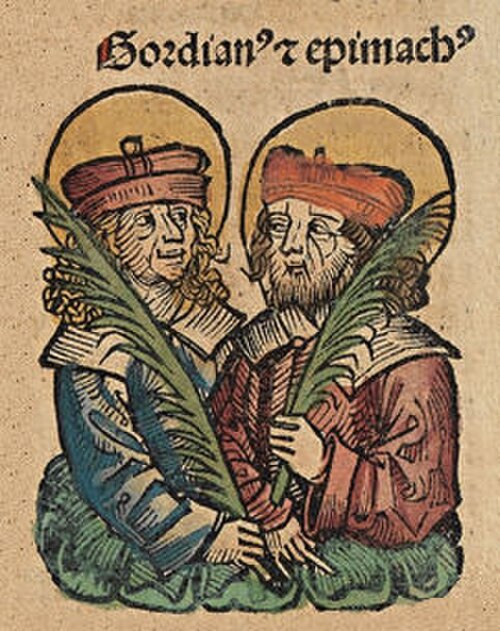
Martyr
Epimachus of Alexandria
Martyr of Alexandria
Martyr of Alexandria, beheaded in Decius' persecution with Alexander and several women.
- Feast
- December 12old style December 25
- Reposed
- 2513rd century
- Place
- Alexandria
- Order
- Martyrs
Life
Holy Martyr Epimachus of Alexandria died in the year 250 or 251, in the persecution of the emperor Decius, at Alexandria, by the sword. With him were killed Alexander, Ammonaria, Mercuria, Dionysia and other women. The sources do not agree on his commemoration: in the Orthodox calendar it is on 9 May, together with Saint Gordian; according to one source, the commemoration of those of Alexandria is on 12 December; and in the Roman Catholic calendar it is on 31 October.
According to the legend in the synaxarion, Epimachus and Gordian were of Roman birth. Because they boldly confessed Christ, they were seized and forced by the ruler of the city to renounce Christ and sacrifice to idols, but they did not bow. They were therefore tormented with various torments and in the end their heads were cut off, and so they received their crowns. Their synaxis is held in the church of the holy martyr Stratonicus. Another source says of Epimachus that he was a native of Rome but was seized at Alexandria, forced to renounce Christ and sacrifice to idols, refused, was tortured and beheaded.
After his martyrdom his body was laid in a crypt on the Via Latina, and later, beside it, the body of Saint Gordian, a martyr in the time of Julian the Apostate. The two saints gave their name to the cemetery of Gordian and Epimachus and were for a long time jointly venerated by the Catholic Church on 10 May; this joint veneration was suppressed in 1969. Many writers deny that there was an Epimachus martyred at Rome, and explain the relics honoured there by the body of an Epimachus of Alexandria, brought to Rome shortly before the martyrdom of Gordian. The Bollandist scholar Remi de Buck maintained that the evidence for the Roman Epimachus is too strong to be doubted, and denied that any relics of Epimachus of Alexandria came to Rome. According to others, the body of Epimachus of Alexandria was translated to Constantinople. According to one source, his holy relics were taken first to Rome, and in the eighth century Queen Hildegard moved them to the Benedictine monastery at Kempten.
Commemorated the same day December 12
SpyridonSaint · Bishop of TrimythousDec 12
 Finnian of ClonardVenerable · Abbot of ClonardDec 12
 Synesius of RomeMartyr · Reader of the Roman ChurchDec 12
- Theodosius of MonzaVenerableDec 12
 Abra of PoitiersSaintDec 12
- AetheriusMartyrDec 12
- Agatha of WimborneVenerableDec 12
- AmmonariaMartyr · Martyr of AlexandriaDec 12
- AmonathasVenerableDec 12
- AnfVenerableDec 12
- CatanSaintDec 12
- Colman of GlendaloughVenerableDec 12