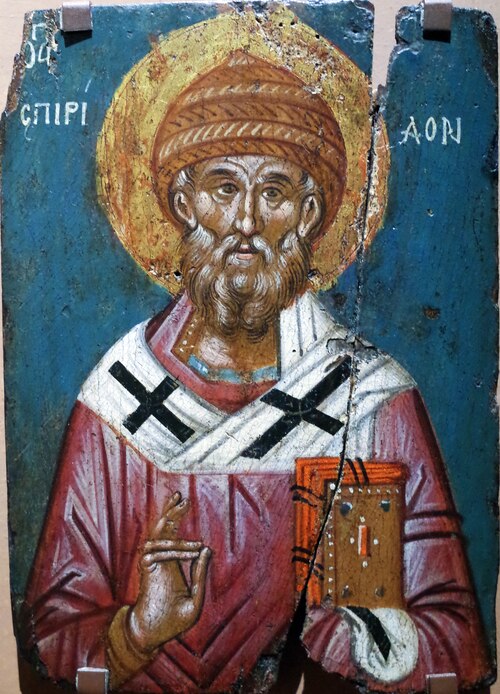
Saint
Spyridon
Bishop of Trimythous
Shepherd of Cyprus who became bishop of Trimythous, wonderworker, present at the First Council of Nicaea.
- Feast
- December 12old style December 25
- Reposed
- 3484th century
- Place
- Tremetousia
- Order
- Hierarchs
Life
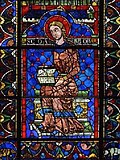
Saint Spyridon, bishop of Trimythous in Cyprus, was a shepherd, a wonderworker and a defender of the faith at the First Ecumenical Council at Nicaea. He is patron of the island of Corfu and of potters and shoemakers. He is commemorated on 12 December.
Life
He was born around 270 in the village of Assia (Askia), in Cyprus, of peasant parents, simple folk, and in youth was a shepherd. He was known from childhood for piety, simplicity and generosity toward the poor. He wished to follow the righteous David in meekness, Jacob in kindness of heart and Abraham in love of strangers; his house was a shelter for the homeless and food for strangers. For his good deeds God gave him the gift of foresight, of healing the incurable, of casting out demons and of raising the dead. He married in youth a pure girl and they had a daughter, Irene, whom Spyridon himself baptized. His wife died after a short time, but he did not fall into despair and went on serving God by good works.
In the time of Constantine the Great and his son Constantius II he was chosen bishop of the city of Trimythous, today near Famagusta. As bishop he kept the habits and the simple life of his shepherding days. In a time of long drought and famine in Cyprus, at his prayer rains came. His kindness was joined with stern justice toward the unworthy: at his prayer a merciless grain dealer was punished, and the poor peasants were saved from hunger. A friend of his, falsely accused, had been condemned to death; Spyridon hurried to help, but came upon a swollen river. Remembering how Joshua crossed the Jordan, he prayed with faith, and the water parted and he crossed with his companions on dry ground. The judge received him with honour and freed the innocent man.
Tradition tells of many other miracles: once, during the service, the oil in the lamp ran low and the flame was fading, but the lamp filled with oil; or angels served unseen with him, and after each litany the chant “Lord, have mercy” was heard; he healed the emperor Constantius II, gravely ill; he raised his daughter Irene to tell where she had hidden some jewels kept with her; at Antioch he raised the infant of a pagan woman, and then the mother, who had fallen dead from astonishment. Before he died, God showed him the nearness of the end. He fell asleep around 348.
At the Council of Nicaea
In 325, at the First Ecumenical Council at Nicaea, Spyridon took part, according to tradition, in a debate with a philosopher who defended Arianism. The philosopher was more skilled in speech and in worldly learning, but Spyridon overcame him by a simple explanation of the faith. Tradition tells the “miracle of the brick”: he took a brick from his bosom and, making the sign of the cross, said, “In the name of the Father”, and flame rose from it; “and of the Son”, and water flowed down; “and of the Holy Spirit”, and the clay remained in his hand. Then he said, “As the brick is one thing of one substance and nature, yet made of three, fire, water and earth, so is God, one in essence and nature, but in persons a Trinity: Father, Son and Holy Spirit.” The philosopher accepted the council’s decisions, believed and was baptized. According to some accounts, at Nicaea he met Saint Nicholas, and a friendship remained between them.
Relics and veneration
His relics were taken, after the Arab invasion of Cyprus, to Constantinople, and after 1453 to Corfu, where they are kept in the great cathedral and carried in processions. It is said that the saint sometimes leaves his reliquary to help those who call on him, so he is called “the traveller saint”; his shoes wear out for this reason. On Corfu he is called “Keeper of the City”, for the miracle of expelling the plague, and also for delivering the island from the Turks and from fires. He is patron of Piraeus, where he is celebrated on 12 December, of potters, shoemakers, tanners and other craftsmen, and in Serbia he is a family slava. His life was first told in a lost poem by his disciple Triphyllius and in two lives of the seventh century, by Theodore of Paphos and, perhaps, Leontios of Neapolis.
Commemorated the same day December 12
 Finnian of ClonardVenerable · Abbot of ClonardDec 12
 Epimachus of AlexandriaMartyr · Martyr of AlexandriaDec 12
 Synesius of RomeMartyr · Reader of the Roman ChurchDec 12
- Theodosius of MonzaVenerableDec 12
 Abra of PoitiersSaintDec 12
- AetheriusMartyrDec 12
- Agatha of WimborneVenerableDec 12
- AmmonariaMartyr · Martyr of AlexandriaDec 12
- AmonathasVenerableDec 12
- AnfVenerableDec 12
- CatanSaintDec 12
- Colman of GlendaloughVenerableDec 12