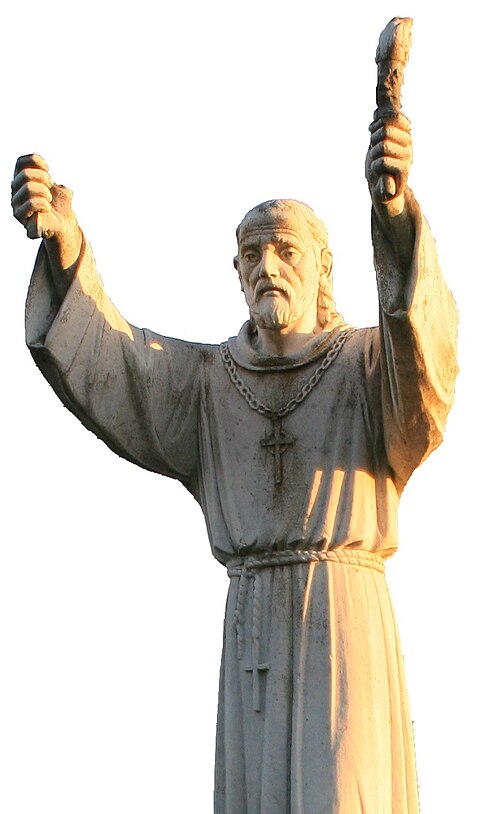
Venerable
Finnian of Clonard
Abbot of Clonard
One of the early monastic saints of Ireland, founder of Clonard Abbey in County Meath, who died in 549.
- Feast
- December 12old style December 25
- Reposed
- 5496th century
- Place
- Myshall
- Order
- Venerables
Life
Venerable Finnian of Clonard was one of the first monastic saints of Ireland, the founder of Clonard Abbey in County Meath. He lived from 470 to 549, and the Twelve Apostles of Ireland were his disciples. Together with Saint Enda of Aran he is counted among the fathers of Irish monasticism. The Church commemorates him on 12 December.
Youth and training
He was born in the kingdom of Leinster, near, it is thought, the present town of New Ross, son of Findlog. Saint Abban baptised him, and while still small he was placed in the care of Bishop Fortchern of Trim, a disciple of Saint Patrick. According to some sources he also studied for a time at the monastic centre of Saint Martin of Tours in Gaul, known for its austerity. He then went to Wales, to the monastery of Saint Cadoc the Wise at Llancarfan, where he remained many years in prayer and study. There he copied the Roman classics and the Vulgate of Saint Jerome. The Codex Salmanticensis speaks of thirty years spent in Wales, but historians think this too long in view of what he later achieved in Ireland.
Foundations
Returning to his homeland, he came first to Aghowle in County Wicklow, where King Oengus of Leinster gave him a site. Tradition says he also founded a community on Skellig Michael, but historians doubt it. From there he went to the monastery of Saint Brigid at Kildare. About the year 520 an angel led him to Cluain Eraird (Clonard), on the river Boyne, the place where he was told he would rise again.
At Clonard he built a small cell and a church of clay and wattle and gave himself to study, mortification and prayer. The fame of his learning and holiness spread quickly, and scholars of all ages came to him. The monastery was modelled on those of Wales, founded on the tradition of the Desert Fathers and the study of Scripture, and its rule was strict. Disciples who later founded monasteries left Clonard carrying a book, a crozier or some other object, which shows that a scriptorium and workshops were there from an early date. The Penitential of Finnian prescribes penances to correct sins and cultivate the opposite virtue, and rests on the teaching of John Cassian on the eight evil thoughts. Tradition also remembers Saints Vitheus and Genocus as his companions on the return to Ireland.
Last years and veneration
The Office of Saint Finnian says that no fewer than three thousand pupils were taught at once at Clonard. The master was unequalled in expounding Holy Scripture, which is why his lectures were so sought after. Among those formed there were Ciarán of Clonmacnoise and Columba of Iona. Finnian died of the plague in 549 and was buried in his own church at Clonard. His biographer gives him an age of 140 years, but scholars think he lived to about sixty. His sister, Regnach, was abbess of Kilreynagh.
The school of Clonard remained for centuries renowned for the study of Scripture. The saint's relics were enshrined at Clonard until 887, when the shrine was destroyed. In 1206 the see of Meath was moved to Trim, and the glory of Clonard departed. His commemoration on 12 December is first attested in a Spanish martyrology of the ninth century.
Commemorated the same day December 12
SpyridonSaint · Bishop of TrimythousDec 12
 Epimachus of AlexandriaMartyr · Martyr of AlexandriaDec 12
 Synesius of RomeMartyr · Reader of the Roman ChurchDec 12
- Theodosius of MonzaVenerableDec 12
 Abra of PoitiersSaintDec 12
- AetheriusMartyrDec 12
- Agatha of WimborneVenerableDec 12
- AmmonariaMartyr · Martyr of AlexandriaDec 12
- AmonathasVenerableDec 12
- AnfVenerableDec 12
- CatanSaintDec 12
- Colman of GlendaloughVenerableDec 12