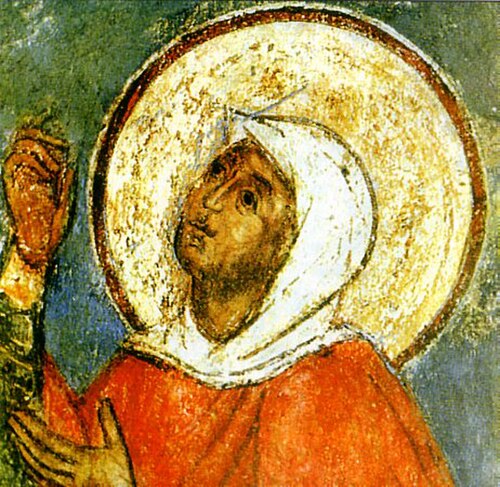
Great Martyr
Euphemia
of Chalcedon
Maiden of Chalcedon, great martyr killed around 303, in whose church the Fourth Ecumenical Council was held.
- Feast
- July 11old style July 24
- Reposed
- 3044th century
- Place
- Chalcedon
- Order
- Great Martyrs
Life
The holy great martyr Euphemia, the all-praised, was a virgin of Chalcedon who suffered for Christ around the year 303, in the persecution of Diocletian. The church built over her tomb housed the Fourth Ecumenical Council. She is commemorated on 16 September, and on 11 July the miracle at the council.
Her martyrdom
According to tradition, Euphemia was the daughter of the senator Philophronos and Theodosia of Chalcedon, a city on the shore of the Bosporus, facing Byzantium. From childhood she was consecrated to virginity. The governor Priscus ordered all the inhabitants to sacrifice to the god Ares. Euphemia was found with forty-nine other Christians, gathered in a house and worshipping God against the order. Because they refused to sacrifice, they were tortured for several days, then all but Euphemia were sent to the emperor. She, the youngest, was kept at Chalcedon, lest without the support of the others she should yield, and she was subjected to especially harsh torments, among them the wheel. Tradition relates that an angel stopped the wheel and healed her wounds, and that two soldiers, Victor and Sosthenes, seeing angels when they were about to cast her into the furnace, believed in Christ. Seeing her strength, Priscus ordered her given to the beasts in the arena. When she was led there, she prayed that the Lord receive her soul. The beasts, lions and bears, came near and licked her feet; one she-bear made a small wound from which blood flowed, and then a voice was heard from heaven calling her, and she gave up her spirit. The account says that the earth shook and all fled from the arena. Her death is recorded in the Hieronymian Martyrology of the fifth century, under the year 303, at the beginning of the great persecution. Egeria, who made a pilgrimage to the Holy Land around 381-384, relates that the place of the martyr was shown to her at Chalcedon.
The relics and the council
Her body was gathered by Christians and placed in a church that bore her name, at Chalcedon, in which the Fourth Ecumenical Council was held, in 451. The tradition of the Synaxarion of Constantinople says that, in the time of the quarrels at the council, the Orthodox and the monophysites each wrote down their confession and placed it on the martyr’s breast, in her tomb; after three days the tomb was opened and the scroll with the Orthodox confession was found in her right hand, and the other at her feet. Those who do not accept the council of Chalcedon do not regard the story as true. Around 620, after the conquest of Chalcedon by the Persians, in 617, the relics were moved to a new church in Constantinople. In the time of iconoclasm the reliquary was, according to tradition, thrown into the sea, but was recovered by the brothers Sergios and Sergonos, who were of the Orthodox party, and given to the local bishop, who hid it in a secret place. The relics were then taken to the island of Lemnos and in 796 returned to Constantinople. The greater part still lies in the Patriarchal Cathedral of Saint George in Istanbul.
Commemorated the same day July 11
 Pius ISaint · Bishop of RomeJul 11
 Olga of KievEqual-to-the-Apostles · Princess of KievJul 11
 Abundius of CórdobaHieromartyr · PriestJul 11
 Theodore the VarangianHoly MartyrsJul 11
- Arcadius of VyazmaVenerable · Recluse of VyazmaJul 11
- Nektarios of AthosVenerable MartyrJul 11
- Nicodemus of ElbasanNew Martyr · Albanian New MartyrJul 11
- Achilleus of RomeSaintJul 11
- AmabilisVenerableJul 11
- Anicius of RomeSaintJul 11
- Arcadius of NovotorskVenerableJul 11
- ArseniusHieromartyr · Patriarch of AlexandriaJul 11