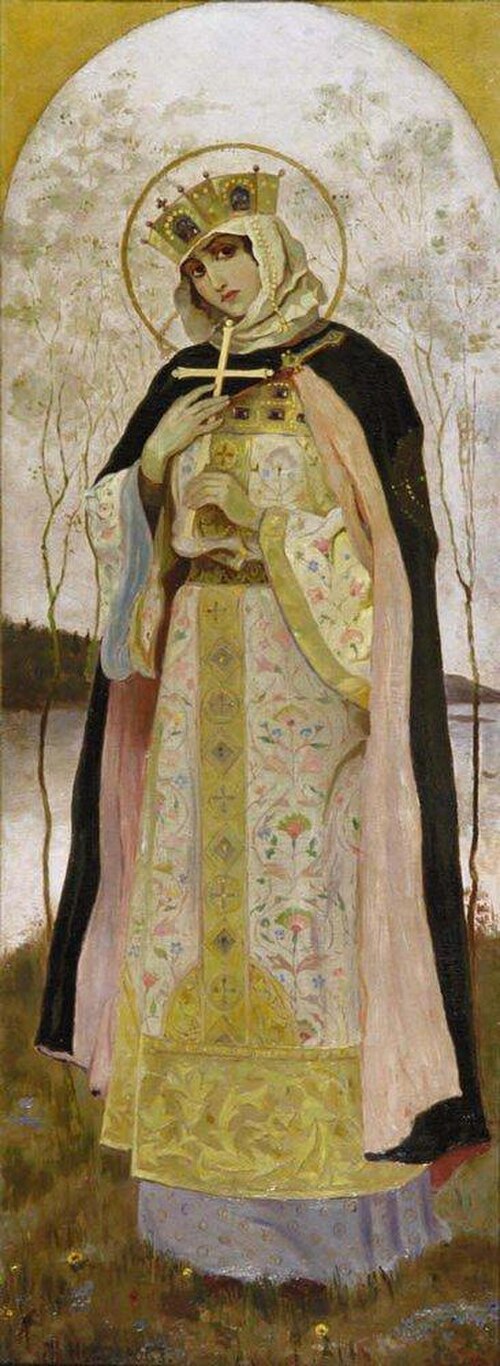
Equal-to-the-Apostles
Olga of Kiev
Princess of Kiev
Regent of Kievan Rus, baptized with the name Helen, grandmother of Saint Vladimir.
- Feast
- July 11old style July 24
- Reposed
- 96910th century
- Place
- Kyiv
Life
Saint Olga of Kiev, in Holy Baptism Helen, was Grand Princess of Kiev, regent of Kievan Rus for her son Sviatoslav and the first of its rulers to receive Baptism. She is the grandmother of Saint Vladimir, the enlightener of the Russian people. The Church honours her as Equal to the Apostles and keeps her feast on 11 July.
Youth and marriage
Her birth date is unknown: it could be around 890 or as late as 925. The Primary Chronicle says she was of Varangian descent and was brought as a wife to Prince Igor from Pskov. Olga is the Slavic form of the Scandinavian name Helga, and the people called her Olga the Wise. Later tradition ties her to the village of Vybuty near Pskov, and her life relates that Igor, hunting there, met her as a ferrywoman and was struck by her purity and sense. The historian Alexey Karpov thinks she was no more than fifteen at the wedding.
Igor was the son of Rurik, founder of the dynasty, and had been raised under Oleg, who made Kiev the capital of the Rus. Their son was Sviatoslav. In 944 Igor made a treaty with the Greeks, sworn both by the baptized Rus, in the church of the Prophet Elijah at Kiev, and by the pagans, on their weapons before the idol of Perun. This shows that Kiev already had a considerable Christian community. Igor himself remained a pagan.
Widowhood and rule
The Drevlians, a neighbouring tribe, had stopped paying tribute after Oleg died. In 945 Igor went to their capital, Iskorosten, received payment, then returned with a small escort to demand more and was killed. Their son was three years old, so Olga took power as regent. She was the first woman to rule Kievan Rus.
The chronicle relates, in a manner often legendary, how she avenged him. The Drevlians asked her to marry their prince Mal. She seemed to agree, but buried the first embassy alive, burned the second in a bath-house, and at the funeral feast for Igor near Iskorosten five thousand Drevlians were killed. The next year she besieged the city and took it by asking three pigeons and three sparrows from each house and tying burning sulphur to their feet. Historians see in this a gathering of folk tales, and the Orthodox synaxarion sees in her victory the triumph of the constructive forces of the land over a dark and destructive paganism, yet Olga was not yet a Christian.
After that she set the land in order. She travelled through the Drevlian land and Novgorod, fixed the tribute, and in place of arbitrary collection created the so-called pogosts, centres of trade, administration and justice, which helped unite the people. She set up hunting grounds, boundary posts and settlements, fortified towns such as Vyshgorod, where she lived with her grandsons, and began building in stone at Kiev. In 968, when the Pechenegs besieged the city and Sviatoslav's army was far away, she led its defence until her son returned.
Baptism
The sources differ on details. The synaxarion tells that around 954 or 957 Olga went to Constantinople, on a journey that was both pilgrimage and diplomatic mission. She attended services at Hagia Sophia and Blachernae, and her heart chose the faith. The chronicle says she was baptized by Patriarch Polyeuctus with Emperor Constantine VII Porphyrogenitus as godfather, while the OCA names Patriarch Theophylact. The year is either 954 or 957, and some historians think she was first baptized at Kiev around 955 and received the name Helen at Constantinople. The emperor's own Book of Ceremonies describes her reception in 957 without mentioning baptism.
She was named Helen after Saint Helena, mother of Constantine the Great. According to the chronicle, the patriarch told her that she was blessed among the women of Rus, for she had loved the light and left the darkness, and that her people would bless her to the last of her descendants. The chronicler says she listened to the teaching with bowed head, like a sponge drinking water. It is told that the emperor wished to marry her, but Olga answered that Church law forbids a goddaughter to marry her godfather, and he admitted she had outwitted him. Modern historians regard the story as a literary embellishment, since Constantine already had an empress.
Mission and the turn to the West
On her return Olga built churches: Saint Nicholas and Holy Wisdom at Kiev, the Annunciation at Vitebsk and the Holy Trinity at Pskov, on a spot shown to her, the chronicler says, by a ray of the Thrice-Radiant Godhead. Holy Wisdom at Kiev was consecrated on 11 May 960 and held a piece of the Holy Cross received at Constantinople. From Byzantium she did not obtain either a marriage of Sviatoslav to a Greek princess or a metropolitan for Kiev.
So she asked the German king Otto I for a bishop and priests. Bishop Adalbert of Trier reached Kiev in 961 or 962, but achieved nothing and had to leave, and some of his companions were killed on the way. Olga belonged to the undivided Church, and the division between East and West appeared to her mostly as a political rivalry. Her son Sviatoslav, a proud warrior, firmly refused Baptism and even grew angry with her, fearing that his soldiers would mock him. She withdrew humbly into prayer, and at his request still governed Kiev while he campaigned on the Danube.
Repose and relics
At the end, when Sviatoslav wished to move to Pereyaslavets on the Danube, the ailing Olga begged him to stay until he had buried her. She reposed on 11 July 969. In her last years she kept a priest near her in secret, so as not to stir pagan anger. Before her death she forbade the pagan funeral feast and asked to be buried by the Orthodox rite, which the presbyter Gregory, who had accompanied her to Constantinople, carried out. As her testament she said that if God had mercy on the Russian land, people would turn their hearts to Him as she had received that gift.
The chronicler Jacob the Monk, about a century later, wrote that God had glorified her body and that it remained whole. Under her grandson Saint Vladimir, her relics were moved to the Desyatinnaya church of the Dormition in a stone sarcophagus, where, it is said, the body could be seen through an opening in the tomb, though only by those who came with faith. She was canonized in 1547.
Olga was the first of the line of Rurik to receive Baptism, and her grandson Vladimir made Christianity the religion of the state. Besides 11 July, she is remembered in the synaxis of the saints of Pskov and in that of the saints of Volhynia (23 October).
Commemorated the same day July 11
 Pius ISaint · Bishop of RomeJul 11
 EuphemiaGreat Martyr · of ChalcedonJul 11
 Abundius of CórdobaHieromartyr · PriestJul 11
 Theodore the VarangianHoly MartyrsJul 11
- Arcadius of VyazmaVenerable · Recluse of VyazmaJul 11
- Nektarios of AthosVenerable MartyrJul 11
- Nicodemus of ElbasanNew Martyr · Albanian New MartyrJul 11
- Achilleus of RomeSaintJul 11
- AmabilisVenerableJul 11
- Anicius of RomeSaintJul 11
- Arcadius of NovotorskVenerableJul 11
- ArseniusHieromartyr · Patriarch of AlexandriaJul 11