Saint
Euphronius of Tours
Bishop of Tours
Eighth bishop of Tours, from 555 to 573, a near relative of Gregory of Tours.
Life
Saint Euphronius was the eighth bishop of Tours, from 555 to 573, a near relative of Gregory of Tours, who succeeded him. He is commemorated on 4 August, and the Roman Martyrology notes in particular the churches he rebuilt.
His election
He was born in 503 or 504, into a noble Gallo-Roman family of senatorial rank. He is said to have been a grandson of Saint Gregory of Langres, and among his close relatives were Saint Nicetius of Lyon and Duke Gundulf. He was related to Gregory of Tours, either a cousin of his mother or her brother. He was a friend of the poet Venantius Fortunatus. We learn of him from Gregory in the "History of the Franks", in the "Glory of the Martyrs" and in the "Miracles of Saint Martin", and from Baudonivia in the Life of Saint Radegund.
When Bishop Gunthar died in 555, King Chlothar I wished to place the priest Cato of Clermont on the see, but he declined, wanting the bishopric of his own city. For ten months the see stayed vacant, until clergy and people proposed the priest Euphronius. When King Chlothar learned of the election, he confirmed it, and the consecration took place in 555 or 556.
His episcopate
In 557 he took part in the council of Paris. The first years of his episcopate fell in the time of strife among the Frankish kings. In 561 much of Tours burned down, and he rebuilt the burned churches, two of them, according to Gregory, at his own expense, while another tradition says all of them with the means of the diocese. He greatly enlarged the basilica of the abbey of Saint Martin with funds given at his request by King Chlothar, and he built several parish churches. Gregory relates that he predicted the death of King Charibert.
He had to resist attempts by laymen to seize the property of the diocese. Thanks to him the claim of the royal official Gaiso, who wanted to appropriate the revenues given to the diocese by Chlothar, was rejected, and from King Charibert he received a charter of immunity, by which the king, "out of respect for Saint Martin", gave up any levy on the inhabitants of Tours. In 562 he refused to sign the acts of the synod of Saintes, in which, at the request of the archbishop of Bordeaux, Emerius was condemned for having allegedly become bishop against the canons. King Sigebert esteemed him greatly and, at his request, returned to the diocese all the lands taken in the time of Charibert. His circular letter to the faithful, which survives, shows his concern for the keeping of the canons on marriage and tithe.
In 566 or 567 the council of Tours was held, on 18 November, and Euphronius was chosen to preside. The bishops of Brittany declined to come, because he claimed authority over the Breton church. The council dealt mostly with church discipline. The bishops noted that some Gallo-Roman customs of ancestor worship were still observed, and Canon XXII decreed that anyone known to practise them should be barred from communion and from entering a church. The bishops of the kingdom of Paris were concerned about the Merovingian habit of seizing church property in outlying areas to fund their wars with each other.
The True Cross and his end
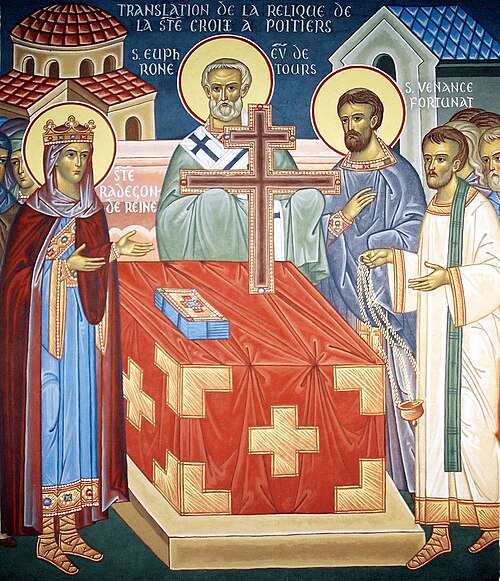
In 569 a particle of the True Cross reached the Frankish kingdom, through the efforts of Saint Radegund, sent by the Byzantine Emperor Justin II to the convent at Poitiers, which Radegund had founded in 552 as the first monastery for women in the Frankish world. Bishop Maroveus of Poitiers refused to preside over the ceremony of its installation; at the request of Radegund and King Sigebert, Euphronius did it, although he was not metropolitan of Poitiers. This began the veneration of the Holy Cross in the Frankish kingdom, described by Baudonivia and in the poems of Fortunatus, among them "Vexilla regis prodeunt" and "Pange lingua gloriosi". Gregory also mentions Euphronius's finding of the relics of two holy virgins of Tours, Maura and Britta. In 568 he went to Nantes for the consecration of the new cathedral.
He died in August 573, in the seventieth year of his life, after nearly eighteen years as bishop, and was buried in the church of the abbey of Saint Martin at Tours. He was succeeded by Saint Gregory of Tours.
Commemorated the same day August 4
 Seven Youths of EphesusHoly Martyrs · The Seven SleepersAug 4
 Crescentius of RomeMartyr · Child martyr of RomeAug 4
- Eudocia the MartyrMartyrAug 4
- Agabius of VeronaSaint · Bishop of VeronaAug 4
- Antoninus of EphesusSaintAug 4
- Bartholomew of NicomediaMartyrAug 4
- BroghanSaintAug 4
- BuanVenerableAug 4
- Constantine of EphesusSaint · ExakoustodianAug 4
- CrescentioMartyrAug 4
- DariaSaintAug 4
- Demetrius VorobyovMartyrAug 4