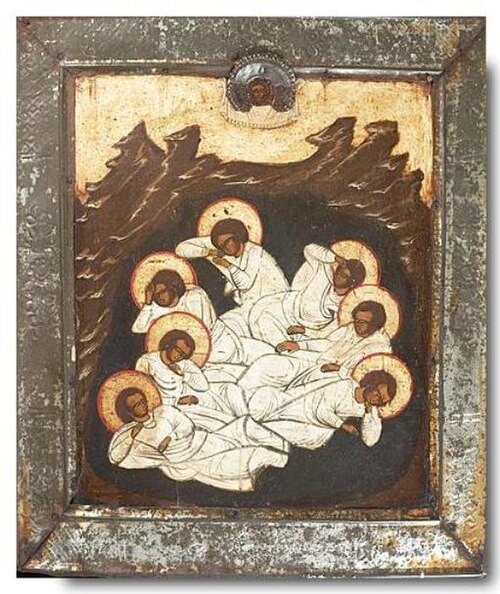
Holy Martyrs
Seven Youths of Ephesus
The Seven Sleepers
Young Christians who hid in a cave during persecution and fell asleep, to awaken after many years.
Life
The Seven Youths of Ephesus, also called the Seven Sleepers, are, according to an ancient Christian account, young soldiers of Ephesus who hid in a cave in the time of the persecution of Decius and fell asleep, to awake after a long time as a sign of the resurrection of the dead. They have been honoured as saints since at least the fifth century. The Orthodox Church commemorates them twice, on 4 August and on 22 October.
The youths of Ephesus
According to tradition, the seven youths lived in Ephesus in the third century. Saint Maximilian was the son of the city's governor, and his six friends were also from the city's noble families. All were in the army and all were Christians. Their names, as given in the Synaxarion, are Maximilian, Iamblichus, Martinian, John, Dionysius, Exacustodianus, who is also called Constantine, and Antoninus; in other lists Malchus appears.
When the emperor Decius came to Ephesus, between 249 and 251, and ordered sacrifices to the gods, the youths refused. In some versions the emperor took away their military insignia but let them go, hoping they would change their minds while he was away at war. They gave their goods to the poor, left the city and hid in a cave on a mountain near Ephesus, called Pion or Ochlon.
The cave and the sleep
When they learned that the emperor had returned and was looking for them, the youths prayed to God. The emperor ordered the mouth of the cave to be walled up with stones, so that they would die inside of hunger and thirst. According to tradition, God did not let them die but put them into a wondrous sleep. Two officials, secret Christians, placed in the masonry a casket with two lead tablets bearing the names of the seven and the circumstances of their walling up.
The awakening
The account says that they slept until the time of Theodosius the Younger, that is, until about 446, nearly two hundred years. At that time a teaching had appeared in Ephesus that denied the resurrection of the dead. The owner of the land began to build on the mountain, and his workmen opened the mouth of the cave. The youths awoke thinking they had slept one night.
One of them, Iamblichus, was sent into the city to buy bread. On the gates he saw the cross and was astonished, for the days of persecution were long past. When he paid with a coin from the time of Decius, he was seized as a man who had found a treasure and brought to the governor, where the bishop also was. The bishop understood that God was revealing a mystery, went with the people to the cave, found the casket with the tablets and found the youths alive.
The emperor also came to Ephesus and spoke with the youths. Then, before everyone, they bowed their heads to the ground and fell asleep again, this time until the day of the general resurrection. The emperor wished to lay them in precious coffins, but they appeared to him in a dream and asked to be left in the cave.
Veneration
What the faithful saw in this event was a proof of the resurrection of the body. The troparion of the day says that the youths slept a long sleep and, rising, confirmed to the faithful the common resurrection of men. The services of the Church recall them also at the beginning of the church year, on 1 September.
The days of commemoration were not the same everywhere: in some foundations they were kept on 2 August, in others on 7 August, and in Jerusalem on 4 August. It is said that they fell asleep on 4 August and awoke on 22 October; according to another tradition, on 22 October they fell asleep a second time.
Near Ephesus, on Mount Pion, excavations in 1926 to 1928 brought to light a church and hundreds of graves of the fifth and sixth centuries, with inscriptions dedicated to the seven youths, a sign that the cave was a place of pilgrimage. A pilgrim who wrote between 518 and 531 mentions a church of the sleepers at Ephesus.
The spread of the account
The oldest surviving form is a verse homily by the Syriac bishop Jacob of Serugh, who died in 521 and who used a lost Greek source. In the East the story was retold by Symeon the Metaphrast, and the Orthodox Church follows this version. In the West it was made known by Gregory of Tours in the sixth century. The number of years of sleep differs from one writing to another, from about two hundred to more than three hundred. The story is also told in the Quran, in sura 18, where the youths are called the companions of the cave.
The facts cannot be checked historically, and the Church keeps them as tradition. The account has remained a witness of faith in the resurrection of the dead, in a time when some doubted it.
Commemorated the same day August 4
 Euphronius of ToursSaint · Bishop of ToursAug 4
 Crescentius of RomeMartyr · Child martyr of RomeAug 4
- Eudocia the MartyrMartyrAug 4
- Agabius of VeronaSaint · Bishop of VeronaAug 4
- Antoninus of EphesusSaintAug 4
- Bartholomew of NicomediaMartyrAug 4
- BroghanSaintAug 4
- BuanVenerableAug 4
- Constantine of EphesusSaint · ExakoustodianAug 4
- CrescentioMartyrAug 4
- DariaSaintAug 4
- Demetrius VorobyovMartyrAug 4