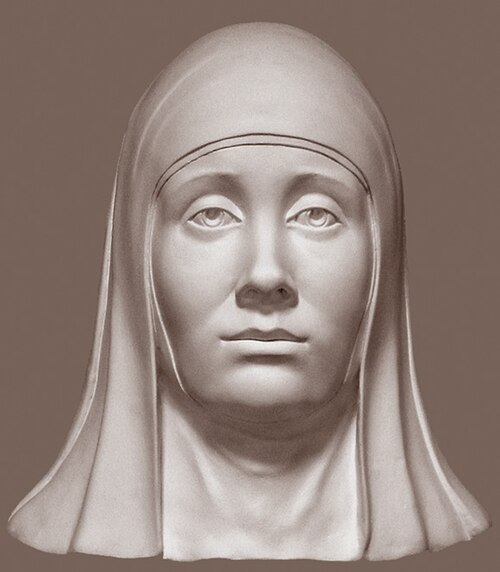
Venerable
Euphrosyne of Moscow
Grand Princess of Moscow
Grand Princess of Moscow from 1366 to 1389, wife of Dmitry Donskoy, who took the monastic name Euphrosyne.
- Feast
- May 17old style May 30
- Reposed
- 140715th century
- Place
- Moscow
- Order
- Venerables
Life
The Venerable Euphrosyne of Moscow, in the world Evdokia Dmitrievna, was grand princess of Moscow between 1366 and 1389, the wife of Grand Prince Dmitry Donskoy, then a nun. She was the first noblewoman of Moscow to enter monasticism. She fell asleep in 1407. Her feast is on 17 May (the day of her tonsure) and on 7 July (the day of her repose).
Marriage
She was born in 1353, the daughter of the grand prince of Suzdal and Nizhny Novgorod, Dmitry Konstantinovich, and of Vasilisa (in other sources, Princess Anna), of Rostov. On 18 January 1366, at thirteen, her father married her to the grand prince of Moscow, aged fifteen, later called Donskoy; the marriage ended the strife between Moscow and Suzdal-Nizhny Novgorod. The wedding took place in the church of the Resurrection in the Kolomna kremlin. She lived twenty-two years with Dmitry in a happy marriage, in which the Russian land rejoiced, and they had at least twelve children: among them Vasily I, Yury, Andrei, Peter and Konstantin. In 1382, when the army of Khan Tokhtamysh approached Moscow, she stayed in the city in her husband's absence; after the birth of her son Andrei she wished to leave, but was stopped by the Muscovites, who let her go only after long negotiations. She was much influenced by Metropolitan Alexis.
Widowhood
Dmitry Donskoy died on 19 May 1389, at thirty-eight. The Tale of the Life of Grand Prince Dmitry Ivanovich keeps the princess's long lament: Why have you died, my life, my dear, leaving me a widow? Why did I not die before you? The light of my eyes has gone out... My sun, early you set, my beautiful moon, early you darkened... With you I lived, with you I wish to die. From 1389 she in fact stood at the head of the principality of Moscow, as guardian of the succession among her sons and guarantor of her husband's will. According to Dmitry's testament she received over thirty districts and settlements and over twenty large villages; part came into her full ownership, with the right to collect taxes and judge, which made her politically and economically independent. Her sons were bound to obey her will, and she was to divide among them the share of whoever died. She was one of the most learned women of her time.
Foundations
She built many churches and monasteries at Moscow and other cities: in 1387, the Ascension convent beside the Frolovskaya (Spasskaya) tower of the Kremlin, at first of wood; in 1393, the stone church of the Nativity of the Mother of God, in the Kremlin, in memory of her husband's victory at Kulikovo, won on the day of this feast; it was consecrated on 11 February 1393 by Metropolitan Cyprian, with the whole princely family, and two years later was painted by Theophanes the Greek and Simeon Chorny; she adorned it with icons, vessels and books. She also built the Goritsky monastery at Pereslavl, around 1392, and the church of the Nativity of Saint John the Baptist in the same town. She had an icon of the Archangel Michael made, in memory of the victory at Kulikovo, which became the patronal icon of the Archangel Cathedral. When Tamerlane invaded southern Russia, in 1395, she gathered a militia to defend Moscow and, according to tradition, had the Vladimir icon of the Mother of God brought to Moscow. At her request, the victory at Kulikovo was celebrated at Moscow on 8 September with special solemnity.
Monastic life and veneration
On 17 May 1407 she withdrew into the Ascension convent and received tonsure with the name Euphrosyne. She fell asleep on 7 July 1407 and was buried in the convent. In 1929 the Soviet authorities ordered the church destroyed and her relics were lost, but they were found in 2002 and then placed in the Archangel Cathedral in the Kremlin. In 2007, six hundred years after her death, the Holy Synod of the Russian Church established the Order of Saint Euphrosyne, for women of special merit in strengthening spiritual and moral traditions in society.
Commemorated the same day May 17
 Stephen I of ConstantinopleSaint · Patriarch of ConstantinopleMay 17
 JuniaApostle · One of the SeventyMay 17
 Adrian of OndrusovVenerable · Monk and wonderworkerMay 17
- Julitta PetrovskaConfessor · Ukrainian asceticMay 17
- SolochonMartyrMay 17
- AdrionSaintMay 17
- AndriusMartyrMay 17
- AquilinusMartyrMay 17
- Arthemius of NeversSaintMay 17
- Basilla of AlexandriaMartyrMay 17
- CathanSaint · BishopMay 17
- CriotanSaintMay 17