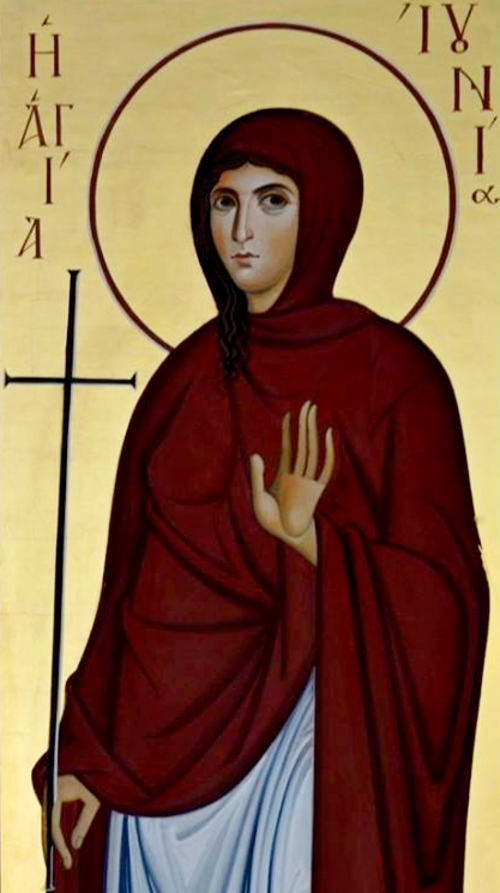
Apostle
Junia
One of the Seventy
Greeted by the Apostle Paul in his Epistle to the Romans and counted among the Seventy Apostles.
Life
Saint Junia, apostle, is greeted by the Holy Apostle Paul in the Epistle to the Romans and is counted among the Seventy Apostles, together with Andronicus. She is the only woman called an apostle in the New Testament. The Orthodox Church commemorates her on 17 May, together with Andronicus, and in the synaxis of the Seventy on 4 January.
In the New Testament Junia (in some manuscripts and later translations, Junias) is mentioned in one place only, Romans 16:7. There Paul greets Andronicus and Junia, whom he calls his kinsmen or compatriots and fellow prisoners, notable among the apostles, who were in Christ before him. Chapter 16 contains Paul's greetings to many members of the community, of whom a third are women. The name Junia shows that she may have belonged to a noble Roman family, but she could also have been a freed slave, or from a family of Greek-speaking Jews. It is not clear whether she and Andronicus were husband and wife, brother and sister, or merely fellow workers. Some scholars have identified her with Joanna, wife of Chuza, in the Gospel according to Luke.
The meaning of the words notable among the apostles is disputed: some understand that they were outstanding apostles, others that they were well known to the apostles. In the first millennium all commentators, among them Origen, Jerome and Saint John Chrysostom, understood that she was a woman and an apostle. Chrysostom wrote with admiration that she was worthy of the name of apostle and urged the women of Constantinople to follow her. The masculine form Junias appears only in manuscripts from the twelfth century, and the first author to use it is Giles of Rome, in the thirteenth century; today it is held that she was a woman. There is no evidence that Junias existed as a man's name in ancient sources.
Tradition Orthodox tradition says that she preached and taught together with Andronicus. Andronicus is said to have been bishop of Pannonia, and the two of them brought many to the faith and pulled down many pagan temples, raising churches. It is told that both had the gift of healing. According to some accounts, Andronicus and Junia died in peace; in the Syriac lists of the apostles a tradition is preserved that Junia suffered as a martyr on the island of Samos. A Byzantine synaxarion says that their relics were found in the Eugenius quarter of Constantinople, in the time of Emperor Arcadius. Her veneration was strong in the fourth century. Most Byzantine calendars commemorate Andronicus and Junia on 17 May.
Commemorated the same day May 17
 Stephen I of ConstantinopleSaint · Patriarch of ConstantinopleMay 17
 Euphrosyne of MoscowVenerable · Grand Princess of MoscowMay 17
 Adrian of OndrusovVenerable · Monk and wonderworkerMay 17
- Julitta PetrovskaConfessor · Ukrainian asceticMay 17
- SolochonMartyrMay 17
- AdrionSaintMay 17
- AndriusMartyrMay 17
- AquilinusMartyrMay 17
- Arthemius of NeversSaintMay 17
- Basilla of AlexandriaMartyrMay 17
- CathanSaint · BishopMay 17
- CriotanSaintMay 17