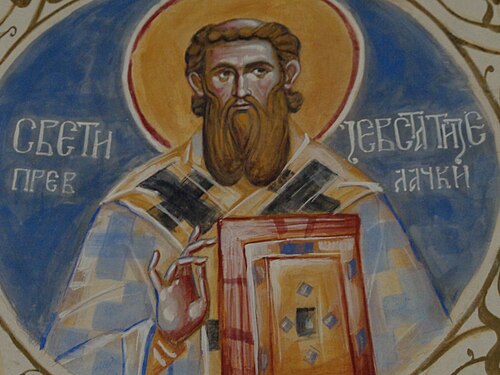
Saint
Eustathius I of Serbia
Archbishop of Serbia
Sixth Archbishop of Serbia, from 1279 to 1286, born near Berane and a former abbot of Hilandar.
Life
Saint Eustathius I (Jevstatije) was the sixth Archbishop of Serbia, between 1279 (according to one source, 1282) and 1286, formerly abbot of Hilandar and Bishop of Zeta. He fell asleep on 4 January 1286 at Žiča. His relics rest at the Patriarchate of Peć. He is commemorated on 4 January by the old calendar, which is 17 January by the new.
Beginnings and monastic life
He was born in the parish of Budimlje, near Berane, in Zeta. He studied at Djurdjevi Stupovi, received the monastic tonsure in Zeta, then went on pilgrimage to Jerusalem and on his return came to the Hilandar monastery on Athos, where he was abbot. While abbot he was elected and consecrated bishop of Zeta, the fourth. He passed through all the stages of monastic life: he had much experience of ascetic labour but also of common life, travelled to many holy places, was abbot of the most important Serbian monastery, Hilandar, then of the monastery of the Archangel Michael at Prevlaka, and then bishop of an important diocese in the west of the country.
The archbishop
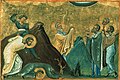
After the death of his predecessor, Archbishop Joanikije I, on 28 May 1279, he was elected archbishop by a council, in the time of King Milutin: the sources give the year 1279 or 1282. He held the see eight years. He made special efforts to preserve Orthodoxy in the archbishopric, with special care for the works on the church of the Ascension of the Lord at Žiča, where his body was laid after death. He fell asleep on 4 January 1286 at Žiča, in the marble coffin he had made himself, saying, according to tradition: Into Your hands, Lord, I commend my spirit. A few years after his death he was numbered among the Serbian saints. His service was written soon, as the service of a Serbian saint, first in a Menaion of the thirteenth century, together with that of Saint Sava. His service and life, like those of Saint Arsenije and Saint Joanikije, were composed later by Archbishop Danilo II, who set their veneration in the synaxis of Serbian saints.
The relics
Soon after his repose, the Žiča monastery was in danger and his successor, Jacob, had to take his body to a safe place. Žiča was attacked by the Cumans, who plundered and burned the monastery (according to another source, by Drman and Kudelin, or by the Bulgarian tsar Shishman with the Tatars). Jacob placed the relics in the church of the Holy Apostles Peter and Paul at Peć, which in 1291 became the new archiepiscopal see. Until the beginning of February 1926 the relics were thought lost, then they were found in a small shrine in the old church of the Holy Saviour at Veles, together with those of Saint Peter of Koriša. They were joined, according to a note, by Patriarch Joanikije, on 30 August 1752, and came to Veles in July 1847 as a gift of Saint Arsenije. For decades they were guarded from the Turks and Bulgarian exarchists. The archpriest of Veles took the shrine to Skopje, to Metropolitan Varnava, in 1926. Now the relics rest in the church of the Patriarchate of Peć.
Commemorated the same day January 4
 ApollosApostle · Apostle of the SeventyJan 4
 Symeon of JerusalemHieromartyr · Bishop of JerusalemJan 4
 EpaphroditusApostle · Envoy of the Church of PhilippiJan 4
 CleopasApostle · Disciple on the road to EmmausJan 4
 Andronicus of PannoniaApostle · Bishop of PannoniaJan 4
 EpaphrasApostle · Companion of the Apostle PaulJan 4
 EvodiusApostle · Bishop of AntiochJan 4
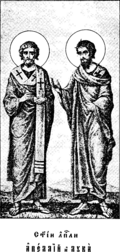 Apelles of SmyrnaApostle · Bishop of HeracleaJan 4
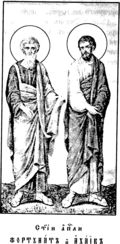 AchaicusApostle · Of CorinthJan 4
 AmpliatusApostle · Greeted by the Apostle PaulJan 4
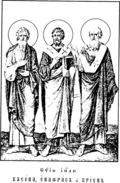 Crispus of CorinthApostle · Bishop of ChalcedonJan 4
 Quartus of BerytusApostle · Bishop of BeirutJan 4