Saint
Fulbert of Chartres
Bishop of Chartres
Bishop of Chartres from 1006 to 1028 and a teacher at the cathedral school.
Life
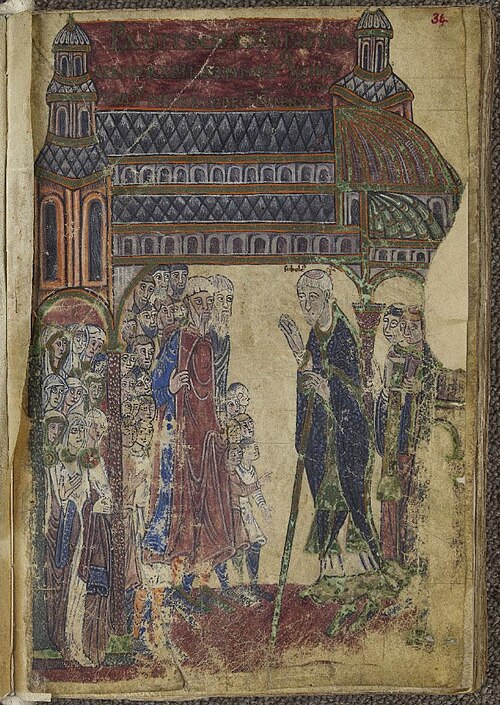
Saint Fulbert of Chartres was bishop of Chartres from 1006 until his death in 1028, and a teacher at the cathedral school of that city. He was loved above all for his devotion to the Mother of God and for his zeal for learning. He is commemorated on 10 April.
His life
Neither the year nor the place of his birth is known for certain; sources give years between 952 and 970 and usually place him in northern France. All say he was of humble birth. In the 980s he studied at the cathedral school of Reims, where among his fellow students was the future king Robert II the Pious. According to some sources he was a pupil of Gerbert of Aurillac, the future Pope Sylvester II, a matter that has been disputed. In the early or mid 990s he came to the cathedral school at Chartres, as a master or assistant, and held some minor church offices, without being a monk. In 1004 he became a deacon, and in 1006 was made bishop of Chartres. When the cathedral burned in 1020, he laboured at its rebuilding, by some accounts even as its architect. He ordered the teaching of the liberal arts and is remembered as the founder of the school of Chartres, whose pupils, among them Berengar of Tours, became famous. He fell asleep on 10 April 1028, by some sources 1029. His contemporaries called him a man of saintly nature, and Rome allowed the dioceses of Chartres and Poitiers to keep his day, although he was not formally canonized.
His writings
Much of what survives from him is letters. The best known is to Duke William V of Aquitaine, on the duties of lord and vassal. He also wrote to other servants of the Church about liturgical matters, the appointment of bishops, excommunication and obedience, and about small everyday matters such as thanks for medicine. He composed about twenty-four poems, among them one on the nightingale. He wrote hymns, most of them in honour of the Virgin, and Chorus novae Ierusalem, to be sung at Easter services. His best-known sermon speaks of the celebration of the Nativity of the Mother of God.
Devotion to the Mother of God
In his time many feared the end of the world, and Fulbert strengthened the veneration of the Virgin, to calm people and to teach them to seek her prayers. Chartres kept as a relic the Holy Tunic of the Mother of God, and devotion to it grew greatly under him. It is told that when Fulbert was gravely ill, the Mother of God healed him with a drop of her milk, for his devotion. He worked that the day of the Nativity of the Mother of God, 8 September, be celebrated with special honour.
Commemorated the same day April 10
 Gregory V of ConstantinopleHieromartyr · Patriarch of ConstantinopleApr 10
 HuldahProphet · Prophetess of JerusalemApr 10
 Misail of RyazanSaint · Archbishop of Ryazan and MuromApr 10
- Phlegon PongilskyHieromartyr · PriestApr 10
- Abdicius of PersiaMartyrApr 10
- AlexanderMartyrApr 10
- Alexander of AfricaMartyrApr 10
- Anastasia of UglichVenerable Martyr · Abbess at UglichApr 10
 ApolloniusMartyr · Martyr of AlexandriaApr 10
- Apollonius of AlexandriaMartyrApr 10
- Apollonius of RomeMartyrApr 10
- Athanasius of NicomediaHieromartyr · Metropolitan of NicomediaApr 10