Prophet
Huldah
Prophetess of Jerusalem
Prophetess in the time of King Josiah, who interpreted the book of the Law found in the Temple.
Life
Saint Huldah the Prophetess lived in Jerusalem in the time of King Josiah of Judah, a contemporary of Jeremiah and Zephaniah. The Second Book of Kings and the Second Book of Chronicles tell, in a few verses, of her meeting with the king's envoys. The Church honors her as a prophetess and commemorates her on 10 April.
Who she was
Huldah was the wife of Shallum, son of Tikvah (also called Tokhath), son of Harhas, keeper of the wardrobe. She lived in Jerusalem, in the "second quarter" of the city, which some translations call "the college" or "the new quarter." Her Hebrew name is taken by some as a feminine form of the word for "mole" or "weasel," and by others as linked to the root meaning "to abide." Jewish tradition places her beside Deborah as one of the principal women prophets of the Old Testament. The Bible says little more about her; we know more of her husband's background than of her own.
The book of the Law and the prophecy
In the eighteenth year of Josiah, who reigned from 641 to 609 BC, the king ordered the Temple of Solomon to be repaired. During the work the priest Hilkiah found the book of the Law and gave it to the scribe Shaphan, who read it to the king. Josiah tore his clothes, afraid of the wrath of God, and sent Hilkiah, Shaphan and three others, among them Ahikam, Achbor and Asaiah, to inquire of the Lord. They went to Huldah without showing her the scroll.
Huldah gave them an answer in two parts. For the people, she foretold that the disaster written in the book would come upon Jerusalem because of its wickedness. To the king, because he had humbled his heart before the Lord, she said in God's name that he would be gathered to his grave in peace and that his eyes would not see all the evil that the Lord would bring on that place. Her word was read to the people and stood behind the king's religious reforms. Some scholars say she is the first person to declare certain writings to be Scripture.
Josiah died in the summer of 609, wounded at the battle of Megiddo against Pharaoh Necho, and was buried in peace at Jerusalem.
Traditions and veneration
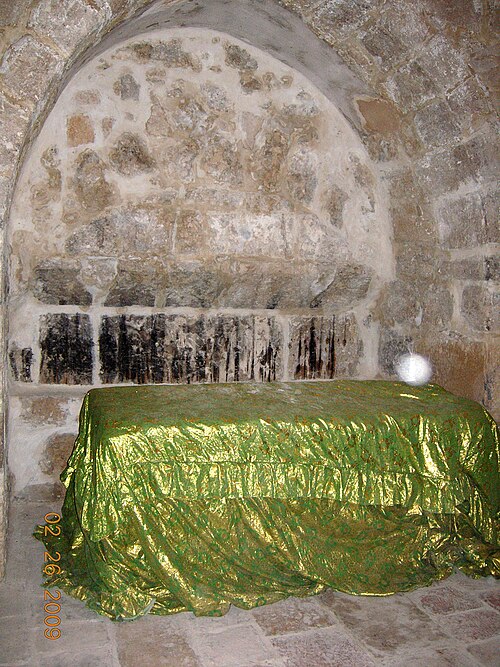
Rabbinic tradition says that she spoke to the king's messengers without ceremony, and that the king went to her rather than to Jeremiah because he thought her more easily moved to pity. She is said to have preached repentance to the women as Jeremiah did to the men. Tradition also holds that she was buried within the walls of Jerusalem. The Huldah Gates in the southern wall of the Temple Mount are named for her. The Orthodox Church honors her as a prophetess and commemorates her on 10 April.
Commemorated the same day April 10
 Fulbert of ChartresSaint · Bishop of ChartresApr 10
 Gregory V of ConstantinopleHieromartyr · Patriarch of ConstantinopleApr 10
 Misail of RyazanSaint · Archbishop of Ryazan and MuromApr 10
- Phlegon PongilskyHieromartyr · PriestApr 10
- Abdicius of PersiaMartyrApr 10
- AlexanderMartyrApr 10
- Alexander of AfricaMartyrApr 10
- Anastasia of UglichVenerable Martyr · Abbess at UglichApr 10
 ApolloniusMartyr · Martyr of AlexandriaApr 10
- Apollonius of AlexandriaMartyrApr 10
- Apollonius of RomeMartyrApr 10
- Athanasius of NicomediaHieromartyr · Metropolitan of NicomediaApr 10