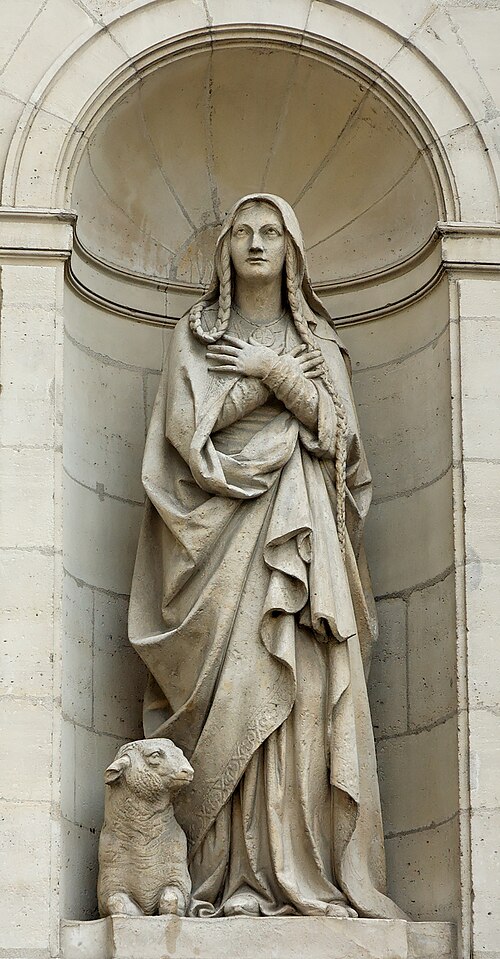
Venerable
Genevieve of Paris
Patron of Paris
Maiden consecrated to God, patron of Paris, who encouraged the city during the Hunnic invasion.
- Feast
- January 3old style January 16
- Reposed
- 5026th century
- Place
- Paris
- Order
- Venerables
Life
Venerable Genevieve of Paris was a virgin consecrated to God, the patron of Paris, who in the time of the Hunnic invasion strengthened the city by prayer. She is honoured by the Orthodox and the Catholic Church, as one of the saints of Gaul before the great schism. Her memory is kept on 3 January (16 January on the new style). Much of what is known of her comes from a Life written after her death, whose author and historical value scholars debate.
Childhood at Nanterre
She was born around 420, by other sources 423, at Nanterre, near Paris, to Severus and Gerontia, ordinary people with names common in the Gallo-Roman aristocracy. Like many girls of the time she tended her father's sheep, and the people later said she was the daughter of poor parents. When she was about seven, in 429, Bishop Germanus of Auxerre (31 July) and Bishop Lupus of Troyes stopped at Nanterre on their way to Britain to fight the heresy of Pelagius.
In the crowd that met them Germanus noticed Genevieve, called her to him and told her parents that she would be great before the Lord and would lead many to salvation. The child answered that she wished to give herself to Christ. The next day Germanus found a copper coin bearing the sign of the Cross at his feet and gave it to her in remembrance, asking her never to wear ornaments of gold, pearls or silver. From that day Genevieve went to the services with even greater zeal.
Her mother, the water and her consecration
On a feast day her mother, Gerontia, kept her from going to church and, in anger, struck her across the face. She was blinded on the spot and stayed without sight for twenty-one months. When she understood that she had opposed the will of God, she asked her daughter for water from the well. Genevieve prayed to the Lord with tears, marked the water with the sign of the Cross, and her mother, washing, began to see, and after the third washing saw clearly. This was the first of her miracles, and the well at Nanterre remained a place of pilgrimage for centuries.
At fifteen she was brought with two other girls before the bishop to receive the veil of the consecrated virgins. The bishop had her go first, though she was the youngest. Through fasting, vigil and prayer she received from God the gifts of foresight and of working miracles. When her parents died she moved to Paris, to the house of her godmother.
Life in Paris
In Paris she lived in strict asceticism. From fifteen to fifty she fasted from Sunday to Thursday and from Thursday to Sunday, eating only barley bread and beans, and she never drank wine. After fifty, at the order of the bishops, she added fish and milk. She held the Saturday night vigil to be great, because it shows how the whole of life should be: to keep watch so that the Lord may find us ready at His coming. One stormy Saturday, when the wind put out her lantern and that of her sisters, she made the sign of the Cross over the candle, which burned with a clear flame, and the sisters reached the church.
Not all loved her. In 445 or 446 her neighbours, full of envy, accused her of fraud and said her visions were a deceit, and plotted to drown her. Germanus, who came to Paris again, defended her, and the bishop placed her in charge of the consecrated virgins.
The Huns and the famine
In 451, when it was known that the Huns of Attila were approaching, the Parisians wanted to flee. Genevieve urged them to stay, prophesied that the city would be spared but that those who left it would perish, and gathered the women for fasting, vigil and prayer, after the example of Esther and Judith. The citizens were angry again, but the attack never came, for Attila bypassed Paris and turned toward Orléans.
Later, in the time of the blockade of Paris by the Franks, Genevieve led a convoy of ships up the Seine, through the enemy lines, to bring grain for the hungry. The eleven ships came back safe, and she gave food first to the poor. It is said that King Childeric ordered the gates closed so that she could not free the condemned, but she opened them by touching them, and Childeric spared the prisoners at her request. Of Clovis it is said that he pardoned prisoners at her asking.
The churches and her repose
Genevieve had a special devotion to Saint Denis, the first bishop of Paris, and in 475 she urged that a basilica be raised in his honour, though the priests had no means. At her word the materials were found, and when the workers ran out of water she made the sign of the Cross over a vessel and water came. Together with Queen Clotilde she worked for the conversion of Clovis and urged him to build the church of the holy Apostles Peter and Paul, on the hill in Paris, completed after the year 500.
Genevieve fell asleep in Paris, between 502 and 512 according to the sources, at an advanced age (eighty-two or eighty-nine years, according to the sources). She was buried in the church she had helped to raise, beside the family of Clovis. Pilgrims came at once to her tomb, and miracles began to take place. Later the Parisians carried her shrine in procession in times of need, more than a hundred and fifty times between 885 and 1791.
Relics and remembrance
In the French Revolution her relics were burned and the church was profaned. A cenotaph stands today in the church of Saint-Étienne-du-Mont, and the Pantheon in Paris was built as a church in her honour. In the Middle Ages she was also counted a patron of vintners. The Orthodox Church remembers her on 3 January, as a saint of Gaul before the schism, and Paris honours her as its protector.
Commemorated the same day January 3
 MalachiProphet · The ProphetJan 3
 Ekvtime TakaishviliSaint · Georgian historian and archaeologistJan 3
 Gordius of CaesareaMartyr · Roman officer of CappadociaJan 3
 Peter ApselamusMartyr · Martyr of PalestineJan 3
- Florentius of VienneSaint · Bishop of VienneJan 3
- Thomais of LesbosVenerableJan 3
- Acacius of LatrosVenerable · The WonderworkerJan 3
- Basil KholmogorovHieromartyrJan 3
 Bertilia of MareuilVenerableJan 3
- Blitmund of BobbioVenerableJan 3
- Cillin ua CollaVenerableJan 3
- Constans of AfricaSaintJan 3