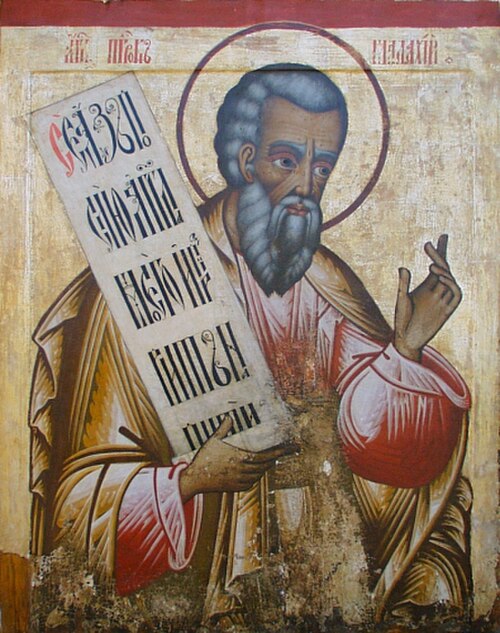
Prophet
Malachi
The Prophet
Last of the minor prophets of the Old Testament, author of the book that bears his name.
Life
The Holy Prophet Malachi is the last of the twelve minor prophets of the Old Testament and the author of the book that bears his name. His book closes the collection of prophets in the Hebrew Scriptures and, in the Christian Old Testament, stands right before the New Testament. The holy Fathers call him "the seal of the prophets". The Church commemorates him on 3 January, new style (Churches keeping the old calendar observe it on 16 January).
His name and time
The name Malachi, in Hebrew Mal'akhi, means "my messenger" or "my angel". For this reason some scholars think it is not a personal name but one taken by the author, and Jewish tradition counts him the same as the scribe Ezra. The Church has understood the name as a sign of his life: Malachi, says the Synaxarion, was an image of spiritual goodness and piety, so that the people marvelled at him and called him "angel".
He lived about four hundred years before the birth of Christ, in the time of the return of the Jews from the Babylonian captivity, after the rebuilding of the second Temple at Jerusalem. Most signs show that he preached in the time of Nehemiah or shortly after, since the sins he rebukes are the same that Nehemiah found at his second coming to Jerusalem. One tradition says he came from the village of Sofa, of the tribe of Levi, but the sources are not uniform and tell us no more about his life.
His book
The Book of Malachi, in four chapters, is composed as a series of disputes between the Lord and His people. It begins with the words: "I have loved you, says the Lord", to which the people answer: "How have You loved us?" The prophet rebukes the priests, who offer unworthy sacrifices, and the people, who withhold the tithe. He also rebukes broken marriage customs, when men put away the wives of their youth, and those who said that serving God was pointless.
Alongside these rebukes the book speaks of the time of fulfilment. In the first chapter the Lord says that from the rising of the sun to its setting His name is great among the nations and that in every place incense and a pure offering are brought to His name. Christians saw here the announcement of the sacrifice of the New Testament. The oldest Christian writing on church order, the Didache, quotes these words when speaking of the Eucharist.
The announcement of Christ and of the Forerunner
In the third chapter the Lord says: "Behold, I send My messenger, and he will prepare the way before Me." The Gospels recognise him in Saint John the Baptist (Matthew 11:10; Mark 1:2). Then he announces that the Lord will come suddenly to His Temple and will judge. The fourth chapter says that for those who fear the Lord's name "the Sun of righteousness shall rise with healing in His wings". The Church sings this image in the troparion of the Nativity of the Lord, where Christ is called the Sun of righteousness.
The book ends with the promise: "Behold, I will send you Elijah the prophet before the coming of the great and dreadful day of the Lord." Christian tradition links this promise with Saint John the Baptist, who came "in the spirit and power of Elijah" (Luke 1:17), and with the second coming of the Lord. The Orthodox sources sum up the prophet's message in four things: his pure life, the announcement of the Lord's coming, the dreadful judgment, and the change of the law of Moses for the new sacrifice.
Veneration
Malachi is commemorated on 3 January. The troparion calls him a prophet whose memory we celebrate, and the kontakion praises him for the gift of prophecy, by which he plainly announced the coming of Christ and the salvation of the world. Another kontakion calls him "angel", because he served as a messenger of God and announced the Incarnation of the Lord.
Commemorated the same day January 3
 Genevieve of ParisVenerable · Patron of ParisJan 3
 Ekvtime TakaishviliSaint · Georgian historian and archaeologistJan 3
 Gordius of CaesareaMartyr · Roman officer of CappadociaJan 3
 Peter ApselamusMartyr · Martyr of PalestineJan 3
- Florentius of VienneSaint · Bishop of VienneJan 3
- Thomais of LesbosVenerableJan 3
- Acacius of LatrosVenerable · The WonderworkerJan 3
- Basil KholmogorovHieromartyrJan 3
 Bertilia of MareuilVenerableJan 3
- Blitmund of BobbioVenerableJan 3
- Cillin ua CollaVenerableJan 3
- Constans of AfricaSaintJan 3