Venerable
Gennady of Kostroma
Founder of Gennady Monastery
Monk born at Mogilev, founder of the Saviour and Gennady monastery, who died in 1565.
- Feast
- January 23old style February 5
- Reposed
- 156516th century
- Place
- Mahilyow
- Order
- Venerables
Life
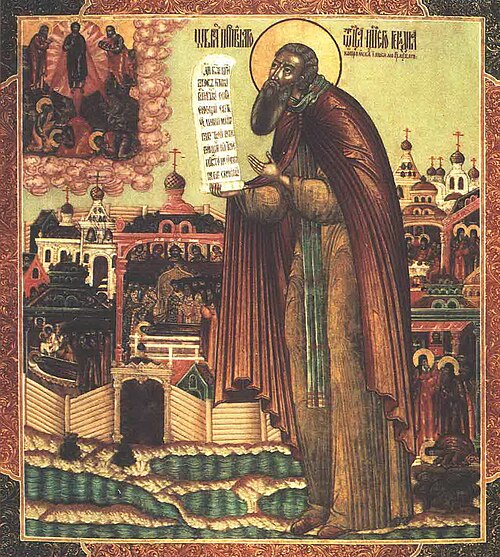
Venerable Gennady of Kostroma and Lyubimograd, also called Gennady of Mogilev, in the world Grigory Ivanovich, was the founder of the Monastery of the Saviour and Saint Gennady, now in the diocese of Yaroslavl. He was born at the start of the sixteenth century at Mogilev, then in the Grand Duchy of Lithuania, and fell asleep in peace on 23 January (old calendar) 1565, in the monastery he had built. He was the beloved disciple of Venerable Cornelius of Komel, was known for foresight and healings and left two writings of instruction for monks. His commemoration is on 23 January, in the Synaxis of the saints of Kostroma and in the Synaxis of the saints of Rostov and Yaroslavl.
Sources and childhood
Gennady's life tells of him, written in 1584 to 1586, and the "Tale of the Finding of the Relics", of the end of the 1640s, and he is mentioned also in the Life of Venerable Cornelius of Komel (1589). Grigory was born in a rich boyar family, of Ivan and Elena, and was their only son. He was thoughtful and loved solitude. His strong piety and desire to visit monasteries often displeased his parents. Then, dressed in poor clothes, he left home for Moscow. After visiting the holy places there, he went to the Novgorod land with a certain Theodore, who also wanted monastic life. They wished to settle at the monastery of Saint Alexander of Svir, but he told them plainly that "one cannot live in the wilderness at so young an age" and blessed them to go to the forests of Vologda, to the Komel hermitage, to Venerable Cornelius.
Disciple of Cornelius
Theodore soon went back to Moscow, had a large family and lived to old age. Grigory, on the contrary, stayed long "in trial" and was tonsured a monk with the name Gennady. In a short time he became an exemplary monk and Cornelius's favourite disciple. The brothers envied Gennady, and among them "murmuring and disobedience" arose toward Cornelius himself. According to Gennady's life, to escape "the storm of abuse, slander and whispers", or, according to Cornelius's life, wishing "to be silent in solitude", Cornelius withdrew with Gennady to Lake Sura, 25 km from Lyubim, once a suburb of Kostroma (now a town in the Yaroslavl region). With the help of the tsar's beekeepers who lived there, the monks made a cell and spent their time in labour, "cutting the forest and ploughing the earth"; to drain the marshes they dug four ponds with their own hands. At the urging of Grand Prince Vasily Ivanovich, Cornelius returned in 1529 to his monastery at Komel, and the "departure hermitage", that is, the new skete in the forest of Lyubim, he "blessed" to Gennady. That hermitage later became the Monastery of the Saviour and Saint Gennady, and Gennady was its hegumen to the end of his days.
Hegumen
For the small brotherhood of six monks a church was built dedicated to the Transfiguration of the Lord. With the help of the grand prince, Gennady adorned it "with all church beauty"; the grand prince also granted a grain allowance. When the number of monks grew, he built a second church, dedicated to Venerable Sergius of Radonezh. The hegumen was for the brothers "an image of humility and patience": he chopped and carried wood to the cells, worked in the kitchen and bakery, washed hair shirts. For rest he painted icons, with love. To "subdue the flesh" he wore iron chains and crosses. In the manuscript life of Pachomius of Nerekhta a portrait of him is given: "of middle age, with reddish hair, black beard, like that of Cosmas and Damian, in the habit of a schema-monk, with hands raised in prayer."
He was famous for foresight and healings. He sometimes went from the Sura to Moscow. It is told that once he entered the house of the boyaress Juliana Fyodorovna, wife of Roman Yuryevich Zakharin, and, blessing her children, foretold to her that her daughter Anastasia would be tsaritsa. She did become the wife of Tsar Ivan the Terrible. The Zakharins, in gratitude, helped Gennady build in his monastery a second church, dedicated to Saint Sergius of Radonezh. He healed of a grave illness the boyar Boris Paletsky, who afterwards gave the monastery a costly bell, and Bishop Cyprian of Vologda. Gennady was the confessor of Ivan the Terrible and baptized his daughter Anna.
His writings
By the testimony of a disciple, Gennady "knew not letters", that is, could not write, but he left two works of ascetic instruction: "Instruction to the Novice Monk" and, before death, "Teaching to the Brothers and to All People". In them he remained faithful to the counsel of his teacher, Cornelius: "Receive the mind of the holy fathers of old, patience, love and humility, above all common and cell prayer, and labour in unfeigned struggles." According to Gennady, a monk should know only the church, the refectory and his cell, perform the monastery's tasks without grumbling, laziness or disturbance, guard the monastery's property and not be "a maker of enmity and speaker of evil". He urged his successors not to wrong peasants with violence. The church, for a monk, should be "heaven on earth". "Do not be absent from the church services," he advised his disciples, "for the first abomination for monks is not to come to church. If a monk does not receive communion for six weeks, he is not a monk." Though he himself could not write, he advised the monks to acquire books: "It is fitting, my children, to read them attentively and apply your mind to knowing wisdom."
Repose and veneration
He passed in peace and was buried in the church he had built. His disciple and second successor, Hegumen Alexis, wrote between 1584 and 1587 the life of Venerable Gennady, with the description of nineteen miracles from his lifetime and after death, and his canon, adding the spiritual testament dictated by Gennady himself. At the same time the service was probably composed. Alexis then opened a petition for canonization, which led nowhere. Local veneration began, however, right after his repose: in the monastery and at Kostroma churches were consecrated dedicated to Venerable Gennady.
The relics were found when the foundation of the stone cathedral of the Transfiguration was laid, on the site of the wooden church built by Gennady: when the coffin was opened, not only the body but the garments too were found "whole and unharmed, untouched by corruption". Placed for a time in the monastery church of Saint Alexis the Man of God, they were solemnly moved to the newly consecrated church of the Transfiguration and set beside the right choir of the Annunciation side chapel. Then, with the blessing of Patriarch Joseph, the church celebration of Venerable Gennady was established. In 1861 a service with an akathist was printed, composed by G. Kartsev and "reworked" by Archbishop Nil of Yaroslavl. The relics were kept at first open to view, then "for unknown reasons and at an unknown time" were hidden beneath the floor. In the early 1920s the monastery was closed, and the relics were opened on 28 September 1920 and taken, with a money-collecting ladle and an axe held to be Gennady's, to the Yaroslavl provincial museum, where they stayed until the mid-1930s; their later fate is unknown. Since 1995 the monastery has been reviving.
His commemoration is on 23 January; in 1983 it was chosen as the day of the Synaxis of the saints of Kostroma, and he is also remembered in the Synaxis of the saints of Rostov and Yaroslavl and on the third Sunday after Pentecost. In the village of Antropovo in the Kostroma region there is a church of Saint Gennady. For the 350th anniversary of the finding of the relics and the 435th of Gennady's repose, the diocese of Kostroma established an award, the badge "Venerable Gennady of Kostroma and Lyubimograd", in two classes, for clergy and laity who show zeal and special contribution to the spiritual revival of the Kostroma land.
Commemorated the same day January 23
 Paulinus of NolaSaint · Bishop of NolaJan 23
 EmerentianaMartyrJan 23
 Clement of AncyraHieromartyr · Bishop of AncyraJan 23
 Abraham of GalichVenerable · Abbot and founder at ChukhlomaJan 23
 Agathangelus of RomeMartyr · Deacon of RomeJan 23
 Messalina of FolignoMartyr · Virgin of FolignoJan 23
 Dionysius of Mount OlympusVenerable · Monk on Mount OlympusJan 23
 Barlaam of ChikoyVenerable · Abbot of Chikoy MonasteryJan 23
 Alexander of VochskVenerable · HegumenJan 23
 Catherine CherkasovaVenerable Martyr · NoviceJan 23
- Amasius of TeanoSaint · Bishop of TeanoJan 23
 Ascholius of ThessalonicaSaint · Bishop of ThessalonicaJan 23