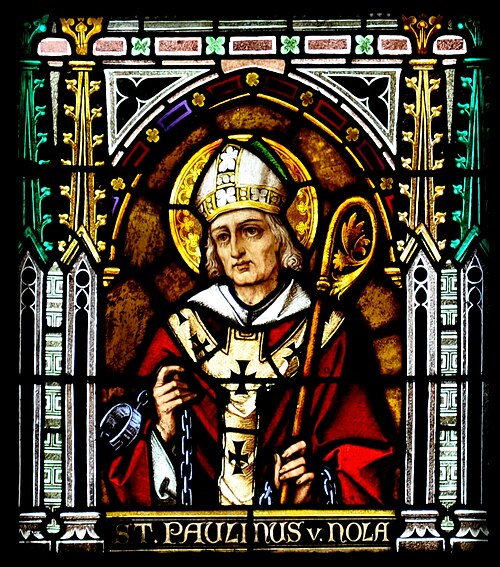
Saint
Paulinus of Nola
Bishop of Nola
Roman senator who became bishop of Nola, a Christian poet and writer of spiritual letters.
- Feast
- January 23old style February 5
- Reposed
- 4315th century
- Place
- Nola
- Order
- Hierarchs
Life
Saint Paulinus of Nola, also called Paulinus the Merciful, was a Roman senator, a Christian poet, a writer of spiritual letters and bishop of Nola in Campania, around 410-431. He left wealth and career for a life of prayer and almsgiving, and his example was honoured by Augustine, Jerome and Ambrose. The Orthodox Church commemorates him on 23 January, the Catholic Church on 22 June.
Youth and renunciation
He was born around 354 at Burdigala (Bordeaux), into a senatorial family with estates in Aquitaine, northern Spain and southern Italy, a kinsman of Melania the Elder. He studied at Bordeaux under the poet Ausonius. The emperor Gratian made him consul and, around 381, governor of Campania. There he saw the people’s devotion to Saint Felix of Nola, and he built a road for pilgrims and a hospice for the poor near the shrine.
After Gratian’s murder, in 383, Paulinus returned to Bordeaux, where he married Therasia, a Christian from Barcelona. He was baptized by Bishop Delphinus of Bordeaux. Around 390 they went to Spain. When they lost their only child, eight days after birth, they decided to withdraw from the world and live a life of prayer. Ausonius tried to persuade him to return, in letters, to which Paulinus answered in 393 with a poem setting out his new faith. According to some sources he gave much of his wealth to the poor, and he and his wife then lived as brother and sister. Unlike the sterner view of Jerome, Paulinus thought that money could be used for the poor and the Church rather than rejected altogether.
Priest and bishop
On Christmas Day, in 393 or 394, after much resistance, he was ordained priest at Barcelona by Bishop Lampius. In 395 he moved with his wife to Nola, where he stayed until his death. He regarded Saint Felix, buried there, as the cause of his conversion, and wrote a poem in his honour every year. In 402-403 he restored and enlarged the old basilica of the martyr and built a large, richly decorated church, with porticoes and fountains, for which water was brought from Avella; crowds of pilgrims came to the martyr’s tomb. In January 406 he hosted a circle of guests, among them Melania the Younger, her husband and her mother Albina. He exchanged letters with Jerome and others about monastic life. He is credited with introducing bells into Christian worship.
Therasia died between 408 and 410, and Paulinus was ordained bishop, around 410, and shepherded the church for twenty years. After the sack of Nola by the Visigoths, in 410, he organized, according to one source, the ransoming of his captive fellow citizens and the rebuilding of the town. He showed himself a good and merciful shepherd. He was a friend of Ambrose, Augustine, Jerome and Nicetas of Remesiana. His writings include poems and some fifty letters of spiritual teaching, on God’s providence, prayer for the dead, the intercession of the saints and the veneration of icons. He died on 22 June 431, at almost seventy-eight, and was buried amid a great crowd.
Veneration
His relics were for a long time in the church of Saint Bartholomew the Apostle in Rome and were taken back to Nola in 1908. The people of Nola commemorate him every year, and in the week of his feast the Festival of the Lilies is held. He is regarded as patron of bell-ringers.
Commemorated the same day January 23
 EmerentianaMartyrJan 23
 Clement of AncyraHieromartyr · Bishop of AncyraJan 23
 Abraham of GalichVenerable · Abbot and founder at ChukhlomaJan 23
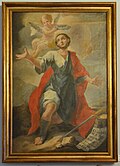 Agathangelus of RomeMartyr · Deacon of RomeJan 23
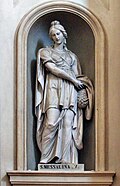 Messalina of FolignoMartyr · Virgin of FolignoJan 23
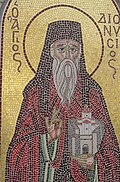 Dionysius of Mount OlympusVenerable · Monk on Mount OlympusJan 23
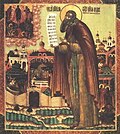 Gennady of KostromaVenerable · Founder of Gennady MonasteryJan 23
 Barlaam of ChikoyVenerable · Abbot of Chikoy MonasteryJan 23
 Alexander of VochskVenerable · HegumenJan 23
 Catherine CherkasovaVenerable Martyr · NoviceJan 23
- Amasius of TeanoSaint · Bishop of TeanoJan 23
 Ascholius of ThessalonicaSaint · Bishop of ThessalonicaJan 23