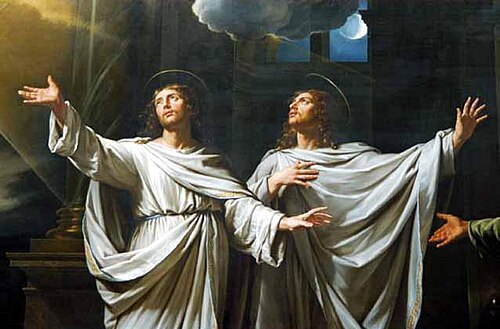
Holy Martyrs
Gervasius and Protasius
Two martyrs, probably of the second century, patron saints of Milan and of haymakers.
Life
The Holy Martyrs Gervasius and Protasius were twin brothers who, according to tradition, suffered martyrdom at Milan in a persecution of the early centuries. Their relics, found by Saint Ambrose in 386, became a sign of the victory of true faith at Milan, and they are patron saints of that city.
According to the martyr acts, written toward the end of the fourth century, they were the sons of the martyrs Vitalis, who died at Ravenna, and Valeria, who gave her life at Milan. Left alone, Gervasius and Protasius were thrown into prison at Milan, where Nazarius and later his disciple Celsus visited them. The brothers remained faithful to Christ and were first beaten with scourges, then beheaded. The acts place them in the time of Nero; some scholars today think they may have suffered under Marcus Aurelius. The opinion that they were victims of Diocletian sits poorly with the fact that by 386 the place of their burial had been entirely forgotten.
Tradition also keeps the story of Nazarius and Celsus. Nazarius was born in Rome to a Jewish father and a Christian mother, who according to the account was baptised by the holy Apostle Peter himself; he himself was baptised by Bishop Linus. He gave his goods to the poor, went to Milan, visited his brethren in prison, and was beaten and driven out. He then preached in Gaul, was thrown to wild beasts, which did not touch him, and into the sea, where he walked on the waters. He returned to Milan, where he was beheaded with Celsus, and Gervasius and Protasius were put to death as well.
In 386, when Saint Ambrose was in sharp conflict with the Arian empress Justina, who had demanded a city church for an Arian bishop, a vision showed him the place where the two martyrs lay, in the cemetery of the church of Saints Nabor and Felix. There two bodies of great stature were found, with their bones whole and much blood. The relics were carried in procession to the Ambrosian basilica. Ambrose wrote of this to his sister Marcellina; Saint Augustine, then in Milan and not yet baptised, tells in his Confessions how a blind man known throughout the city regained his sight by touching the saints' bier with a cloth. Justina and her son Valentinian II gave up supporting the Arians.
Their veneration spread at once: churches were built in their honour at Pavia and Nola, around 400 at Le Mans, Rouen and Soissons, and Pope Innocent I dedicated a church to them at Rome. Their names entered the Litany of the Saints early. Saint Ambrose, who died in 397, was buried beside them at his own wish. In 835 Archbishop Angilbert II placed the relics of the three saints in a porphyry sarcophagus, found in January 1864; today they rest in the crypt of the basilica of Sant'Ambrogio in Milan. Orthodox Christians commemorate them on 14 October, in memory of their death, and the Roman Catholic Church on 19 June, the day of the translation of the relics. They are patrons of Milan and of haymakers.
Commemorated the same day June 19
 Jude ThaddeusApostle · The ApostleJun 19
 Paisius of HilendarVenerable · Bulgarian Athonite monkJun 19
 John of Shanghai and San FranciscoSaint · Archbishop of Shanghai and San FranciscoJun 19
 Paisius the GreatVenerable · Hermit of ScetisJun 19
 Deodatus of NeversSaint · Bishop of NeversJun 19
 Hildegrim of ChâlonsSaint · Bishop of ChâlonsJun 19
 Ursicinus of RavennaSaint · Archbishop of RavennaJun 19
- ZosimusMartyrJun 19
- John the Solitary of JerusalemVenerableJun 19
- Zeno of EgyptVenerable · Desert FatherJun 19
- AsyncritusHieromartyrJun 19
 Barlaam of ShenkurskVenerableJun 19