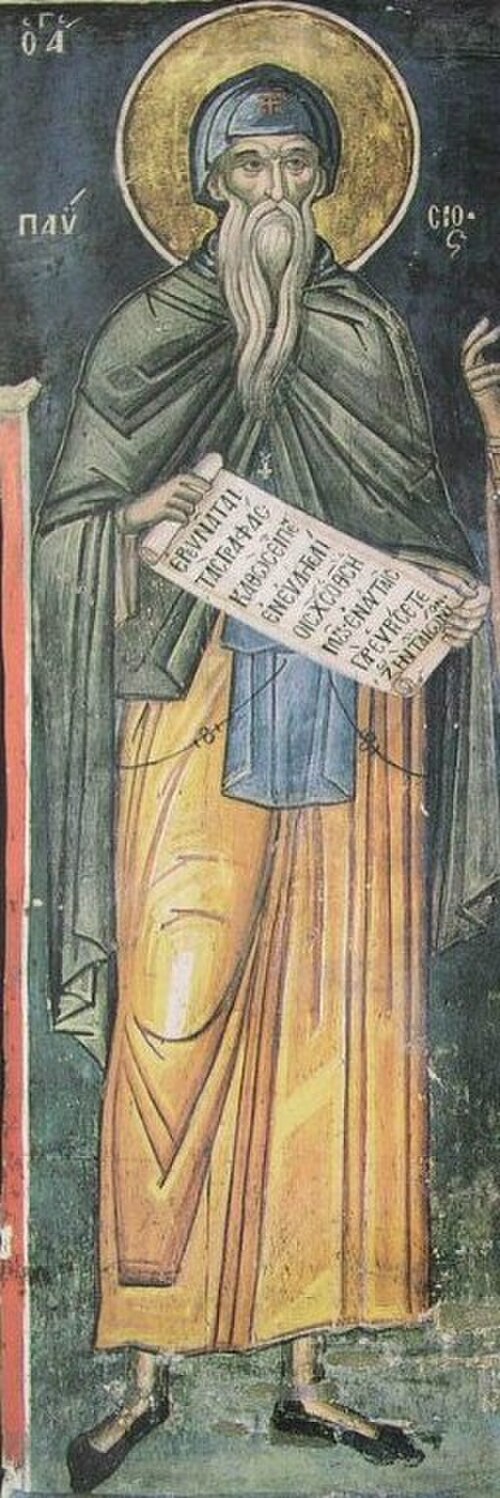
Venerable
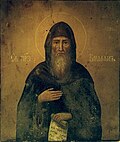
Paisius the Great
Hermit of Scetis
Desert father of Scetis in Egypt, known in Europe as Paisius the Great, who died in 417.
- Feast
- June 19old style July 2
- Reposed
- 4175th century
- Place
- Ancient Egypt
- Order
- Venerables
Life
Venerable Paisius the Great, called in the Coptic tradition Pshoi or Bishoy, was a monk of the desert of Scetis in Egypt, known for his strict asceticism and for the gifts of wisdom and wonderworking. He is believed to have been born around 320 and to have fallen asleep in the Lord in 417. The Orthodox commemorate him on 19 June and the Coptic Church on 15 July. The Copts call him the "Star of the Desert" and the "Beloved of our Good Savior."
Childhood and calling
According to the Coptic tradition, Paisius was born in the village of Shansa, in the present governorate of Minufiya, the youngest of seven brothers, weak and frail. His mother saw an angel in a vision who asked her to give one of her children to God and pointed to him; when she tried to offer a stronger one, the angel insisted that Paisius was the chosen one. The Greek and Russian tradition, however, says that he lost his parents early and was made a cleric, and later became a monk in one of the sketes of Egypt.
At twenty he went to the desert of Scetis and was tonsured a monk by Abba Pambo, who also tonsured John the Dwarf. Abba Pambo is regarded as his spiritual guide. After Pambo's death Paisius, according to the Coptic tradition guided by an angel, settled at the site of the monastery that now bears his name, and according to the Russian one withdrew deep into the desert, to a cave. There he lived as a hermit, and many monks gathered around him and took him as their spiritual father.
Asceticism and the tradition of his life
He was known for his love, wisdom, simplicity and kindness, as well as for his very strict asceticism, and he loved quiet and solitude. The Coptic tradition says that to resist sleep in his night prayers he tied his hair and hands with a rope to the ceiling of his cell. This asceticism is said to have made him so famous that Saint Ephrem the Syrian visited him. The Serbian tradition adds that he had a special gift of abstaining from food: often he did not taste bread for fifteen days, more often for a week, and once, by the witness of John the Dwarf, he lived seventy days without tasting anything. He had great battles with the spirits of wickedness, who appeared to him sometimes as they are and sometimes as angels of light.
According to his life, once while he was praying he was lifted to heaven and saw the beautiful dwellings of paradise, full of unspeakable light and joy, and the church of the firstborn, and was able to partake of the immaterial food of the Divine Mysteries.
The Coptic tradition tells that Paisius saw Christ several times. When his brethren learned that Jesus was coming, they gathered on the top of a mountain to see him. On the way they met an old man who asked them to help him, but they passed him by. Paisius saw him, carried him on his back and discovered that it was Christ, who told him that his body would not see corruption, because of the greatness of his love. The same tradition says that he washed the feet of Christ, who had come to him as a poor stranger.
The Copts also honor him as a defender of the right faith. Hearing of an ascetic in the mountain of Ansena who taught that there was no Holy Spirit, Paisius went to him with a woven basket with three handles. When the old man asked why he had made three handles, he answered, "I have a Trinity, and everything I do is in the image of the Trinity." After a long debate from the Scriptures, the old man returned to the right faith.
Death and relics
In 407 or 408, when the Mazices invaded the desert of Scetis, Paisius left and settled in the mountain of Ansena, where he met Paul of Tammah, with whom he became close friends. There he built another monastery, Saint Bishoy, at Deir el-Bersha near Mallawi, which still stands today. He fell asleep in the Lord in 417, on 15 July by the Coptic calendar, at an advanced age.
According to the Greek and Russian tradition, soon after his death Isidore of Pelusium moved his relics to Pisidia in Asia Minor, together with those of Saint Paul. The Coptic tradition says that on 13 December 841 Pope Joseph I of Alexandria moved his body, with that of Paul of Tammah, to the monastery of Saint Bishoy in the desert of Scetis. It is told that when he tried to take only the body of Paisius, the boat on the Nile would not move until Paul's body was brought too. Today both bodies lie in the main church of the Coptic monastery of Saint Bishoy in the Natrun desert. Eyewitnesses say that the body of Paisius remains incorrupt to this day.
His first life is said to have been written by John the Dwarf in the fifth century and includes, besides the story of the ascetic, the first mention of the story of the Seven Sleepers of Ephesus. He is honored in the Orthodox Church and in the Oriental Orthodox Churches, and three monasteries in Egypt bear his name.
Commemorated the same day June 19
 Jude ThaddeusApostle · The ApostleJun 19
 Paisius of HilendarVenerable · Bulgarian Athonite monkJun 19
 John of Shanghai and San FranciscoSaint · Archbishop of Shanghai and San FranciscoJun 19
 Gervasius and ProtasiusHoly MartyrsJun 19
 Deodatus of NeversSaint · Bishop of NeversJun 19
 Hildegrim of ChâlonsSaint · Bishop of ChâlonsJun 19
 Ursicinus of RavennaSaint · Archbishop of RavennaJun 19
- ZosimusMartyrJun 19
- John the Solitary of JerusalemVenerableJun 19
- Zeno of EgyptVenerable · Desert FatherJun 19
- AsyncritusHieromartyrJun 19
 Barlaam of ShenkurskVenerableJun 19