Hieromartyr
Glycerius of Nicomedia
Priest
A priest of Nicomedia, who died a martyr for Christ.
- Feast
- December 28old style January 10
- Era
- 4th century
- Order
- Martyrs
Life
Holy Hieromartyr Glycerius of Nicomedia was a priest in Nicomedia, at the beginning of the fourth century, in the time of Emperor Maximian (284-305), who had ordered that the churches of the Christians be destroyed, their service books burned and the Christians deprived of rights and offices. The bishop of the city was then Saint Cyril, whose preaching and life increased the faith, so that many of the emperor's officials were Christians in secret.
In the emperor's palace there lived a pagan priestess, Domna, who, in Maximian's absence, read the Acts of the Apostles and the Epistles of Saint Paul and came to desire to know the Christian teaching. With the help of a young Christian woman she came in secret to Bishop Cyril, accompanied by her faithful servant, the eunuch Indes. Saint Cyril catechised them, and both received Holy Baptism. Domna began to help the poor, distributing her jewels through Indes, and food from the imperial table. Learning of their unusual life, the chief of the eunuchs imprisoned them and starved them, but they were strengthened by angels. So as not to live any longer among pagans, Domna feigned madness, was removed from the palace and settled in a convent of women, with the abbess Agatha, who dressed her in men's clothes, cut her hair and let her go.
The emperor returned and ordered Domna to be sought. Soldiers reached the convent and laid it waste. The sisters were thrown into prisons, tortured and mocked, but none was defiled. Saint Theophila, given to a brothel, kept her virginity there with the help of an angel, who led her out of it. One day the emperor arranged a pagan sacrifice in the city square; when the sprinkling of the crowd with the blood of the sacrificed animals began, the Christians started to withdraw. The emperor grew angry, but did not give vent to his anger, for the earth shook. After a time Maximian entered a church and commanded the Christians to renounce Christ, threatening to burn the church and kill them. The priest Glycerius answered that Christians would never renounce their faith, whatever torments faced them. The emperor went out, restraining his anger, but soon ordered Glycerius brought to trial. The torturers tormented him, and he did not cease to pray and call on the name of the Lord. Unable to make him renounce, Maximian ordered him burned.
On the feast of the Nativity of Christ in the year 302, when about twenty thousand Christians had gathered in the cathedral of Nicomedia, the emperor sent a herald to order all to come out and sacrifice to idols, otherwise he would burn the church with those in it. No one would bow. While the tormentors were preparing the fire, Bishop Anthimus, who was serving, baptised all the catechumens and communed everyone. All twenty thousand died in the flames, among them the abbess Agatha and Theophila. Bishop Anthimus managed to hide.
Maximian thought he had destroyed all the Christians of Nicomedia, but soon learned that many remained and were ready to die for Christ. He ordered the general Zeno seized, who had denounced in public the emperor's impiety and cruelty; he was cruelly beaten and at last beheaded. The eunuch Indes was thrown into prison because he would not take part in the pagan festival. Meanwhile Domna was hiding in a cave and feeding on plants. The governor of Italy Dorotheus, Mardonius, the deacon Migdonius and several officials were thrown into prison, whom Bishop Anthimus strengthened by letters. One letter was intercepted from the deacon Theophilus, who was tortured to reveal where the bishop was, but endured every torment without disclosing anything. Then he was put to death, together with those to whom the bishop had written.
When Domna returned to the city she wept long over the burned ruins, grieving that she had not been found worthy to die with her sisters. On the seashore, fishermen drew out with their nets the bodies of the martyrs Indes, Gorgonius and Peter. Still in men's clothes, Domna helped them haul the nets, and they left the bodies to her. She looked at them with reverence, above all at the body of her spiritual friend Indes, and after the burial she did not leave the graves, censing them daily. When the emperor was told of an unknown youth who honoured the graves of the condemned Christians, he ordered his head cut off. With Domna the martyr Euthymius was also put to death.
He is commemorated on 10 January (new style), among the twenty thousand martyrs burned at Nicomedia.
Commemorated the same day December 28
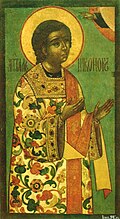 Nicanor the DeaconApostle · One of the Seven DeaconsDec 28
- Theonas of AlexandriaSaint · Patriarch of AlexandriaDec 28
 Anthony of LérinsVenerable · Hermit of the Lérins IslandsDec 28
Cornelius of KrypetskVenerable · Monk of Krypetsk MonasteryDec 28
 Arephas NasonovHieromartyr · PriestDec 28
 Paisius of PechengaVenerable Martyr · Abbot of Pechenga MonasteryDec 28
 Simon the Myrrh-streamerVenerable · Athonite monkDec 28
- Agatha of NicomediaVenerable MartyrDec 28
- Alexander DagaevHieromartyrDec 28
- Alexander TsitseronovHieromartyrDec 28
- Arcadius ReshetnikovHieromartyrDec 28
- BabylasVenerableDec 28