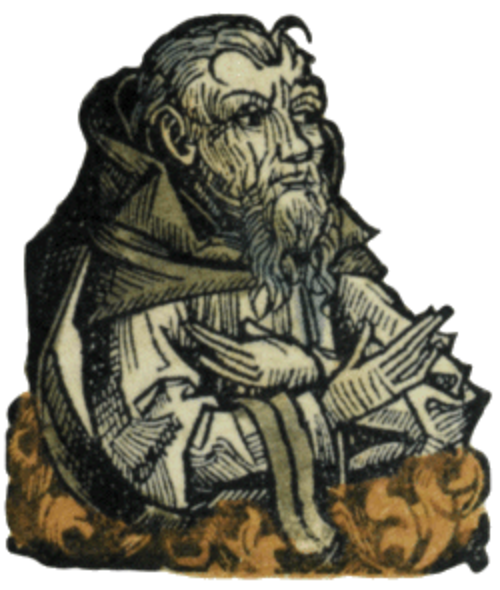
Venerable
Goar
A priest from Aquitaine and hermit on the Rhine, reposed around 649.
- Feast
- July 6old style July 19
- Reposed
- 6497th century
- Place
- Aquitaine
- Order
- Venerables
Life
Saint Goar of Aquitaine was a priest and hermit on the banks of the Rhine in the seventh century, and he reposed on 6 July 649. The place where he lived is now called Sankt Goar.
He was born around 585 into a noble family of Aquitaine and was noted for piety from his youth. After being ordained priest he became known for his forceful preaching. But he wished to serve God more discreetly, and so he went abroad to the diocese of Trier and in 618 withdrew as a hermit near the town of Oberwesel. Though he wanted solitude, the fame of his holiness spread throughout the land, and travelers sought him out for counsel.
According to tradition, two pilgrims denounced him to Rusticus, bishop of Trier, as a hypocrite who did not keep his vows of poverty and chastity. Goar was summoned to defend himself, and a miracle proved his innocence and showed the bishop guilty of the very faults of which he had accused him. In another telling, Rusticus accused him of sorcery, King Sigebert III of Austrasia cleared him at Metz, and after Rusticus was deposed the see of Trier was offered to Goar. The saint asked for time to reflect, since he did not want the burden of a bishopric, returned to Oberwesel, fell ill and died without becoming bishop. It is told that when he declined the see he hung his cloak on a sunbeam, which held it as if it were solid.
His Life was written in 839 by the monk Wandalbert of Prüm. Charlemagne is said to have built a church over the site of his hermitage, and around it grew the town of Sankt Goar on the left bank of the Rhine. He is regarded as a patron of innkeepers, potters and vine growers. He is commemorated on 6 July as a saint of the undivided Church, by the New Calendar.
Commemorated the same day July 6
 Sisoes the GreatVenerable · Hermit in EgyptJul 6
 Sexburga of ElyVenerable · Abbess of ElyJul 6
 Quirinus of TegernseeMartyr · Martyr of RomeJul 6
 Juliana of OlshankaRight-Believing · Princess of the Olshansky familyJul 6
 Romulus of FiesoleSaint · Bishop of FiesoleJul 6
 Dorotheus of RadonezhVenerable · Monk of St Sergius LavraJul 6
 Sisoes the SchemamonkVenerableJul 6
- Euthymius LyubovichevVenerable Martyr · Hieromonk of OptinaJul 6
 Vassian RyloSaint · Archbishop of RostovJul 6
- Dometios the MercifulVenerable · Archimandrite of RâmețJul 6
- Ferapont of BorovenskVenerable · Hieromonk and monastery founderJul 6
 Michael II of SmolenskSaint · Bishop of SmolenskJul 6