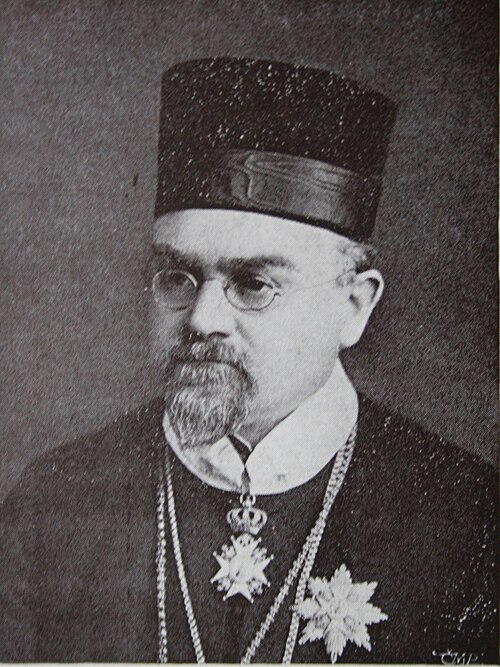
Hieromartyr
Gorazd of Prague
Bishop of Prague
Head of the Orthodox Church in Czechoslovakia, executed by the Nazis in 1942 for sheltering Heydrich's assassins.
Life
Saint Gorazd of Prague, in the world Matěj Pavlík, was born on 26 May 1879 and died a martyr on 4 September 1942. He was bishop of Moravia and Silesia, the head of the Orthodox Church in Czechoslovakia as it was renewed after the First World War. He was shot by the Nazis because he took upon himself the guilt of having sheltered, in the Orthodox cathedral of Prague, the men who had attacked Reinhard Heydrich. The Church commemorates him on 22 August by the old calendar (4 September by the new).
Youth and the turn to Orthodoxy
Matěj Pavlík was born in the Moravian village of Hrubá Vrbka, into a Roman Catholic family, one of three brothers. He finished secondary school at Kroměříž and the faculty of theology at Olomouc, and on 5 July 1902 he was ordained a Catholic priest. From youth he was drawn to the mission of Saints Cyril and Methodius and to Orthodoxy; he taught himself Church Slavonic and visited Kiev in 1900 to see the services of the Russian Church. After serving as a hospital chaplain at Kroměříž, he joined, in the new Czechoslovak state, the national movement of Karel Farský, but soon parted from it because he was drawing ever closer to Orthodoxy. The final break came on 21 June 1924.
The Serbian Orthodox Church gave him its support. In September 1921 he was tonsured a monk at Krušedol with the name Gorazd, after the disciple of Saint Methodius who succeeded him as bishop of Moravia. The choice of name pointed to the continuity with the ancient Orthodoxy of those lands, of nearly eleven hundred years before. On 25 September 1921 he was consecrated bishop of Moravia and Silesia at Belgrade by the Serbian Patriarch Dimitrije, together with other hierarchs.
Ministry
Over the following years Gorazd and his faithful organized parishes and built eleven churches and two chapels in Bohemia. He translated and printed the needed service books in Czech, and the services were held in Czech. He also helped many in Subcarpathian Rus and Slovakia who were returning to the Orthodox faith of their ancestors, which led in 1931 to the founding of the eparchy of Mukachevo and Prešov. After the Nazi occupation, in 1941 the Church was placed under the care of Metropolitan Seraphim of Berlin.
Martyrdom
On 27 May 1942 members of the Czech resistance attacked Reinhard Heydrich, ruler of the Protectorate of Bohemia and Moravia. The men who carried out the attack hid in the crypt of the cathedral of Saints Cyril and Methodius in Prague. Gorazd, who was in Berlin at the time, learned of this and asked that they move elsewhere as soon as possible, understanding the heavy burden that had fallen on the Church. On 18 June the Nazis found the hiding place after a member of the group betrayed them, and those hidden there died in the fighting with the SS.
Reprisals came quickly. The cathedral's two priests and its lay leaders were arrested. Gorazd, wishing to help the Church and its faithful, took the blame on himself, even writing letters to the Nazi authorities. He was arrested on 27 June and tortured, and on 4 September 1942 he was shot at Kobylisy together with the cathedral priests and the lay leaders. His body was burned at the Strašnice crematorium. The Orthodox Church in the Czech lands was banned and its churches closed, while Metropolitan Seraphim courageously refused to issue a statement condemning Bishop Gorazd. The reprisals went much further, with mass arrests and the destruction of the village of Lidice. Only after the war could the Church serve again.
Veneration
In 1945 the executed clergy received posthumously the cross In Memoriam. The Serbian Orthodox Church glorified him among the new martyrs on 4 May 1961, and the Church in Czechoslovakia on 24 August 1987, in the cathedral at Olomouc, which bears his name. In 1992 a monastery for men was founded in his native Hrubá Vrbka, and streets and squares in Prague, Olomouc and Brno bear his name.
Commemorated the same day August 22
 AriadneRight-Believing · Byzantine empressAug 22
 Symphorian of AutunMartyr · Martyr of AutunAug 22
 AgathonicusMartyrAug 22
- Alexis OrlovHieromartyr · Archbishop of OmskAug 22
- Isaac of OptinaVenerable · Abbot of OptinaAug 22
- Theodore SmirnovHieromartyr · Bishop of PenzaAug 22
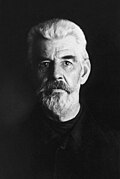 Basil SmirnovHieromartyr · PriestAug 22
- Bogolep of UglichVenerableAug 22
- Acindynus of PotamiaMartyrAug 22
- Adrian Vozhakov of OleksandriiaHieromartyrAug 22
- Alexander RatkovskyHieromartyrAug 22
- Alexis NaumovHieromartyrAug 22