Venerable
Isaac of Optina
Abbot of Optina
Schema-archimandrite, abbot of Optina and one of its fourteen elders, born in Kursk, who died in 1894.
- Feast
- August 22old style September 4
- Reposed
- 189419th century
- Place
- Optina Pustyn
- Order
- Venerables
Life
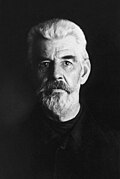
Venerable Isaac I of Optina (in the world Ivan Ivanovich Antimonov, 31 May 1810 to 22 August 1894) was a schema-archimandrite, abbot of Optina for thirty-two years and one of its fourteen elders. He was born at Kursk. He is commemorated on 22 August and on 11 October, in the synaxis of the Venerable Elders of Optina, Old Style (4 September and 24 October New Style). He was glorified locally on 26 July 1996, and in 2000 was numbered among the saints for veneration in the whole Russian Church.
Childhood and the road to the monastery
He was born at Kursk, into a family of well-to-do and well-known merchants. Ivan was the fifth and last child of his father's first marriage, of Ivan Vasilyevich to Anna Puzanova; in all the family had thirteen children. The parents, brought up in the Christian spirit, kept a strict, patriarchal life. A tradition is kept that in 1809 his father went on pilgrimage to Kiev, where the old hieromonk Parthenius greeted him at the entrance with the words that blessed is the womb that will bear a monk; so he foretold the fate of the son not yet born. From youth Ivan was modest, loved solitude and avoided games and amusements. He went to church with longing, loved church singing, in which he took part, and on feasts made choirs at home. After one more failed match he judged that this was God's ordering. In 1847, after informing his father by letter, he left for Optina, then led by Venerable Moses. They sent him to the skete. He worked with the brothers at various labours: at the apiary, he baked bread, was cook, mowed, dug potatoes, bound books. After a year he went home, to Kursk, and asked his father's forgiveness for his self-willed act, thus making peace with him.
Monk and abbot
On 5 October 1854 he was tonsured into the mantle and received the name Isaac. Because of his humility and gentleness, without desire for glory, he tried to escape the fame of the world and avoided even the priesthood; only at the urging of his spiritual father, Elder Macarius, he consented, against his will, to be ordained: deacon on 19 June 1855, then hieromonk on 8 July 1858. In 1860 Elder Macarius, at a meeting with Metropolitan Philaret of Moscow, expressed his wish that Isaac be named abbot after the death of Moses, and received consent. Macarius died on 7 September 1860, and two years later, in 1862, Moses also died. Isaac became abbot and took on the burden of governing the monastery. He was raised to hegumen by the Holy Synod on 8 September 1864.
In the thirty-two years of his leadership he set right the material state of the monastery and carried to completion all the works begun before him: he finished the church of All Saints at the new cemetery, enlarged the Kazan cathedral on the porch side and made a new iconostasis, choir stalls and a room for the sacristy, and the wall painting was renewed. Outside the monastery a hospital with a pharmacy was built and, at it, a church of Venerable Hilarion the Great. He made in the monastery its own candle factory, raised buildings for the bookshop, for a new guesthouse and a house for pilgrims, the poor and needy, for the bakery, for the abbot's kitchen, a laundry, and rebuilt many other buildings. Orchards and gardens were planted at the monastery. Through the idea of Elder Ambrose, 12 km north of Optina, near the village of Shamordino, the convent of Shamordino was founded.
The end and the relics
Toward the end of his life he grew visibly weak and received in his cell tonsure into the schema. He died on 22 August 1894 and was buried on 24 August in the north chapel of the Kazan cathedral of Optina. In 1995, during restoration work in the cathedral, his relics were found on 13 February, moved with the blessing of Patriarch Alexy II to the Vvedensky cathedral, and after the works were finished were brought back to the Kazan cathedral. On 26 July 1996 he was glorified in the synaxis of the Elders of Optina and numbered among the locally venerated saints; the jubilee Council of Bishops of 2000 glorified him for veneration in the whole Church. A particle of his relics is in the cathedral of the Great Martyr Catherine at the Yekaterininskaya Hermitage. His teaching, kept in two short sayings, urges us to live by conscience and ask the help of the Queen of Heaven, and then all will be well, and to love God, neighbour and the Church, seeking in service and in prayer heavenly blessings, not earthly ones.
Commemorated the same day August 22
 AriadneRight-Believing · Byzantine empressAug 22
 Gorazd of PragueHieromartyr · Bishop of PragueAug 22
 Symphorian of AutunMartyr · Martyr of AutunAug 22
 AgathonicusMartyrAug 22
- Alexis OrlovHieromartyr · Archbishop of OmskAug 22
- Theodore SmirnovHieromartyr · Bishop of PenzaAug 22
 Basil SmirnovHieromartyr · PriestAug 22
- Bogolep of UglichVenerableAug 22
- Acindynus of PotamiaMartyrAug 22
- Adrian Vozhakov of OleksandriiaHieromartyrAug 22
- Alexander RatkovskyHieromartyrAug 22
- Alexis NaumovHieromartyrAug 22