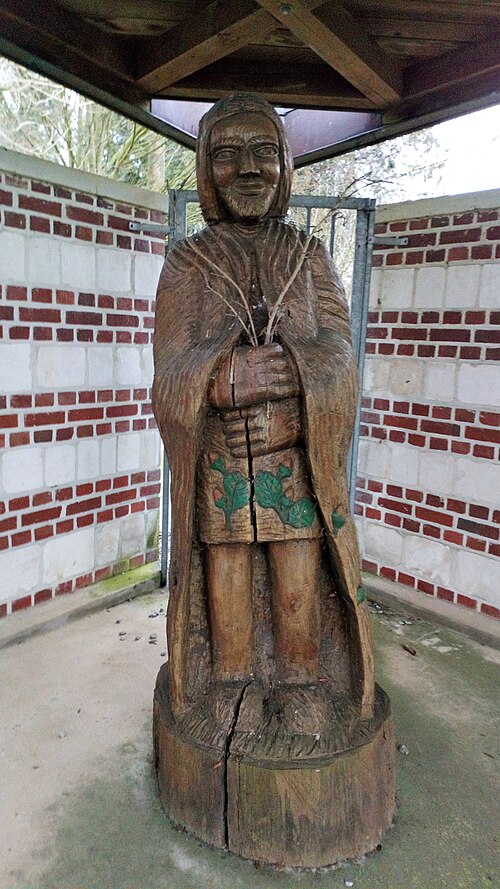
Saint
Gratian
A saint venerated at Amiens, who died around 303, remembered in the calendars of the Church.
- Feast
- October 23old style November 5
- Reposed
- 3034th century
- Place
- Saint-Gratien
Life
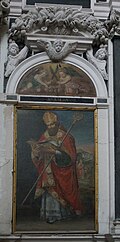
Saint Gratian of Amiens was a Christian martyred in the year 303, in the persecution of Diocletian. Little is known of him. According to tradition, he was born in the third century at Rome in a senatorial family, embraced Christianity and left to preach in Gaul, settling in a small village of Gallia Belgica near Amiens, where he became a shepherd. The prefect Rictiovarus, charged with persecuting Christians, arrested him, put him to torture and condemned him to death after Gratian refused to sacrifice to the Roman gods. He was beheaded in 303.
His body was buried at the place of his torment. According to the legend, before the executioner's blow Gratian planted his shepherd's staff in the ground and a spring welled up; according to another version, the staff was planted by the inhabitants after his death, and in one night it took root and bore blood-red fruit on his grave. The miracle is said to have repeated each year on the night of 23 October, the day of his commemoration (new style). His relics were moved in 1015 to the abbey of Notre-Dame de Coulombs; an arm was given to a parish that took the name Saint-Gratien, near Montmorency, and in 1770 the head was brought back to Picardy, to the church of Saint-Gratien (Somme), where a calvary at the supposed site of the martyrdom bears an inscription about his death on 23 October 303.
Commemorated the same day October 23
 James, Brother of the LordHieromartyr · First Bishop of JerusalemOct 23
 Ignatius of ConstantinopleSaint · Patriarch of ConstantinopleOct 23
 Severin of CologneSaint · Bishop of CologneOct 23
 Theodoret of AntiochHieromartyr · Priest of AntiochOct 23
 Elisha of LavrishevVenerable · Founder of Lavrishev MonasteryOct 23
 Jacob of BorovichiFool-for-Christ · Fool for ChristOct 23
 Vladimir AmbartsumovHieromartyr · PriestOct 23
- Constantin SârbuHieromartyr · Priest of BucharestOct 23
- Simeon of Volodymyr-VolynskyiVenerable · Bishop of Volodymyr-VolynskyiOct 23
- Aethelflaed of RomseySaintOct 23
- Alexander SolovyovHieromartyrOct 23
 Amon of ToulSaint · Bishop of ToulOct 23