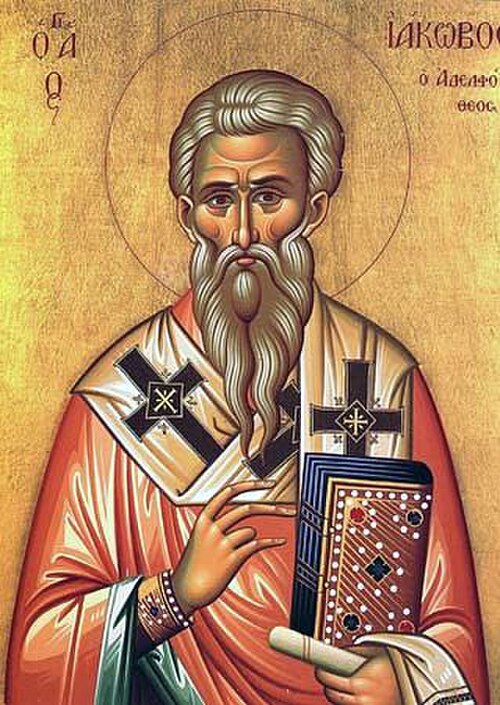
Hieromartyr
James, Brother of the Lord
First Bishop of Jerusalem
Kinsman of the Lord, first bishop of Jerusalem, killed around the year 62.
- Feast
- October 23old style November 5
- Reposed
- 621st century
- Place
- Jerusalem
- Order
- Martyrs
Life
Saint James, Brother of the Lord, also called James the Just, was the first bishop of Jerusalem, one of the Seventy Apostles and the author of the catholic Epistle that bears his name. The Church calls him "brother of the Lord" and hieromartyr, because he received the crown of martyrdom at Jerusalem around the year 62. She commemorates him on 23 October, and on the Sunday after the Nativity of the Lord, together with the Prophet David and Saint Joseph.
The Brother of the Lord
The Gospels of Mark and Matthew name James, Joses, Simon and Judas as brothers of Jesus, together with sisters (Mark 6:3; Matthew 13:55). The Orthodox Church teaches that they were not children of the Mother of God, but sons of Joseph by an earlier marriage, as the Protoevangelium of James tells; so James is called "brother of the Lord" according to the law. In the Roman Catholic Church the saint is usually identified with James the son of Alphaeus, and in other traditions he is counted a cousin of the Lord. The Orthodox Church distinguishes him from the Apostle James the son of Alphaeus, as from the Apostle James the son of Zebedee, following the Gospel (where the brothers of the Lord are set apart from the Twelve) and the writings of Eusebius of Caesarea, Cyril of Jerusalem, Epiphanius of Cyprus and Jerome.
James did not follow the Lord during His public ministry. Saint Paul writes, however, that the risen Jesus appeared to him (1 Corinthians 15:7). According to tradition, the Lord Himself appointed him bishop of Jerusalem. Paul tells that three years after his conversion he went up to Jerusalem and met Peter and "James the Lord's brother" (Galatians 1:18 and 19). He later names him, with Peter and John, as one of the "pillars" of the Church (Galatians 2:9).
Bishop of Jerusalem
James did not travel to foreign lands like the other apostles. He stayed in Jerusalem, teaching and serving for about thirty years, and was for many a father of the mother Church. When Peter escaped miraculously from prison, he sent word: "Tell this to James and to the brothers" (Acts 12:17). James had a decisive part in the Apostolic Council at Jerusalem, around the year 50. After Peter, Paul and Barnabas, he spoke last and proposed that the Gentiles who turn to God should not be burdened with the law of Moses, but should abstain from things sacrificed to idols, from blood, from strangled animals and from fornication (Acts 15). His decision was accepted by the apostles and elders and sent to all the Churches. When Paul came to Jerusalem for the last time, he went to James, and the elders told him how many thousands of Jews had believed (Acts 21:18 and 20).
His ascetic life
Eusebius of Caesarea, following Hegesippus, writes that James was holy from his mother's womb, drank no wine or strong drink, ate no meat, did not cut his hair, did not anoint himself with oil, did not bathe and wore only linen. He would enter the temple alone and pray on his knees for the people, so much that his knees became hard like a camel's. Because of his life all called him "the Just" and "bulwark of the people", not only Christians but Jews too.
Martyrdom
His great influence disturbed the Jewish chief priests. Around the year 62, in the interval between the death of the governor Festus and the arrival of his successor, Albinus, the high priest Ananus, a Sadducee, assembled the Sanhedrin. The historian Josephus writes that James, "the brother of Jesus who was called Christ", was handed over to be stoned. Hegesippus, who wrote in the second century, tells it otherwise, and the tradition of the Church has kept mostly his account.
According to it, the scribes and Pharisees led him to the pinnacle of the temple and asked him about the Crucified One. James answered in a loud voice that the Son of Man sits in heaven at the right hand of the Power and will come on the clouds of heaven. The crowd of Christians cried "Hosanna to the Son of David", and the scribes threw him down. James was able to rise to his knees and prayed: "Lord, forgive them, for they know not what they do." His enemies began to stone him. A priest of the Rechabites cried: "What are you doing? The Just One is praying for you." At that moment a fuller struck him on the head with his club and killed him. Many Christians were killed with him.
It is said that he was buried near the temple. Josephus, naming the causes of the fall of Jerusalem a few years later, mentions also the killing of James the Just.
The Epistle and the Liturgy
The Epistle of James is one of the seven catholic epistles. It was written to comfort and strengthen the Israelites who had believed in Christ and to guard them from the wrong thought that faith alone is enough: "Faith apart from works is dead" (James 2:26). From him also comes the exhortation: "Be doers of the word, and not hearers only" (James 1:22). The Epistle also speaks of the anointing of the sick with oil.
Tradition attributes to Saint James the most ancient order of the Divine Liturgy, called the Liturgy of Saint James, which Jerusalem still serves on his day. From it, in later times, the liturgies of Saint Basil the Great and Saint John Chrysostom developed.
Veneration
The troparion of the Church honours James as a disciple of the Lord, as a martyr, as a brother of the Lord with boldness in prayer and as a hierarch. He is commemorated on 23 October, on the Sunday after the Nativity of the Lord together with David and Joseph, and on 4 January in the Synaxis of the Seventy Apostles. The church of Saint James at Jerusalem is visited by pilgrims today.
Commemorated the same day October 23
 Ignatius of ConstantinopleSaint · Patriarch of ConstantinopleOct 23
 Severin of CologneSaint · Bishop of CologneOct 23
 Theodoret of AntiochHieromartyr · Priest of AntiochOct 23
 Elisha of LavrishevVenerable · Founder of Lavrishev MonasteryOct 23
 Jacob of BorovichiFool-for-Christ · Fool for ChristOct 23
 Vladimir AmbartsumovHieromartyr · PriestOct 23
- Constantin SârbuHieromartyr · Priest of BucharestOct 23
- Simeon of Volodymyr-VolynskyiVenerable · Bishop of Volodymyr-VolynskyiOct 23
- Aethelflaed of RomseySaintOct 23
- Alexander SolovyovHieromartyrOct 23
 Amon of ToulSaint · Bishop of ToulOct 23
- Antonia TimofeevaVenerable MartyrOct 23