Hieromartyr
Gregory Pospelov
A hieromartyr of the Russian Church, commemorated in the Orthodox calendar.
Life
Holy Hieromartyr Gregory Pospelov, an archpriest, was born on 12 December 1877 in Saint Petersburg, in the family of Ioann Pospelov, a singer of the Court Chapel, later ordained deacon and who ended his life as deacon of the Naval Epiphany church in Kronstadt. Gregory studied at the Alexander Nevsky theological school in Petersburg, then at the Petersburg theological seminary, which he finished in 1900. That same year his father died, and on 11 June 1900 Gregory was ordained deacon at the Naval Epiphany church. Besides the services, he was teacher of religion at the Port school, at the primary school of the Kronstadt city police and at the parish school of the Holy Trinity Temperance Society. In 1905 a prayer house of the Society was built, and from 1909 it was attached to the Naval Epiphany church. In 1913 the newly built cathedral, the magnificent church of Saint Nicholas, was consecrated, and Father Gregory began to serve there too as deacon.
The prayer house of the Temperance Society, with its services and readings in which Deacon Gregory Pospelov took an active part, drew up to a thousand people on Sundays, mostly workers of the Kronstadt port. The Society's parish school had been opened in 1908, and later a new building was put up, in whose construction the deacon took part. From 1908 he was assistant head of the Society, and in 1917 its head. In 1917, after the retirement of one of the priests of the Epiphany cathedral, the Society petitioned the church authorities that Deacon Gregory be ordained to that vacancy; on 15 October 1917 he was ordained priest at the Epiphany cathedral and soon after raised to archpriest.
In March 1921 the sailors of the Kronstadt garrison rose against the Bolsheviks. After the fighting and the first casualties, Archpriest Gregory was asked to conduct the funeral of those killed. After the suppression of the uprising, the Bolsheviks began searches and arrests. On 25 March his flat was searched and some papers were found, about which one of the soldiers testified: in a cupboard of children's books, under the books, in a folder of papers with children's papers and schoolwork, a printed correspondence in which the names of the leaders were mentioned with mockery. When the papers were shown to Gregory, he categorically denied them.
After the search he was imprisoned in the naval investigative prison of Kronstadt. At the interrogation the next day he said that he had not taken part in the uprising, but had performed his priestly duties when needed. Asked why he was arrested, he said he did not know. Accused of agitation against Soviet power, he answered that he had never carried on any agitation and had preached no sermons in favour of the revolutionary committee, only church talks. He said he had been present only at a memorial service in the hospital and those at the naval cathedral, where he did not preach; that there was no bell ringing and the clergy did not accompany the procession to the graves. He said he had treated Soviet power conscientiously, carried out its decrees exactly and made no agitation even when he received the minimum ration of a quarter pound of bread, and that he had not considered the uprising a revolution but was indifferent to it. About the papers found, which mocked the leaders, he again said they were not his. The Cheka officers removed them from the file, from which it may be supposed that they had been planted in his flat, since his other papers, of non-political character, were attached to the file. Immediately after the interrogation, the investigator found him guilty of agitation.
The extraordinary revolutionary troika sentenced him to death. Archpriest Gregory Pospelov was shot almost immediately after the sentence, in the yard of the naval investigative prison of Kronstadt. During the execution he held tightly in his hands the cross, which, despite the orders and blows of the soldiers, he did not give up.
He is commemorated on 26 March, on 7 February, in the Synaxis of the New Martyrs and Confessors of the Russian Church, and on 11 July, in the Synaxis of the Saints of Saint Petersburg (new style, the last two being movable days).
Commemorated the same day March 13
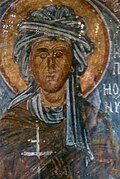 Helena DragašVenerable · Byzantine EmpressMar 13
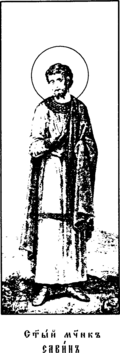 Sabinus of HermopolisMartyr · Martyr of EgyptMar 13
- Christina of PersiaMartyr · Persian noblewomanMar 13
 Cassian the RecluseVenerable · Recluse of the Kiev CavesMar 13
- Gerald of MayoVenerableMar 13
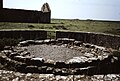 Mochoemoc of LiathmoreVenerable · Abbot of LiathmoreMar 13
- Africanus of CarthageMartyrMar 13
- Alexander of MacedoniaMartyrMar 13
- Alexander of PydnaMartyrMar 13
- AltheusSaintMar 13
- Ansovinus of CamerinoSaint · Bishop of CamerinoMar 13
- CoincheandSaintMar 13