Venerable
Herman of Stoloben
Venerable of Stoloben
A venerable father of the Russian Church at Stoloben, who died in 1614.
- Feast
- February 22old style March 7
- Reposed
- 161417th century
- Order
- Venerables
Life
Holy Venerable Herman of Stoloben († 1614) was a hieromonk of the brotherhood of the Saint Nicholas monastery at Rozhki and the founder of the Nilov Hermitage on the island of Stoloben. He is numbered among the saints of Novgorod and commemorated on 11 July (new style, a movable day).
His calling
The small island of Stoloben, hallowed by the prayers and labours of Venerable Nil, became the place of the hermit's eternal rest. It drew those seeking salvation, from near and far, and some stayed beside Nil's grave for months and even years. One such pilgrim was Hieromonk Herman. He is thought to have been born in the first half of the sixteenth century. It is certain that he never met Nil, either in childhood or in youth.
He came to the Saint Nicholas monastery at Rozhki, though it is not known whether with his parents' blessing or after their death. As a novice he listened to the old-timers' stories, and his heart was drawn to the hermit's cell on the island. The hegumen did not at first give his blessing, for such a labour was beyond a beginner: he had to learn humility and obedience among the brethren. After a time not known he was tonsured with the name Herman and ordained hierodeacon, then hieromonk. He greatly revered Nil of Stoloben and composed his life from the accounts of others, among them those of his own forebears, devout people who had passed on to their grandson their love for the hermit of Stoloben.
The hermitage of Nil
Herman visited the island many times, both to enjoy in thought a communion with the saint resting there and to check what he had heard of him against the testimonies of various people. He always found worshippers there, monks and laity, and some lived there for a time. On one of these visits he met Hegumen Anthony, a monk from a Novgorod monastery. They lived together for three years, renewed the chapel over Nil's grave, made a tomb over the grave and covered it with a pall. In those years many miracles took place at Nil's grave: those possessed by evil spirits and the gravely ill were healed, and those who committed sacrilege were punished.
The number of pilgrims kept growing, and Herman wished to build a church. In 1591 to 1594, with the blessing of Metropolitan Alexander of Novgorod, a wooden church of the Theophany was built, with a side chapel of Saint Basil the Blessed, fool for Christ. Some of those already living there or newly arrived wished to stay as monks and built themselves wooden cells. Herman then petitioned Patriarch Job of Moscow to open a monastery with a communal rule, after the pattern of the ancient monasteries of Palestine.
The monastery was opened by the patriarch's charter in 1594 and received the name Nilov Hermitage. Its first superior was Herman, with the title of builder (stroitel). In 1595 two icon-painting monks, Job and Nifont, came from the Orshin monastery in Tver, and, following the account of elders who had known Nil and remembered his face, painted the first icon of the saint on a board.
The life of Nil
Herman had long since gathered and briefly set down information on the life of Nil, but, not skilled enough in writing, he looked for a writer. In 1596 a cleric, Mitrophan, told him of Philotheus Pirogov, a monk at the Gerasimov hermitage, who had heard from travellers of Nil's labours and wished to write his life but lacked information. Herman sent him his notes, and in 1598, being in Moscow for the election of Boris Godunov as tsar, he also sent through Hegumen Theoctistus the list of miracles worked after the saint's repose. On this basis Philotheus wrote the life of Nil, with stichera and a canon. From that time an annual local feast of Venerable Nil was established, on 20 December.
As hegumen
Life at Nilov Hermitage was hard. At the beginning of the seventeenth century the hegumen and brethren suffered much from poor harvests, famine and the devastation of villages by the Lithuanians and the Swedes. Yet the monastery held on. It had the church of the Theophany with a bell tower, Nil's chapel, a refectory, six cells and a granary, but as yet no land of its own; the brethren numbered about twelve. Herman acquired the first sacred vessels and vestments and laid the beginning of the library.
He was also the first historian of the hermitage: he left a Spiritual Memorial, in which he listed in detail all the acquisitions of the monastery and all the icons of the church, the chapel and the refectory. From it we learn that he bought a courtyard in Ostashkov, where he set up a cell and a refectory, probably the monastery's first dependency there.
Repose and veneration
Venerable Herman reposed on 7 March 1614 and was buried at the Nilov Hermitage. He was numbered among the locally venerated saints, and his name entered the paterikons of Novgorod. His first icon was painted in 2005 by Archpriest Anatoly Volgin for the opening of the church of Saints Nil and Herman of Stoloben in the village of Sosnitsa.
Commemorated the same day February 22
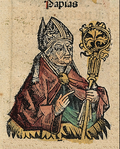 Papias of HierapolisSaint · Bishop of HierapolisFeb 22
- Avilius of AlexandriaSaint · Patriarch of AlexandriaFeb 22
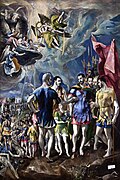 Exuperius of AgaunumMartyr · Standard-bearer of the Theban LegionFeb 22
- Thalassius of SyriaVenerableFeb 22
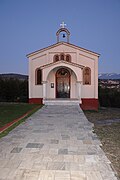 BaradatesVenerable · Hermit in SyriaFeb 22
- LimnaeusVenerable · Syrian hermitFeb 22
- Adarnase of KolaiMartyrFeb 22
- AnthusaMartyrFeb 22
- AristonSaint · Bishop of ArsinoeFeb 22
- Athanasius the ConfessorConfessorFeb 22
- Bakar of KolaMartyrFeb 22
- Barbara LosevaMartyrFeb 22