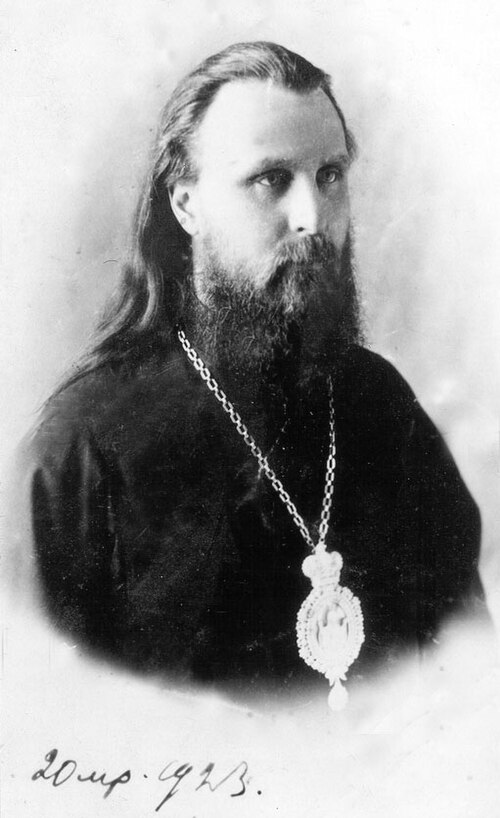
Hieromartyr
Hilarion Troitsky
Archbishop of Vereya
Archbishop of Vereya, born in 1886, who died in December 1929 at Leningrad in Soviet custody.
Life
The Holy Hieromartyr Hilarion Troitsky, in the world Vladimir Alexeyevich Troitsky, was Archbishop of Vereya, a vicar bishop of the Moscow diocese, a theologian, preacher and spiritual writer. A close helper of Saint Patriarch Tikhon, he passed through prisons and the Solovki camp and died in 1929 in Leningrad on his way into exile. The Russian Orthodox Church numbered him among the saints in 1999.
Childhood on the Oka
He was born on 13 September 1886 (25 September New Style) in the village of Lipitsy in the Kashira district of Tula province (now in Moscow region), into a priest's family. He learned Church Slavonic early, and at the age of five he was already reading the Hours and the Six Psalms in church.
In one of his writings he recalled his birthplace with great warmth. He described climbing the hill behind the village and seeing the Oka valley for dozens of versts, where in the distance only the churches stood out, red and white, with the bell towers of Kashira on the horizon. At Pascha, he wrote, the joyful peal of bells carried over the water from both banks, as though two dioceses were joined in one hymn, and his eyes filled with tears.
Studies and teaching
He graduated from the Tula theological school in 1900, the Tula seminary in 1906 and the Moscow Theological Academy in 1910, earning the degree of candidate of theology for a thesis on the history of the dogma of the Church. He was considered the best student the academy had seen in fifty years and received the prizes of Metropolitans Macarius and Joseph of Moscow for his work.
He stayed at the academy to prepare for a professorship and from August 1911 taught New Testament studies. In December 1912 he defended his master's thesis, "Essays from the History of the Dogma of the Church", which received the Macarius Prize. In these years he also published studies such as "Christianity or the Church", "Gnosticism and the Church in Relation to the New Testament", "The Trinity of the Godhead and the Unity of Mankind" and "Repentance in the Church and Repentance in Catholicism".
After his defence he travelled to Kiev and Zhytomyr, where he met Bishop Procopius (Titov), to whom he was very close. Together they often visited Archbishop Anthony (Khrapovitsky), whom he deeply respected.
Monk and professor
On 28 March 1913 he was tonsured a monk with the name Hilarion at the Paraclete Skete near the Holy Trinity Lavra of Saint Sergius. On 11 April he was ordained hierodeacon, on 2 June, the feast of Pentecost, hieromonk, and on 5 July he was raised to the rank of archimandrite. He was the youngest archimandrite and professor in Russia at the time.
From May 1913 he was inspector of the academy, and from December of that year an extraordinary professor in the chair of the New Testament. In 1917 he led the academy for several months as acting rector. During the First World War he took part in missionary work and, at the request of the Holy Synod, wrote twenty-four polemical leaflets against the Uniate movement, printed in six hundred thousand copies. In 1915 he received the Order of Saint Anna, second class.
Teaching on the Church
His theological works are devoted above all to the doctrine of the Church. Grounded in Scripture and the Holy Fathers, he saw the Church as a "union of love", a living organism, the mystical Body of Christ, whose members are united by a common life of grace whose name is love.
He held that the Orthodox Church is the one, holy, catholic and apostolic Church and that the West had fallen away from it in 1054. He was a convinced Slavophile and reproached the Russian intelligentsia for breaking with the Church and with their roots through the Western culture and education imposed since the time of Peter the Great. He criticized scholasticism and called for theology to be cleansed of foreign influence.
At the Council of 1917
Archimandrite Hilarion was an ardent supporter of the restoration of the patriarchate. In October 1917 he told his students that the time had come when the patriarch's crown would be not a royal crown but rather the crown of a martyr and confessor.
He was a member of the Local Council of the Russian Church of 1917-1918 and reporter of its department on the higher church administration. On 23 October 1917 he gave a celebrated speech in defence of the patriarchate, arguing that it is the fundamental law of the higher government of every local Church. He compared the empty patriarchal seat in the Dormition Cathedral of the Kremlin to a "wailing wall", where Russian believers had wept for two hundred years over the church freedom lost under Peter the Great. His speech played an important part in the Council's decision to restore the patriarchate.
Beside Saint Patriarch Tikhon
After the election of Saint Tikhon, Hilarion became his secretary and chief adviser on theological questions. He continued to serve at the academy as well, lecturing even after regular classes ceased in 1919.
In March 1919 he was arrested and held for about three months in Butyrka prison. He wrote to those close to him that three professors shared his cell and gave lectures from time to time, and that he had spent those months profitably, even more interestingly than in freedom.
In the spring of 1920 he was appointed superior of the Sretensky Monastery in Moscow. In late May 1920 he was consecrated Bishop of Vereya, vicar of the Moscow diocese, by Patriarch Tikhon. At his nomination he said that the Church stands unshaken, adorned with the blood of new martyrs, and that it had given more martyrs and confessors than traitors. Despite his many duties he served often in the churches of the Vereya district.
On 22 March 1922 he was arrested again and exiled for a year to Arkhangelsk. On his return in 1923 Patriarch Tikhon raised him to the rank of archbishop. He negotiated with the authorities on behalf of the Church, took part in public debates with atheists, and when many Renovationists began returning to the Church, he drew up a rite of repentance and himself heard the confessions of hundreds of priests and laypeople. Thanks to him, church life in Moscow was restored in a very short time.
Prisoner of Solovki
In November 1923 the archbishop was arrested and sentenced to three years in the camps, although Patriarch Tikhon wrote asking for his case to be reviewed and for his release. In January 1924 he reached the transit camp on Popov Island, and in June he was taken to the Solovki Special Purpose Camp. There he knitted nets and fished, worked as a forester while living in the Chapel of Saint Barbara, and served as a watchman at the Skete of Saint Philip.
Those who were with him bore witness to his complete lack of possessiveness, his simplicity, humility and childlike meekness; he gave away whatever he had to anyone who asked. The writer Boris Shiryaev, himself a prisoner, recalled that even the guards never allowed themselves coarse jokes in his presence and that no one ever called him by mocking nicknames, while some even addressed him as "Vladyka".
Another prisoner, the priest Paul Chekhranov, said that many saw in him a spiritual father and that to souls poisoned by unbelief he was a missionary. Word of his work in the camp reached the Russian emigration.
The test at Yaroslavl
At that time the Soviet authorities were preparing a new schism in the Church, to be led by Archbishop Gregory (Yatskovsky) of Yekaterinburg. In July 1925 Hilarion was moved to the political isolation prison in Yaroslavl, where he was given a separate cell, books and the chance to work, and was asked to join the Gregorians in exchange for freedom. He refused, regarding them as schismatics, and told the other prisoners about the offer.
For revealing the conversation he was sentenced in November 1926 to another three years at Solovki. Back on the island, he joked that he had been made to "repeat the year".
He was one of the authors of the "Memorandum of the Solovki Bishops" of 1926, which described the systematic persecution of the Church, condemned Renovationism and called for the honest application of the separation of Church and state, so that the Church might act without the tutelage of officials. He had reservations about the Declaration of Metropolitan Sergius (Stragorodsky) but firmly upheld the need to keep canonical and prayerful unity with him. He wrote that he had no sympathy at all for those who separated, and that an administrative measure, even a mistaken one, is no ground for schism.
His death
In October 1929 he was sentenced to three years of exile in Central Asia. He was transported from prison to prison, robbed on the way, and fell ill with typhus. He reached Leningrad in high fever, dressed only in rags, and was put in prison there; a day later he was sent to a hospital, to which he was forced to walk.
He died a few days later, on 28 December 1929 (15 December Old Style). In his delirium he said that now he was completely free. The doctor present testified that the archbishop thanked God and rejoiced at his approaching meeting with Him.
Metropolitan Seraphim (Chichagov) of Leningrad obtained permission to bury him as befitted a bishop. His relatives and friends could hardly recognize him, for the years of camps had turned a young man into a grey-haired elder. He was buried in the cemetery of the Resurrection Novodevichy Convent in Leningrad, and in the 1990s his grave became a place of prayer.
Glorification and veneration
Saint Hilarion was glorified by the Russian Orthodox Church in 1999, and in the same year his relics were uncovered and translated to the Sretensky Monastery in Moscow, which he had once led. He is commemorated on 15 December (28 December New Style), the day of his repose, and in the Synaxis of the New Martyrs and Confessors of the Russian Church.
Commemorated the same day June 17
 Hervé of BrittanySaint · Breton saintJun 17
- Hypatius of BithyniaVenerable · Abbot near ChalcedonJun 17
 ManuelMartyrJun 17
 Himerius of CremonaSaint · Bishop of CremonaJun 17
- Manuel, Sabel and IsmaelHoly MartyrsJun 17
 Shalva of AkhaltsikheMartyr · Duke of AkhalkalakiJun 17
 PapinusSaintJun 17
- Averky SeverovostokovHieromartyr · Priest of UfaJun 17
- Ananias of NovgorodVenerable · Icon painter of Antoniev MonasteryJun 17
- PiorVenerableJun 17
- Joseph the AnchoriteVenerableJun 17
- Maxim PopovVenerable Martyr · HieromonkJun 17