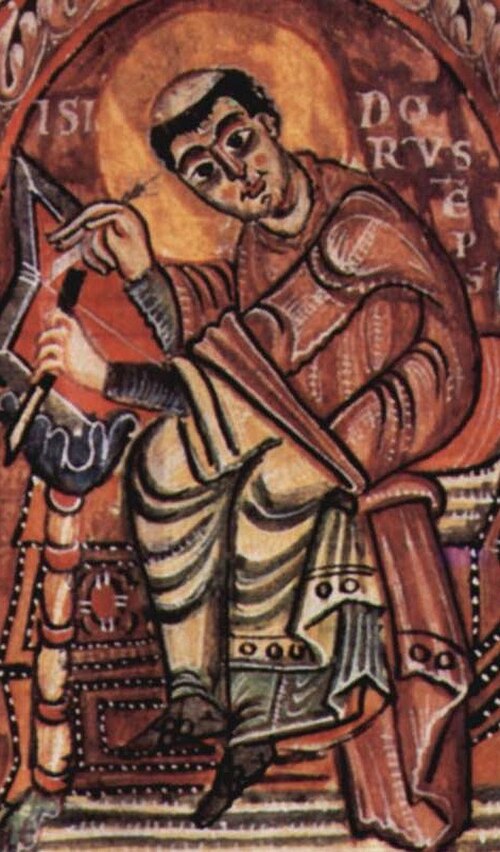
Saint
Isidore of Seville
Archbishop of Seville
Archbishop of Seville in Visigothic Spain, a learned encyclopedist, author of the Etymologies.
Life
Saint Isidore of Seville was archbishop of Seville in Visigothic Spain from 600 to 636, a learned hierarch called "the last scholar of the ancient world". The Orthodox Church remembers him on 4 April as a saint of the undivided Church.
Family and education
He was born around 560 (saint.gr gives 565 to 570) at Cartagena in Spain, to Severianus and Theodora, a family related to the Visigothic royal house. His brother Leander was bishop of Seville, his brother Fulgentius bishop of Astigi, and their sister Florentina a nun; all are honoured as saints. Orphaned young, he was raised by his elder brother Leander and studied at the cathedral school of Seville, mastering classical Latin and gaining some Greek and Hebrew.
Bishop of Seville
After Leander's death in 600 or 601, Isidore succeeded him on the throne of Seville. Both brothers worked for the passage of the Visigothic kings from Arianism to the Orthodox faith, in the time of Reccared after Liuvigild. As bishop he showed himself a protector of monks, though he is not known to have been a monk himself, and he pronounced anathema on clergy who wronged monasteries. He sought to unite the peoples of the Gothic kingdom into one nation and put teaching at the service of this aim.
He presided over the Second Council of Seville in November 619, whose acts set forth the nature of Christ against the Acephali, and in 633 over the Fourth Council of Toledo, which commanded every bishop to found a school for clergy in his cathedral city on the model of Seville. The order of services preserved as the Mozarabic rite is credited to him.
Writings
He wrote on religious, historical and scientific subjects. The Etymologies (Origins), in twenty books, are a compendium of the knowledge of his age that preserved fragments of many ancient works otherwise lost, and it was read throughout the Middle Ages. Of greater interest today is his History of the Goths and Vandals. He also composed a monastic rule, wrote lives of biblical figures and illustrious men, and rose against the Arian and Monophysite heresies.
Repose
At the end of his life he gave his goods to the poor; according to the Greek synaxarion, four days before his death he asked to be laid on ashes in the middle of the cathedral, praying and asking forgiveness. He reposed on 4 April 636. His relics were laid at Seville beside those of Leander and Florentina and later carried to León.
Commemorated the same day April 4
 Joseph the HymnographerVenerable · HymnographerApr 4
 Zosimas of PalestineVenerable · Hermit of PalestineApr 4
 Joseph the Much-SufferingVenerable · Monk of the Kyiv Caves LavraApr 4
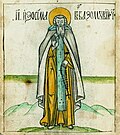 Zosima of VorbozomaVenerable · Disciple of St. Cornelius of KomelApr 4
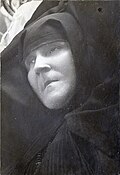 Maria of GatchinaVenerable Martyr · Nun of the Josephite movementApr 4
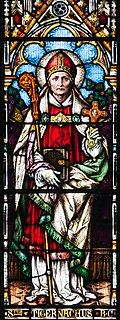 Tigernach of ClonesSaintApr 4
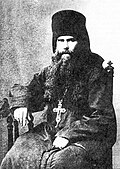 Benjamin KononovVenerable Martyr · Archimandrite of Antoniev-Siysky MonasteryApr 4
 Jacob of GalichVenerableApr 4
 Theonas of ThessalonikiSaint · Metropolitan of ThessalonikiApr 4
 Nicholas KaraulovHieromartyr · Bishop of VelskApr 4
- Nicetas of SerresNew Martyr · New Martyr of SerresApr 4
- Adrian the New of CorinthMartyrApr 4