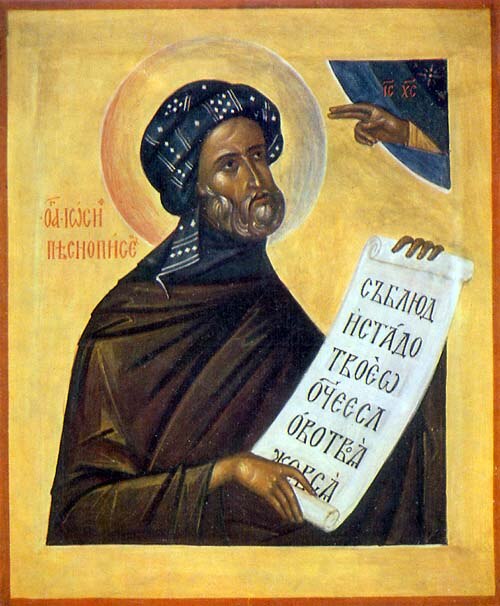
Venerable
Joseph the Hymnographer
Hymnographer
Greek monk of the ninth century, one of the greatest liturgical poets of the Orthodox Church, who died in 886.
- Feast
- April 4old style April 17
- Reposed
- 8869th century
- Place
- Constantinople
- Order
- Venerables
Life
Saint Joseph the Hymnographer was a Greek monk of the ninth century, one of the greatest liturgical poets of the Orthodox Church. He was born around 816 in Sicily and fell asleep in 886, according to some sources in 883. He confessed the right faith against iconoclasm, and his canons and stichera are sung to this day at the services of the Church. He is commemorated on 3 April.
Beginnings
He was born in Sicily of pious parents, Plotinus and Agatha. When the Arabs invaded the island the family fled, according to Theophanes, his biographer, to the Peloponnese. At fifteen he was tonsured at the Latomos monastery in Thessalonica, and around 840 the bishop there ordained him hieromonk. Saint Gregory of Decapolis, visiting Thessalonica, was so impressed with Joseph's rare character that he invited him to his own monastery of the Stoudios in Constantinople.
The mission to Rome
When iconoclasm revived under Leo the Armenian and Theophilus, Gregory sent Joseph to Rome, at the pope's invitation, to gather support for the defence of the holy icons. On the way he was captured by pirates and sold as a slave in Crete. In captivity Saint Nicholas appeared to him, asked him to sing in the name of God, and said to him: “Arise and follow me.” Soon after the vision he found freedom. According to some sources he was a slave for more than a year, according to others six years. He returned to Constantinople after the death of Theophilus and the restoration of the holy icons, received with joy by the faithful.
Monasteries and exile
In 855, according to Daniel Stiernon's reconstruction, he founded a monastery in honour of Gregory, his departed spiritual father, and moved there the relics of Gregory and of their disciple John, placing them in a chapel of the monastery church dedicated to Saint Bartholomew the Apostle. Earlier, for a time, he had lived in a hermitage dedicated to Saint John Chrysostom, where other disciples came to him.
In 858 he was exiled to Cherson for rebuking the Caesar Bardas, brother of Empress Theodora, over an unlawful cohabitation. He returned to Constantinople in 867, after the murder of Bardas. Patriarch Ignatius appointed him skeuophylax of the Great Church, keeper of the sacred vessels, and Patriarch Photius the Great, who succeeded him, valued him so highly that he took him into exile too. Photius entrusted him with the confession of the clergy, calling him “a man of God, an angel in the flesh and father of fathers.” Tradition ascribes to him the gift of spiritual discernment.
His hymns
Joseph devoted his whole life to composing church hymns, above all canons. It is said that he composed some three hundred canons, more than any other hymnographer, and scholars have attributed still larger numbers to him, including hundreds of canons in the Menaion, canons in the Parakletike, and many for the Triodion and Pentecostarion. The finest of them are the penitential canons. Because his name has often been confused with that of Joseph of Thessalonica, brother of Saint Theodore the Studite, not every hymn put down to him is certainly his.
He fell asleep on 3 April 886, according to Theophanes, who succeeded him as abbot and wrote his earliest Life. There is also a synaxarion about him, probably of the eleventh century. He is commemorated on 3 April.
Commemorated the same day April 4
 Isidore of SevilleSaint · Archbishop of SevilleApr 4
 Zosimas of PalestineVenerable · Hermit of PalestineApr 4
 Joseph the Much-SufferingVenerable · Monk of the Kyiv Caves LavraApr 4
 Zosima of VorbozomaVenerable · Disciple of St. Cornelius of KomelApr 4
 Maria of GatchinaVenerable Martyr · Nun of the Josephite movementApr 4
 Tigernach of ClonesSaintApr 4
 Benjamin KononovVenerable Martyr · Archimandrite of Antoniev-Siysky MonasteryApr 4
 Jacob of GalichVenerableApr 4
 Theonas of ThessalonikiSaint · Metropolitan of ThessalonikiApr 4
 Nicholas KaraulovHieromartyr · Bishop of VelskApr 4
- Nicetas of SerresNew Martyr · New Martyr of SerresApr 4
- Adrian the New of CorinthMartyrApr 4