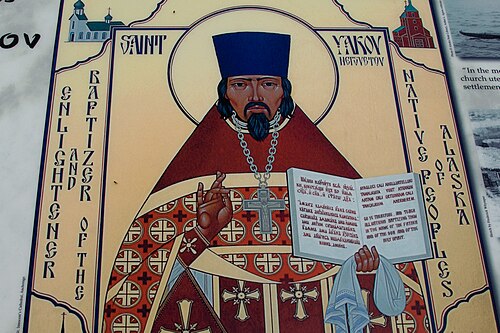
Righteous
Jacob Netsvetov
Enlightener of Alaska
Aleut Creole priest who continued the mission of Saint Innocent among the native peoples of Alaska.
- Feast
- July 26old style August 8
- Reposed
- 186419th century
- Place
- Sitka
- Order
- The Righteous
Life
Saint Jacob Netsvetov the Righteous (1802 to 1864) was a Creole priest of Alaska, born on Atka Island in the Aleutians to a Russian father and an Aleut mother. He was the first native of Alaska ordained priest and continued the missionary work of Saint Innocent among the native peoples of Alaska, first on the Aleutian Islands, then on the Yukon river. The Orthodox Church in America numbered him among the saints in 1994 as "Enlightener of the Peoples of Alaska". He is commemorated on 26 July, the day of his death.
Childhood and ordination
He was born in 1802 on Atka Island, in the Aleutian chain, the eldest of the four children who survived infancy of Yegor Vasilievich Netsvetov, a Russian from Tobolsk, a manager of the Russian-American Company, and Maria Alekseevna, an Aleut from Atka. His brothers and sister were Osip (Joseph), Elena and Antony. Osip became a naval officer and the first Creole shipbuilder of Russian America, and Antony attended the Naval Academy. His sister Elena married a clerk of the Company.
In 1823 the family moved to Irkutsk, where Jacob entered the theological seminary. On 1 October 1825 he was tonsured subdeacon. He married Anna Simeonovna, a Russian woman who may have been, like him, of mixed descent, and in 1826 he graduated from the seminary, with certificates in history and theology. On 31 October 1826 he was ordained deacon at the church of the Holy Trinity and Saint Peter in Irkutsk. Archbishop Michael ordained him priest on 4 March 1828, making him the first native of Alaska ordained priest. At this time he made plans to return to Alaska to preach the Word of God.
On departure, Archbishop Michael gave him two antimensia, one for the new church he planned to build at Atka and the other for missionary journeys. After a molieben, Netsvetov and his party, his wife Anna and his father Yegor, tonsured reader for the new Atka church, set off for Alaska on 1 May 1828. The journey took over a year, and they arrived at Atka on 15 June 1829.
The mission at Atka
His Atka parish covered most of the islands and shores around the Bering Sea, among them Amchitka, Attu, Copper, Bering and the Kuril Islands. He was bilingual and bicultural, which helped him settle into a varied community. While the church of Saint Nicholas was being built he held services in a large tent, which he continued to use after the church was finished, to preach in remote places. By the end of 1829, six months after arrival, he had recorded 16 baptisms, 442 chrismations, 53 marriages and eight funerals.
After finishing the church he turned to the education of children, teaching them to read and write both Russian and Unangan Aleut. At first the school was supported by the Russian-American Company, and in 1841 it was reorganized as a parish school. Many of his students later became Aleut leaders. Netsvetov also helped collect and prepare specimens of fish and marine animals for the museums of Moscow and Saint Petersburg. He corresponded with Saint Innocent on questions of linguistics and translation. He worked on an alphabet of the Unangan language, on translations of Scripture and other church publications. He also made an explanation for the translation of the Catechism into the language of Unalaska, prepared by John Veniaminov, in his parishioners' dialect. He received several distinctions and was raised to archpriest, with the Order of Saint Anna.
His wife Anna died in March 1836, and in July that year his house burned. His father, Yegor, died the following year. After these events he asked his bishop to let him return to Irkutsk and enter monastic life. The request was approved a year later, on condition that his replacement arrive, but the Church sent none. Soon Saint Innocent (Veniaminov) invited Father Jacob on a missionary journey to Kamchatka. On the way Father Jacob became convinced, under the saint's influence, that God's providence had prepared for him a share as missionary in the remote inland regions of Alaska.
The mission on the Yukon
On 30 December 1844 Saint Innocent named him head of the new Kvikhpak Mission, along the Yukon river. With his nephew Vasily Netsvetov and two young Creole assistants, Innokenty Shayashnikov and Konstantin Lukin, he made his headquarters in the Yup'ik village of Ikogmiut. From there he travelled hundreds of miles along the Yukon and Kuskokwim rivers, visiting the inhabitants of the settlements. In the years that followed he learned new languages, met new people and cultures, devised another alphabet and built more churches and communities. At the invitation of native leaders he went as far as the Innoko river and baptized hundreds from tribes formerly hostile. Between 1850 and 1852 he baptized 437 people, and by mid-1852 the number of baptized in the Kvikhpak Mission was 1,720. In 1851 another new church was consecrated. He led the mission from 1845 to 1857. It is remembered that in his last missionary journeys in the Kuskokwim and Yukon delta he baptized 1,320 people and distinguished himself as the evangelist of the Yup'ik and Athabascan peoples.
In 1857 he was moved as archpriest to the Mikhailovsky Redoubt, and in 1863 to Sitka. An assistant brought charges against him in 1863. To settle the case Bishop Peter called him to Sitka, where he was cleared. His health failing, he remained at Sitka and served at the Tlingit chapel.
Repose and veneration
He died of natural causes, while serving as priest at Saint Michael's Cathedral, on 26 July 1864, aged 60, and was buried at the Holy Trinity Church in Sitka. His troparion calls him the adornment of Atka and the Yukon delta, who offered himself as a living sacrifice to bring light to a searching people, offspring of Russian America, flower of brotherly unity, healer of sickness and terror of demons. The kontakion says he was a teacher of the knowledge of God, who showed his love for his people, taking up his cross and following Christ, and enduring hardships like the Apostle Paul.
The publication of his journals, previously unknown and found only in the second half of the twentieth century, gave rise to his veneration as a saint, ascetic and missionary. In October 1994 the Holy Synod of the Orthodox Church in America numbered him among the righteous saints, as "Enlightener of the Peoples of Alaska". The canonization celebrations took place on 15 and 16 October 1994 in Saint Innocent Cathedral in Anchorage. In 2015, in Sitka National Historical Park, in connection with work to restore the "Blockhouse on the hill", hope appeared of finding his grave. According to Bishop David (Mahaffey), it is known he was buried somewhere there, but the exact place is not known. His journals, in two volumes, appeared at Kingston, Ontario, in 1980.
Commemorated the same day July 26
 Paraskevi of RomeVenerable MartyrJul 26
 Moses the HungarianVenerable · Monk of the Caves LavraJul 26
 Hermolaus of NicomediaMartyr · Priest of NicomediaJul 26
 Benignus of MalcesineVenerable · Hermit of Lake GardaJul 26
- Simeon of MantuaVenerableJul 26
- Leontius of NaplesSaint · Bishop of NaplesJul 26
- OraiozeleMartyrJul 26
- Sergius StrelnikovHieromartyr · PriestJul 26
- Sava III of SerbiaSaint · Archbishop of SerbiaJul 26
- AppionMartyrJul 26
 Benignus and CarusHoly VenerablesJul 26
- Christiana of TermondeSaintJul 26