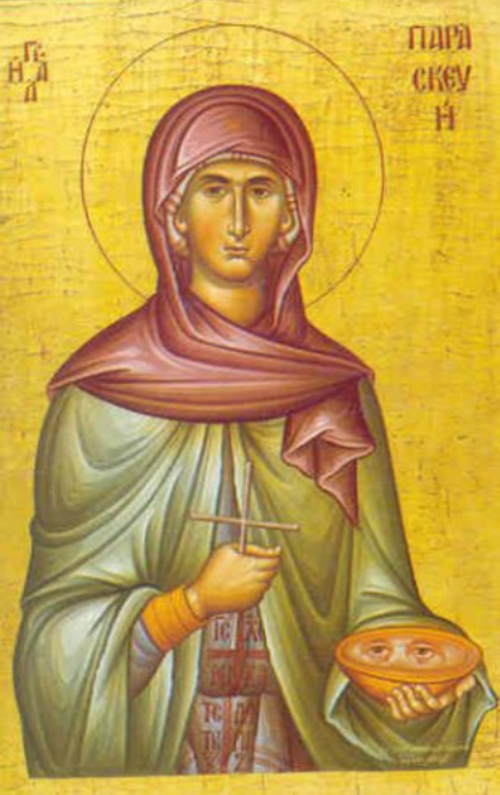
Venerable Martyr
Paraskevi of Rome
Martyr of the second century, arrested several times for her faith and finally beheaded.
Life
Saint Paraskevi of Rome the Martyr (also called Parasceva) was a Christian virgin of the second century, remembered as a martyr for her faith in Christ. She was arrested several times for being a Christian and was finally beheaded by the governor Tarasius. She is invoked for the healing of ailments of the eyes, and the Church commemorates her on 26 July.
Early life
Paraskevi was born in a village near Rome, probably in the reign of the Emperor Hadrian (117 to 138). Her parents, Agathon and Politia, Christians of Greek origin, had prayed for many years for a child. Politia bore a girl on a Friday, the day of the Lord's passion, and so they named her Paraskevi, which in Greek means Friday, literally preparation for the sabbath. The daughter grew up devout and well read and rejected several suitors. After her parents died she gave away her inheritance to the poor, lived in fasting and prayer and began to preach the Christian faith. At thirty she left Rome and taught in many towns and villages.
The first persecution
In the village of Therapia, near Constantinople, she was arrested by soldiers of the Emperor Antoninus Pius and brought to trial, accused of blasphemy and of having caused by her words the misfortunes that had lately struck the empire. The emperor tried to persuade her to renounce her faith and even offered to marry her. Paraskevi refused and was beaten and tortured, with a steel helmet lined with nails put on her head and tightened with a vice. She seemed to feel no pain, and her endurance led many to turn to Christianity. In the end the emperor commanded that she be plunged into a great kettle of oil and tar, but she came out of it unharmed. Accused of using magic, she threw the liquid in the emperor's face, and he was blinded and begged her help in despair. Antoninus regained his sight, was moved by the miracle, believed in Christ and set her free. From then on he did not persecute the Christians.
The second persecution
After the death of Antoninus Pius the laws changed under Marcus Aurelius. A plague struck the Roman people, and many, among them Marcus Aurelius, held the Christians guilty of angering the gods. Paraskevi was arrested again in a city governed by a man named Asclepius, who threw her into a pit with a great snake. She made the sign of the Cross and the snake fell dead. As with Antoninus, the miracle brought Asclepius to the Christian faith, and he released her, and she went on from city to city, preaching.
Martyrdom
Finally Paraskevi was arrested by an official named Tarasius and taken to the temple of Apollo. When she entered she made the sign of the Cross and all the idols in the temple fell. The crowd, instead of turning to Christ, was enraged and beat her, and Tarasius ordered her beheaded. According to some Orthodox traditions, Asclepius and Tarasius arrested her at the same time; Asclepius wished to free her after the miracle of the snake, but Tarasius was not persuaded and he condemned her after she overthrew the idols in the temple of Apollo.
The Western tradition
In the Latin tradition the saint is also known as Venerand, Venera or Venerina, and in some tellings her life is set in Sicily, with her relics at Acireale, and in southern Italy. In Serbia she is often confused with Saint Paraskevi, there called Saint Petka, who is commemorated on 27 October, although almost a thousand years lie between the two saints. On icons they are told apart: Paraskevi of Rome, protectress of the blind, holds in her hands a tablet with eyes, while Saint Petka holds a cross and a sprig of myrtle.
Veneration
Paraskevi is the most prominent of the female healing saints, honoured especially as healer of the blind, which is why she is often painted with two eyes in her hands. Her relics reached Constantinople, though how is not known, where it seems they were shown to pilgrims. Her feast is on 26 July, with a vigil and the Divine Liturgy of Saint John Chrysostom. The Romanian Orthodox church in Istanbul bears her name.
Commemorated the same day July 26
 Moses the HungarianVenerable · Monk of the Caves LavraJul 26
 Hermolaus of NicomediaMartyr · Priest of NicomediaJul 26
 Benignus of MalcesineVenerable · Hermit of Lake GardaJul 26
 Jacob NetsvetovRighteous · Enlightener of AlaskaJul 26
- Simeon of MantuaVenerableJul 26
- Leontius of NaplesSaint · Bishop of NaplesJul 26
- OraiozeleMartyrJul 26
- Sergius StrelnikovHieromartyr · PriestJul 26
- Sava III of SerbiaSaint · Archbishop of SerbiaJul 26
- AppionMartyrJul 26
 Benignus and CarusHoly VenerablesJul 26
- Christiana of TermondeSaintJul 26