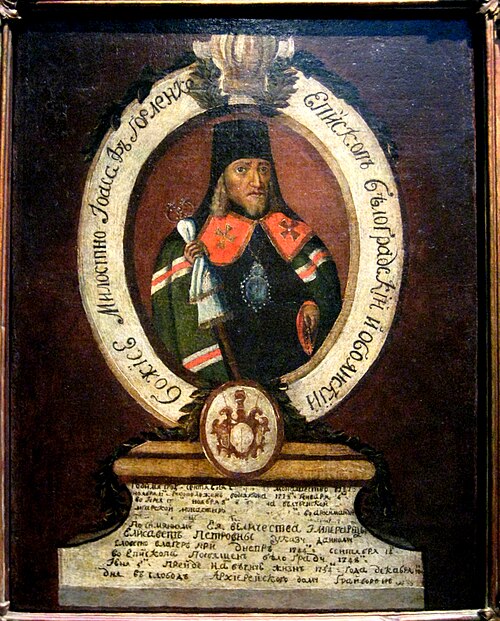
Saint
Joasaph of Belgorod
Bishop of Belgorod
Bishop of Belgorod from 1748 until his death in 1754, born Ioakim Gorlenko.
- Feast
- December 10old style December 23
- Reposed
- 175418th century
- Place
- Grayvoron
- Order
- Hierarchs
Life
Saint Joasaph of Belgorod, Hierarch, in the world Ioakim Andreyevich Gorlenko, was bishop of Belgorod and Oboyan from 1748 until his death in 1754. His incorrupt body remained, after many miracles, for veneration and was glorified in 1911; stolen from his shrine in 1917 and thought lost, it was found in a museum and returned to Belgorod in 1991. He is remembered on 10 December (the day of his repose), on 4 September (the day of the glorification) and on other days.
Childhood and calling
He was born on 8 (19) September 1705 at Pryluky, in the Cossack Hetmanate, in the old family of the Gorlenkos, son of the colonel of the Pryluky regiment, Andrei Dmitrievich Gorlenko, and of Maria Danilovna, daughter of Hetman Danylo Apostol. Among his relatives were also people of the Church: his uncle, the hieromonk Pachomius, his younger brother Michael, Archimandrite Mitrofan Gorlenko, and his nephew, Archimandrite Narkis Kvitka. In 1709 his grandfather and father fled with Ivan Mazepa to the Ottoman Empire, but after the hetman's death returned home. In 1713 he was sent to the Mohyla Academy in Kyiv, having as protector and confessor his uncle, the hieromonk Pachomius of the Caves Lavra. Already at eleven, by his own account, he “loved monasticism” and thought of becoming a monk, but for a long time did not dare tell his parents. Only in 1723 did he come home to ask his parents' blessing for tonsure, but was refused. Nevertheless, in secret from his parents he entered the Mezhyhirya monastery, where on 27 October 1725 he was tonsured a rassophore, with the name Hilarion. In 1727 he was moved to the Epiphany Brotherhood monastery in Kyiv, where on 21 November Abbot Hilarion Levytsky tonsured him a monk, with the name Joasaph; on 6 January 1728 Archbishop Varlaam Vonatovych ordained him hierodeacon.
Service before the episcopate
After finishing the course he was kept as a teacher: from 1729 he taught literature in the lower classes of the academy, from 1731 the syntax class in the middle ones. In 1733 he was also ecclesiarch of the Kyiv monastery. On 8 November 1734 he was ordained hieromonk by Archbishop Rafail at the Saint Michael Golden-Domed monastery, and on 23 November was moved to the cathedral of Saint Sophia; soon he became a member of the Kyiv spiritual consistory. On 24 June 1737 he was appointed abbot of the Transfiguration monastery at Mhar, near Lubny, which grew much stronger under his leadership. On 14 September 1744, by decree of the empress Elizabeth Petrovna, he was raised to archimandrite and, in November, summoned to Moscow; from 29 January 1745 he was named vicar of the Trinity Lavra of Saint Sergius. By decree of the empress of 15 March 1748 he was appointed bishop of Belgorod and Oboyan, and consecrated on 2 June 1748 in the Peter and Paul cathedral at Saint Petersburg.
Bishop of Belgorod
After his arrival in Belgorod he was noted for tireless efforts for his diocese and above all for his work to help those in need, often visiting the poor and the sick. In his six years as bishop he often travelled through his diocese, despite his weak health. The diocese was one of the largest in the empire, with a thousand and sixty parishes; he cared for the uplifting of church life, the rebuilding of churches, the Kharkiv college, and gave much attention to the development of education in Slobozhanshchyna. He is said to have been very merciful to all who suffered, often visiting the sick and even bringing them healing. In his writings he avoided the praise of the powerful common in his time. On one of his journeys through the diocese he fell ill and, stopping in the village of Graivoron, where he had the episcopal estate, spent more than two months on his sickbed and fell asleep on 10 December 1754, aged only forty-nine. On 15 December his body was taken to Belgorod and placed in the Holy Trinity cathedral. Not until 28 February 1755 was the coffin placed in the crypt in the cathedral, made on Joasaph's orders; the burial had been delayed by the flooding of rivers, which had stopped Bishop John of Pereyaslav, appointed by the Synod to perform it. For two and a half months the body stood open in its coffin in the cathedral. On 8 July 1755, by decision of the Synod, a side chapel was consecrated above the crypt.
Incorruption of the relics and glorification
Some years later the clergy of the cathedral opened the entrance to the crypt and saw that the body had not decayed. The news spread, the sick began to come to Joasaph's coffin and many reported cures. The miraculous power of his relics became known throughout the empire, and every year more people came to Belgorod to seek help. In 1883 the Holy Trinity cathedral became a monastery cathedral and requests for glorification began. In 1910 Tsar Nicholas II asked the Holy Synod to glorify Joasaph as a saint, which it agreed to do. On 4 September 1911 the glorification was celebrated in the Holy Trinity cathedral in Belgorod, before more than two hundred thousand people, many of whom had come from all over the empire and beyond. Before the First World War the relics were greatly venerated and were brought out for the curing of the sick, when great crowds came hoping for a miraculous cure; a witness wrote: “Now it is hard to imagine that sight: thousands and thousands of sick, bent, crippled, possessed and blind people stood and lay on both sides of the road along which the saint's relics were to be carried.” A substantial shrine of silver was made in the cathedral. In the summer of 1914, when news came of the bombardment of Belgrade by Austro-Hungarian monitors beginning on 29 July, a landowner, Prince Obolensky, spoke stirringly to his peasantry of the need for war with Austria, and they reacted enthusiastically; he later learned that his hearers had understood him to mean the Belgorod which held the relics of the newly glorified saint.
Loss and return of the relics
After the October Revolution of 1917 the Bolsheviks removed his relics from the shrine in the cathedral at Belgorod, and for some seventy years their whereabouts were unknown. In 1927 the Holy Trinity cathedral itself was demolished. In the late 1980s the relics were discovered in the Museum of the History of Religion and Atheism of the Academy of Sciences of the USSR in Leningrad, and on 16 September 1991 they were solemnly returned to the new Cathedral of the Transfiguration in Belgorod, at a service in which Patriarch Alexy II took part. His name is revered by the Orthodox faithful, above all by those from Ukraine. Joasaph left a short autobiography (“The Journey in This World of the Sinner Joasaph, Abbot of Mhar”), family notes, a dialogue in verse, “The Battle of the Seven Virtues with the Seven Deadly Sins,” a sermon on love of God, a few letters and circular epistles and a prayer. The diocese of Belgorod recognized him in 2012 as the ancestor of the artistic literature of the region. He was the uncle of the writer Hryhoriy Kvitka-Osnovianenko, who wrote his biography. The first Orthodox church dedicated to him in America, at Muddy, Illinois, was built in 1913.
Commemorated the same day December 10
 Miltiades of RomeSaint · Bishop of RomeDec 10
 Stefan Branković the BlindRight-Believing · Despot of SerbiaDec 10
 Vakhtang IIIRight-Believing · King of GeorgiaDec 10
 Gemellus of AncyraMartyrDec 10
 Anatoly PravdolyubovHieromartyr · Priest of KasimovDec 10
 Jacob ShestakovHieromartyr · Priest and writerDec 10
- Wulfhilda of BarkingVenerable · Abbess of BarkingDec 10
 Menas KallikeladosMartyrDec 10
- Michael BlagievskyHieromartyr · ArchpriestDec 10
 Alexander TuberovskyHieromartyr · Theologian and archpriestDec 10
- Tatiana EgorovaMartyrDec 10
- Eugenios KaraviasHieromartyr · Metropolitan of AnchialosDec 10