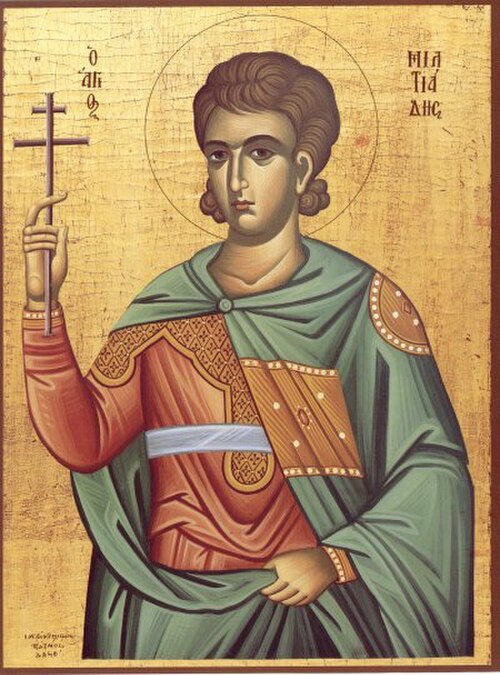
Saint
Miltiades of Rome
Bishop of Rome
Bishop of Rome from 311 to 314, when the Church received freedom under Constantine the Great.
- Feast
- December 10old style December 23
- Reposed
- 3144th century
- Place
- Rome
- Order
- Hierarchs
Life
Saint Miltiades of Rome, also called Melchiades the African, was bishop of Rome from 311 to 314, in the years when the Church came out of the age of persecution and received freedom under Constantine the Great. Little is known of his life before his episcopate. He was of African descent, born in the Roman province of Africa, and belonged to the clergy of Pope Marcellinus.
Bishop in a time of peace
In April 311 the emperor Galerius issued an edict of toleration at Serdica, ending the persecution of Diocletian in the East. Miltiades was elected on 2 July 311, after a long vacancy of the see that followed the death of Pope Eusebius, who had died in Sicily, where Maxentius had sent him into exile. Church property taken during the persecution was then restored.
In October 312 Constantine defeated Maxentius at the Milvian Bridge. In February 313 he and Licinius issued the Edict of Milan, by which Christians gained freedom of worship and regained their places of worship and their property. Constantine gave Miltiades the Lateran palace, which would long be the residence of the bishops of Rome. Tradition credits him with the practice of sending portions of the bread blessed by the bishop to the churches of Rome as a sign of unity, and with the custom of not fasting on Thursdays and Sundays, though scholars think these customs were older.
The Lateran synod
In his time the Church of Carthage was divided over the election of Bishop Caecilian, who was supported by Rome. His opponents, gathered around Donatus, demanded that bishops and priests who had fallen be rebaptized and reordained. Constantine asked Miltiades to judge the matter together with three bishops from Gaul. Miltiades turned it into an ordinary synod and called fifteen more Italian bishops. The synod met at the Lateran from 2 to 4 October 313. The Donatists left without presenting their case, and Miltiades kept Caecilian as bishop of Carthage and condemned the teaching of rebaptism. The Donatist movement nevertheless continued to spread in Africa.
Later the Donatists claimed that Miltiades, together with Marcellinus and Sylvester, had handed over sacred books to the pagans during the persecution. Saint Augustine rejected this accusation.
Repose and commemoration
Miltiades fell asleep on 10 or 11 January 314. Constantine convened a further council at Arles in 314, which also ruled against the Donatists, but Miltiades was no longer alive. He was buried in the catacomb of Callixtus on the Appian Way.
The Orthodox Church commemorates him on 10 April. The Greek Synaxarion calls him Miltiades or Melchiades, pope of Rome, and says, following the Roman Martyrology, that he suffered under the emperor Maximin, though history knows of no martyrdom of his. In the West his memory was entered in the calendar in the Middle Ages on 10 December, with the title of martyr given in error, and since 1969 it has been kept on 10 January, without that title. The calendar of Western saints of the Orthodox Church has him on 10 December.
Commemorated the same day December 10
 Stefan Branković the BlindRight-Believing · Despot of SerbiaDec 10
 Vakhtang IIIRight-Believing · King of GeorgiaDec 10
 Joasaph of BelgorodSaint · Bishop of BelgorodDec 10
 Gemellus of AncyraMartyrDec 10
 Anatoly PravdolyubovHieromartyr · Priest of KasimovDec 10
 Jacob ShestakovHieromartyr · Priest and writerDec 10
- Wulfhilda of BarkingVenerable · Abbess of BarkingDec 10
 Menas KallikeladosMartyrDec 10
- Michael BlagievskyHieromartyr · ArchpriestDec 10
 Alexander TuberovskyHieromartyr · Theologian and archpriestDec 10
- Tatiana EgorovaMartyrDec 10
- Eugenios KaraviasHieromartyr · Metropolitan of AnchialosDec 10