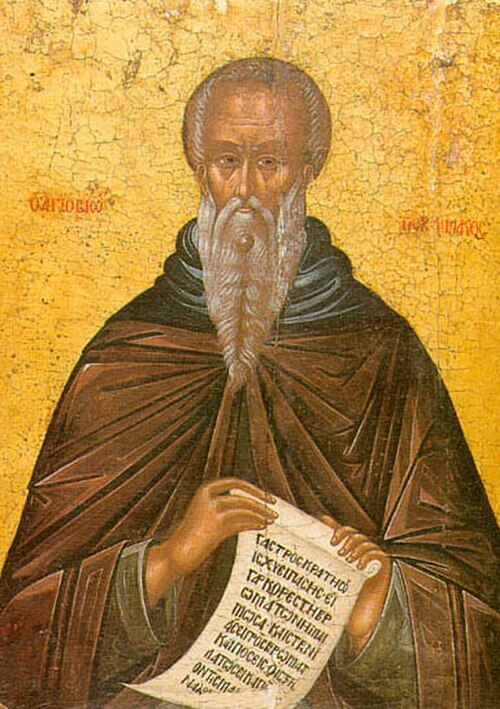
Venerable
John Climacus
Abbot of Mount Sinai
Abbot of the monastery on Mount Sinai, author of The Ladder of Divine Ascent.
- Feast
- March 30old style April 12
- Reposed
- 6497th century
- Place
- Mount Sinai
- Order
- Venerables
Life
Venerable John Climacus (in Greek Ioannes tes Klimakos), also called John of the Ladder or John of Sinai, was a monk of the monastery of Mount Sinai in the sixth and seventh centuries and the author of The Ladder of Divine Ascent, one of the most widely read books of Orthodox spiritual life. The Church commemorates him on 30 March and again on the fourth Sunday of Great Lent, when the Ladder is remembered.
What is known
Few details of his life are certain. The principal early source is a Life written by Daniel, a monk of Raithu, who claims to have been his contemporary but admits that he does not know where John came from or what his parents were. He gives no dates. The Church places his birth around 579 and his repose around 649. Later calendars add that he was the son of the holy Xenophon and Maria of Constantinople, and some give his birth as about 570, but this rests on late tradition and cannot be proved.
Some modern scholars question the traditional picture. They note that the learning and rhetoric of his writing suggest a solid education in law or administration, which could not have been acquired on Sinai, and they suggest that he may have lived in a seaside city such as Gaza and entered the monastery as a mature man, perhaps after the death of his wife. The tradition that he came to Sinai at sixteen, they argue, is a standard way of showing a saint untouched by worldly learning.
On Sinai
According to Daniel, John came to the monastery on Mount Sinai at sixteen and placed himself under the obedience of Abba Martyrius. After four years he was tonsured a monk, and Abba Strategius, who was present, said that he would become a great light of the Church. For nineteen years he stayed with Martyrius, and when his elder fell asleep he withdrew to a place called Thola, about five miles from the monastery, where he lived in silence, fasting, prayer and tears of repentance for forty years.
His hermitage was no place of hiding. Because of his wisdom and discernment, people from all walks of life came to him to hear a word of salvation, and he received them with love. Once some monks reproached him for talking too much, and he kept silence for a whole year, until they saw their mistake and begged him to speak again.
One story shows the strength of his prayer. John had a disciple, Moses, whom he sent to bring dung for the vegetable garden. At noon, in the heat, Moses lay down to rest in the shade of a great rock. John, asleep in his cell, was woken by a man of remarkable appearance, who said, "John, why do you sleep so heedlessly, when Moses is in danger?" John awoke and prayed for his disciple. In the evening Moses told him that he had left the place because he thought he heard John calling him, and that the rock had fallen where he had slept. John thanked God and told him nothing of his vision.
When he was about seventy-five (other sources say sixty-five), the monks of Sinai chose him as their abbot, and he led the monastery for four years. Toward the end of his life he received the gifts of foresight and wonderworking.
The Ladder of Divine Ascent
At the request of another John, abbot of the monastery of Raithu on the shore of the Red Sea, he wrote a book of teaching for monks. He thought the task beyond him, but obeyed. He called it a ladder, recalling the ladder Jacob saw in a dream, which touches earth and reaches heaven (Genesis 28:12). It has thirty steps, one for each year of the Lord's life before His Baptism.
The book begins with renunciation of the world and goes on to obedience, repentance, remembrance of death, mourning for sins, meekness, and the struggle against anger, slander, despondency, vainglory, pride and the other passions. The first seven steps treat the general virtues needed for a monastic life, the next nineteen the vices and the virtues that answer them, and the last four the high virtues toward which all this aims: prayer, stillness, freedom from passion and, at the top, love. The last step is God, who is love (1 John 4:8). On the way there are many short stories from the lives of monks.
Of tears he writes: "Just as fire burns and destroys wood, so pure tears wash away every impurity." The twenty-second step, on vainglory, is among the most read. There the Saint confesses how the vice follows the monk everywhere: when he fasts he is vain, and when he eats to hide his fasting he is vain of his prudence. He adds a shorter book, To the Shepherd, as a guide for abbots.
Although written for monks, the Ladder is useful for every Christian. Saint Theodore the Studite, Saint Sergius of Radonezh and Saint Joseph of Volokolamsk relied on it. In monasteries it is read at table, and in the Triodion it is appointed for Great Lent.
Veneration
On the fourth Sunday of Great Lent the Church honours John as a guide on the road to Pascha. On the icon of the Ladder, monks climb toward Christ at the top, angels help them, and demons try to drag them down or shoot them with arrows, even high on the ladder, and at least one figure is falling. Many churches are dedicated to him, among them the church and belltower in the Moscow Kremlin.
He should not be confused with John Scholasticus, Patriarch of Constantinople.
Commemorated the same day March 30
 Secundus of AstiMartyrMar 30
 Irenaeus of SirmiumHieromartyr · Bishop of SirmiumMar 30
 Rieul of SenlisHieromartyr · First Bishop of SenlisMar 30
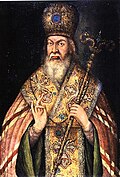 Sophronius of IrkutskSaint · Bishop of Irkutsk and NerchinskMar 30
- Joad the Man of GodProphet · The man of God from JudahMar 30
- Aquila of ThessalonicaVenerableMar 30
- CliniusVenerableMar 30
- Colman of Linn UachailleSaintMar 30
- Colman son of RonanSaintMar 30
- Euboula of NicomediaVenerableMar 30
- Eulalia of ThessalonicaVenerableMar 30
- EvvoulaSaintMar 30