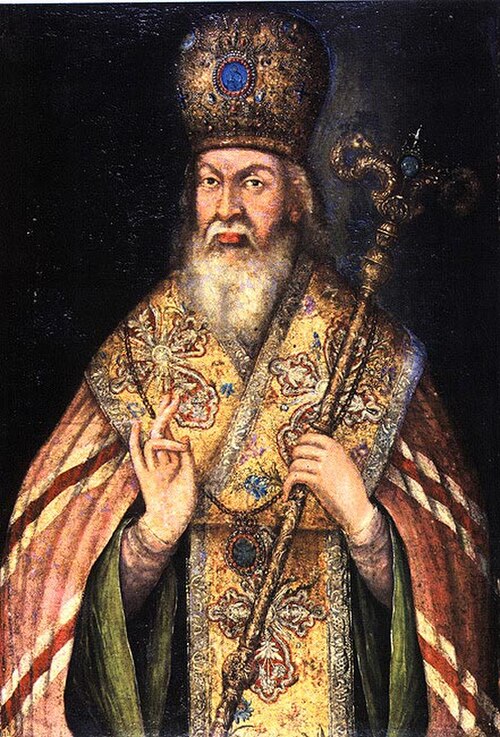
Saint
Sophronius of Irkutsk
Bishop of Irkutsk and Nerchinsk
Bishop of Irkutsk and Nerchinsk, born in 1703 and died in 1771; venerated as a saint in the Russian Church.
Life
Saint Sophronius of Irkutsk, the Hierarch (in the world Stefan Nazarievich Kristalevsky, 1703 to 1771), was, from 1753, bishop of Irkutsk and Nerchinsk, in eastern Siberia. Born in Ukraine, he was a monk at Kyiv and at the Alexander Nevsky Lavra in Saint Petersburg, then pastor, missionary and founder of schools in Siberia. His body, remaining incorrupt, was honoured as relics, and the Local Council of the Russian Church canonized him in 1918. He is commemorated on 30 March, on 10 June, in the Synaxis of the Siberian Saints, and on 30 June.
Youth and monasticism
He was born on 25 December 1703, by the Ukrainian sources at Berezan, in the Pereyaslav regiment, to a family of simple peasants, son of Lazar Feodorovich. He studied at the Mohyla Academy in Kyiv (or, by one source, at the Pereyaslav seminary) and, after graduating in 1727, became a novice at the Protection monastery of Krasnogorsk in the diocese of Pereyaslav. There, on 23 April 1730 (by one source, 25 March), he received monastic tonsure, with the name Sophronius, in honour of Saint Sophronius of Jerusalem. In 1732, in the cathedral of Saint Sophia in Kyiv, he was ordained hierodeacon, then hieromonk, by Metropolitan Raphael (Zaborovsky). For two years he was steward of the Protection monastery, then by decree of Bishop Arsenius (Berlov) of Pereyaslav he was moved as steward to the bishop's house.
In 1735 he was sent on diocesan business to Saint Petersburg, where he spent two years and was noticed at the Synod. In 1742, among 29 monks gathered from the whole empire to fill out the brotherhood of the Alexander Nevsky Lavra, Sophronius was moved to Saint Petersburg and made steward, and in 1746 abbot of the monastery, a post he held for seven years. His helper was his countryman, Venerable Synesius (Ivanov), whom he invited to Saint Petersburg and made builder of the New Sergiev Hermitage, attached to the lavra.
Bishop of Irkutsk
After the death of Bishop Innocent of Irkutsk, the vast diocese of Irkutsk remained five years without a bishop. By decree of Empress Elizabeth Petrovna of 23 February 1753 the Synod was recommended to raise Sophronius to the episcopal rank and name him to the see of Irkutsk. On 18 April the same year he was consecrated, in the Dormition Cathedral of the Moscow Kremlin, bishop of Irkutsk and Nerchinsk. After consecration he went first to Kyiv to pray at the holy shrines of the Caves Lavra, then set out for his diocese. He reached Irkutsk on 20 March 1754, after four months on the road.
Taking up the governance, he made a journey through the diocese, visited Nerchinsk, Kirensk and Yakutsk and then made several missionary journeys. He proved a builder of churches and the founder of the theological seminary, where he himself taught. He brought with him to Siberia several helpers, mostly Ukrainians. His friend Synesius he took with him, in 1754 named him abbot of the Ascension monastery of Irkutsk, then raised him to archimandrite and made him a member of the consistory, where he was his helper in the work of governance. He ordered that the children of priests and peasants must be taught in the schools, moved the seminary to a new episcopal house built with his own money, called teachers from Kyiv and gathered a large library. He converted many of the local people.
He gave great care to the native peoples. Avoiding pressure and compulsion, he preached to them the Word of Christ, teaching the foundations of faith and prayers in their own languages. He wrote: "To those who do not wish holy baptism, after exhortation and persuasion, no compulsion is to be used and no threats made, since Christian preaching belongs with love, humility, submission and gentleness, because the human heart cannot be forced." In 1760, only thanks to his report to Saint Petersburg, was the attention of Empress Elizabeth Petrovna drawn to the lawlessness, continuing for more than a year and a half at Irkutsk, of the collegiate assessor Pyotr Krylov.
His repose
Feeling old age and failing health, Sophronius asked the Synod to let him retire, but the search for a replacement dragged on and the saint fell asleep at Irkutsk on 30 March 1771, on the second day of Pascha. He was not buried at once. For six months and ten days his body lay in the Kazan side chapel of the Epiphany Cathedral of Irkutsk. On 8 October 1771 the burial took place. All this time the body showed no sign of corruption, which was the start of his veneration as a saint, to which reports of miracles at prayers to him were later added. His remains were examined in 1874 (by one source, in 1903) and judged incorrupt.
Glorification
On 18 April 1917 a fire in the Epiphany Cathedral destroyed Bishop Sophronius's tomb. The remains that survived the fire were gathered and reverently placed in a special casket. In the same year, 1917, by decision of the 49th diocesan congress of the diocese of Irkutsk, Archbishop John petitioned the Holy Synod for the glorification of Saint Sophronius throughout the Church. The question of his canonization had been raised several times since 1909, not only at Irkutsk but in the neighbouring dioceses of eastern Siberia. Archbishop John prepared the canonization materials and a booklet, "Appearances of the Gracious Help of Saint Sophronius, Third Bishop of Irkutsk", with the description of 65 miracles verified by a special commission, among the 68 recorded and verified before canonization, with sheets bearing the signatures of over 18,000 persons expressing the conviction that "the time has truly come for the glorification of Saint Sophronius throughout the Church". The booklet included testimonies of the doctors Klevezal and Volobuev about some of the most striking healings through the saint's prayers, on the basis of statements given under oath. In 1918 the Local Council of the Russian Church canonized Sophronius among the saints. The saint is also commemorated on 30 June (13 July by the new calendar).
Commemorated the same day March 30
 John ClimacusVenerable · Abbot of Mount SinaiMar 30
 Secundus of AstiMartyrMar 30
 Irenaeus of SirmiumHieromartyr · Bishop of SirmiumMar 30
 Rieul of SenlisHieromartyr · First Bishop of SenlisMar 30
- Joad the Man of GodProphet · The man of God from JudahMar 30
- Aquila of ThessalonicaVenerableMar 30
- CliniusVenerableMar 30
- Colman of Linn UachailleSaintMar 30
- Colman son of RonanSaintMar 30
- Euboula of NicomediaVenerableMar 30
- Eulalia of ThessalonicaVenerableMar 30
- EvvoulaSaintMar 30