Fool-for-Christ
John of Sezenovo
Fool for Christ and recluse
A fool for Christ and recluse of the Tambov region, born in 1791 and reposed in 1839.
- Feast
- December 14old style December 27
- Reposed
- 183919th century
- Place
- Voronezh Governorate
- Order
- Fools-for-Christ
Life
Blessed John of Sezenovo (John Lukich Bykov, 24 June 1791 to 14 December 1839) was an ascetic, recluse and fool for Christ, founder of the convent in the village of Sezenovo, in the Tambov region. He was glorified in 1988 in the Synaxis of the Saints of Tambov, as a saint venerated locally, not for the whole Church; he is venerated as venerable, blessed, recluse and fool for Christ. He is commemorated (Old Style) on 14 December.
Beginnings
He was born on 24 June 1791 in the Korotoyak district, Voronezh province, in the family of the household serf Luke Ivanovich Bykov. He often made pilgrimages, especially to the Kyiv Caves Lavra, where he spent two years as a novice. He dreamed of the monastery, but, being a bonded labourer of a landowner, he had to work, sometimes in the carpentry workshop, sometimes tending the flock. From fifteen he began his folly for Christ. He liked to pray before the icon of Saint Demetrius of Rostov. Once, at night, he came to the house of the priest who honoured the youth, to pray, and the priest was awakened by sweet singing; looking through the keyhole, he saw the youth kneeling, brightly lit by a heavenly radiance falling on him from the icon of Saint Demetrius. Once the landowner, angered by a long absence, beat John, chained him in iron fetters and shut him in a barn, forbidding that he be given food and drink, but the fetters fell from the youth's thin arms, and he went away again.
After a time he wandered, living on alms, and met the elder Daria Katukova. When they arrived together at Saint Hilarion of Troekurovo, he blessed John to begin his reclusion in the village of Sezenovo, today in the Lipetsk region. Then the landowner of the village, Prince F. Nesvitsky, dreamed that he was sitting in the drawing room and from the Korsun icon of the Mother of God hanging on the wall a large infant came out, who named himself John and begged him for a place of prayer; the infant asked for an old bathhouse standing apart, and the prince carried him there in his arms. Soon two travellers came to the prince, the elder Daria and the infant. Indeed John resembled somewhat a child.
Reclusion
At Sezenovo his labours as a recluse began. He did not spare his body: he wore it out with fasting, eating once in two or three days or once a week, with iron chains of over seven kilograms, cast-iron prayer rope and iron shoes. He made a thousand prostrations a day, at times copying holy sayings and prayers. He showed his face to no one; only his cell attendant, Basil, and very few others could see him. He received from God the gift of foresight. When people came to him, he left his reclusion for a time, helped them, counselled them, healed them by sprinkling with holy water and anointing with oil from the lamp; thus he healed the four-year-old son of the Lebedyan merchant Cosmas Angelov, who had weak legs and could not walk.
The blessed one reposed on 14 December 1839, at forty-eight, of which twenty-two he spent in reclusion. On 12 January 1840 permission came from the diocesan authorities and he was buried. During the Liturgy many saw drops of myrrh on his face, which the sick wiped with handkerchiefs and applied to painful places, receiving healing. Thousands of people pressed to touch the body, and on that day many sick were healed. It is known that the miracles did not stop afterward. The future Athonite elder Silouan felt drawn to monasticism after he learned of the righteous life of the recluse John of Sezenovo and of the miracles that did not cease after his blessed death.
The founding of the convent
John's prophetic words that at Sezenovo there would be a convent were taken seriously by few, but gradually widows and maidens gathered around him, desiring a pious life under his guidance, and he became the founder of the convent. On 23 October 1826 he went with an axe into the forest together with the peasant John Biryukov; at the place he indicated the peasant drove in a stake, and he said: "Here a bell tower will be built, and the bell here will be heard in all Rus'". Then, going a little further, he ordered another stake driven: "Here will be our boundary and this will be our land". Many later heard the elder say: "We shall have here Kyiv, Jerusalem, Athos. We shall have priests from among the nobles", and all his prophecies were fulfilled. A year before his death, on 8 September 1838, with the blessing of Bishop Arsenius of Tambov, he laid the foundation of a new seven-altar stone church, marking the ground with his iron staff of eighteen pounds and setting wooden crosses at the places of the altars. The builder and parishioners asked him to move the foundation higher, but he answered: "If you move it, you will not build in twenty years, while on this place you will finish in three".
Commemorated the same day December 14
 Venantius FortunatusSaint · Bishop of PoitiersDec 14
 Agnellus of NaplesVenerable · Abbot of NaplesDec 14
 CallinicusMartyr · Former pagan priest of BithyniaDec 14
 Philemon of AntinoeMartyr · Flautist of AntinoopolisDec 14
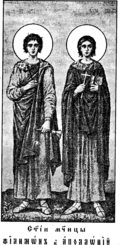 Philemon, Apollonius, Arian and TheotychusHoly MartyrsDec 14
- 36 Martyrs of the ThebaidHoly MartyrsDec 14
- Aaron, Athena, Isidorus and DioscorusHoly MartyrsDec 14
- Apollonius of AntinoeMartyrDec 14
- AresMartyr · Martyr of AscalonDec 14
- Arrian of AntinoeMartyrDec 14
- Colman AlainnSaintDec 14
- Colman of Rath MaoilsidheSaintDec 14