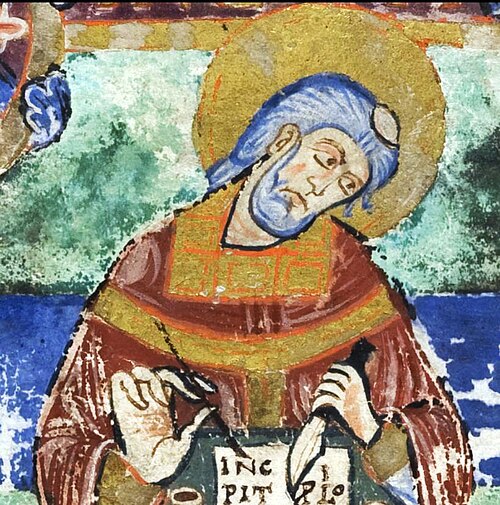
Saint
Venantius Fortunatus
Bishop of Poitiers
Latin poet and hymnographer at the Merovingian court, who became bishop of Poitiers.
- Feast
- December 14old style December 27
- Reposed
- 6097th century
- Place
- Poitiers
- Order
- Hierarchs
Life
Saint Venantius Fortunatus was a Latin poet and hymnographer at the Merovingian courts, and later bishop of Poitiers. His hymns Vexilla regis and Pange lingua are still sung in the services of the Holy Cross. He is honoured as a saint of the undivided Church, though no formal canonization took place. He is commemorated on 14 December.
Early life
He was born between 530 and 540 at Duplavis, near Treviso in northern Italy. His childhood is debated: some think the family moved to Aquileia, others that it stayed where he was born. In the 550s or 560s he went to study at Ravenna, where he received a classical education. His writing shows traces of Virgil, Horace, Ovid, Statius and Martial, and of the Christian poets Arator, Claudian and Sedulius. He says that his diseased eyes were healed with the oil of a lamp burning before the altar of Saint Martin, which led him to make a pilgrimage to the tomb of Saint Martin at Tours.
In Gaul
In the spring of 566 he reached Metz by a winding road through Italy, Austria, Germany and France. His arrival coincided with the wedding of King Sigebert I and Brunhild, for which he recited a poem. From then on he had many patrons, kings, bishops and nobles, who asked him for verses. He stayed briefly at the court of King Charibert in Paris, then withdrew toward Tours and Poitiers, where he met Saint Radegund. A lasting friendship grew between them, and he wrote many poems in her honour. Saint Gregory of Tours was also his friend and patron, and in 580 Fortunatus defended him in verse when he was charged with treason at the court of Chilperic. After the deaths of Sigebert and Chilperic he moved to the court Childebert had set up at Poitiers. Around 576 he was ordained, and around 599 to 600 he became bishop of Poitiers, succeeding Plato.
Hymns of the Holy Cross
For a fragment of the Holy Cross that the emperor Justin II sent to Radegund, Fortunatus composed Vexilla regis prodeunt ("The royal banners forward go") and Pange lingua gloriosi proelium certaminis ("Sing, my tongue, the glorious struggle"). The first is sung in the West on Good Friday, and the second inspired the hymn with the same opening written later by Thomas Aquinas. Fortunatus left eleven books of Latin poetry: epitaphs, praises of kings, poems of consolation and religious verse, together with a verse Life of Saint Martin and a life of Saint Radegund. Through them he preserved much information about his time.
His end
He died in the early seventh century, around 600 to 609. No canonization in the modern sense took place, but he received the title of saint after his death, and the Roman Martyrology commemorates him on 14 December.
Commemorated the same day December 14
 Agnellus of NaplesVenerable · Abbot of NaplesDec 14
 CallinicusMartyr · Former pagan priest of BithyniaDec 14
 Philemon of AntinoeMartyr · Flautist of AntinoopolisDec 14
- John of SezenovoFool-for-Christ · Fool for Christ and recluseDec 14
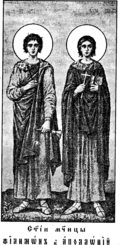 Philemon, Apollonius, Arian and TheotychusHoly MartyrsDec 14
- 36 Martyrs of the ThebaidHoly MartyrsDec 14
- Aaron, Athena, Isidorus and DioscorusHoly MartyrsDec 14
- Apollonius of AntinoeMartyrDec 14
- AresMartyr · Martyr of AscalonDec 14
- Arrian of AntinoeMartyrDec 14
- Colman AlainnSaintDec 14
- Colman of Rath MaoilsidheSaintDec 14