Martyr
John Vladimir
Prince of Duklja
Ruler of Duklja from about 1000 to 1016, killed around 1016 and honored by the Serbs as a martyr.
Life
Saint John Vladimir, martyr, ruled Duklja, the most powerful Serbian principality of the time, from around 1000 to 1016, and received martyrdom at Prespa. He is regarded as the first Serbian saint and protector of the city of Bar in Montenegro. He is commemorated on 22 May (4 June in the new style).
His rule
He came to the throne while still young, after his father Petrislav, around 1000 (according to other sources, between 990 and 998). The principality had two regions, Zenta in the south and Podgoria in the north; his court, by local tradition, was at Kraljič, near Lake Skadar, in the Krajina region, near the church of Prečista Krajinska, dedicated to the Mother of God, which already existed in his time. The Chronicle of the Priest of Duklja and the Byzantine historian John Skylitzes describe him as a wise, pious, just and peaceful ruler. His reign coincided with the long war between Emperor Basil II and Tsar Samuel of Bulgaria. John Vladimir held to his link with Byzantium, but it did not spare Duklja from Samuel, who conquered the principality around 1010 and took him prisoner. According to a medieval chronicler, in prison he prayed day and night, and an angel of the Lord told him that he would soon be free but would die a martyr.
Samuel’s daughter Theodora Kosara fell in love with Vladimir and begged her father to give him to her as husband. The tsar allowed the marriage and gave back Duklja, which Vladimir ruled as a vassal. He took no part in his father-in-law’s wars. He strove, as the synaxarion story tells, to strengthen the Orthodox faith: he appointed teachers and preachers, and founded monasteries, churches and hospitals, among them an oratory in a forest, where he came daily to pray.
Martyrdom
Samuel was defeated by the Byzantines in 1014 and died soon after. In 1016 Vladimir fell victim to a plot of Ivan Vladislav, Samuel’s nephew and the last ruler of the First Bulgarian Empire. He was beheaded before the church at Prespa, capital of the empire, and buried there. According to tradition, the saint lifted his severed head from the ground, mounted his horse and rode to the church; there he dismounted, said “Into Your hands, Lord, I commend my spirit” and gave up his soul, on 22 May 1016. His tomb, over which a light from heaven often appeared, became a place of healing.
Relics and veneration
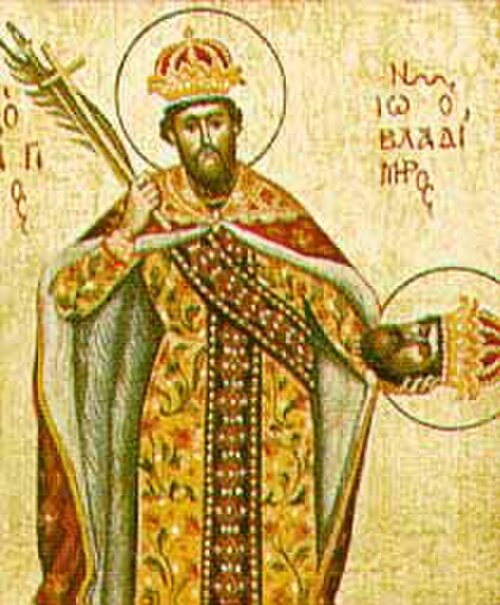
His widow Kosara moved his relics to the church of Prečista Krajinska, near his court. In 1215 they reached Dyrrachion (Durrës), and from 1381 they were kept in the church of Saint John Vladimir near Elbasan, built by Karl Thopia, the ruler of Albania. Since 1995 they have been in the Orthodox cathedral of Tirana and are taken on the feast day to the church near Elbasan. The cross he held when he was beheaded is kept by the Andrović family of the village of Velji Mikulići, and is shown to the faithful only at Pentecost, when it is carried in procession to the summit of Mount Rumija. His earliest Life, lost, was written between 1075 and 1089; a short Latin version is preserved in the Chronicle of the Priest of Duklja. Lives in Greek and Slavonic were printed in 1690 and 1802. In icons he is shown as a monarch with a crown, the cross in his right hand and his own head in his left.
Commemorated the same day May 22
 MelchizedekSaint · King of SalemMay 22
 Elen of the HostsSaint · Church founder in WalesMay 22
 Bobo of VogheraRight-Believing · Warrior and pilgrimMay 22
 Maxim ZhizhilenkoHieromartyr · BishopMay 22
- Paul of PeloponnesosSaintMay 22
- AemiliusMartyrMay 22
- Aigulf of BourgesSaint · Bishop of BourgesMay 22
- AurelianMartyrMay 22
- Ausonius of AngoulêmeSaint · Bishop of AngoulêmeMay 22
- BoethianMartyrMay 22
- CastusMartyrMay 22
- Castus and EmiliusHoly MartyrsMay 22