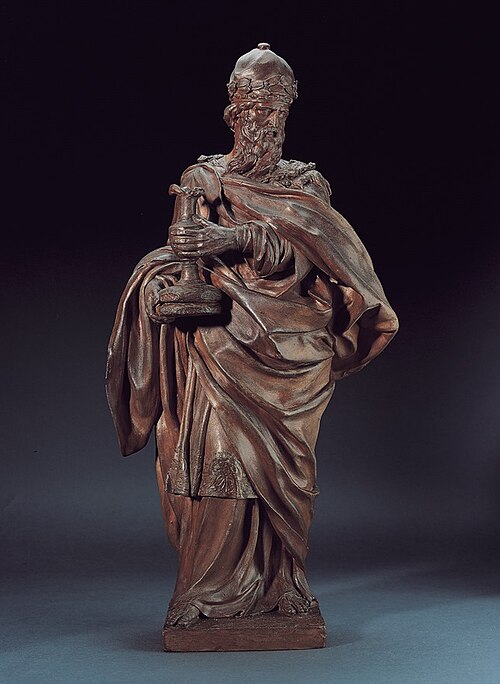
Saint
Melchizedek
King of Salem
King of Salem and priest of God Most High, who blessed Abraham with bread and wine.
- Feast
- May 22old style June 4
- Era
- 17th century BC
- Place
- Salem
Life
Melchizedek was, according to the book of Genesis, king of Salem and priest of God Most High, who went out to meet Abraham with bread and wine and blessed him. His name, in Hebrew Malki-Tzedek, means king of righteousness. The Church regards him as a figure of Christ, the Great High Priest, and remembers him on the Sunday of the Holy Forefathers, before the Nativity, as well as on the Sunday of the Holy Fathers.
In Scripture
Melchizedek is mentioned three times in Scripture: in Genesis 14:18 to 20, in Psalm 109 (110):4, and in the Epistle to the Hebrews, chapters 5 to 7. When Abraham returned from defeating the four kings of the east, who had taken Lot captive with the goods of Sodom, Melchizedek, king of Salem, went out to meet him. He brought bread and wine and said: Blessed be Abram by God Most High, Who made heaven and earth, and blessed be God Most High, Who has delivered your enemies into your hand. Abraham gave him a tithe of all the spoil.
According to the tradition of the Church, Salem is the city that was later given the name Jerusalem. Mar Jacob of Serugh held that Melchizedek was a Canaanite, which is why Scripture gives no genealogy for him.
A king and a priest
Scripture shows him, in a single appearance, as king and priest of God Most High, though he was not of the chosen race. He was a priest of the true religion before the law of Moses and before the priesthood of Aaron. He did not receive the priesthood from another and left it to no one. Tradition shows that he offered no animal sacrifices, but offered himself to God, through prayers from a pure heart, and watched over his kingdom in peace.
A figure of Christ
Psalm 109 says of the Messiah: You are a priest for ever after the order of Melchizedek. The Epistle to the Hebrews shows that Jesus Christ is this eternal High Priest. Of Melchizedek the Epistle writes that he is without father, without mother, without genealogy, having neither beginning of days nor end of life, but, made like the Son of God, he remains a priest continually. Scripture says nothing of his birth and death, and this silence is understood as a sign that he portrays the priesthood of Christ, without beginning or end.
The Epistle further shows that Melchizedek is greater than Abraham, because he blessed him, and the lesser is blessed by the greater. Abraham, the forefather of Levi and of Aaron, gave him a tithe, so the priesthood after the order of Melchizedek stands above the Levitical priesthood. His name, king of righteousness, and the title king of Salem, that is, of peace, are regarded by the Fathers as names of Christ.
The bread and the wine
The bread and wine brought by Melchizedek are understood by the Church as a foreshadowing of the Holy Eucharist and the Divine Liturgy, in which Christ the High Priest offers Himself and gives Himself. The holy Fathers, among them Saint Cyprian of Carthage, saw in this a prefiguring of the sacrifice on the altar. For this reason, in the third ode of the Great Canon of Saint Andrew of Crete, read in the first week of Great Lent, the Church urges us to imitate that Priest of God and solitary King, an image of the life of Christ among men.
The icon of the Great High Priest, which shows Christ as High Priest, rests on the very word of Psalm 109 about the order of Melchizedek.
The views of the commentators
Who Melchizedek was has been asked many times. Later Jewish commentators, among them the Talmud and the Targums, said that he is Shem, the son of Noah, who would have lived in the time of Abraham. Others counted him of the family of Ham or of Japheth. Neither opinion existed in the time of the apostles. Some Christians saw in him an appearance of the Son of God in the Old Testament, and a sect called the Melchizedekians taught that he is a divine power, which the Church does not accept. In the manuscripts of Qumran he appears as a heavenly being. The apocryphal Second Book of Enoch tells of a miraculous birth for him, but the Church does not recognize it as Scripture.
Some scholars today hold that the verses about Melchizedek were inserted later into the Genesis narrative, to give a basis to the priesthood and tithe of the second temple. This view lies outside the interpretation of the Church, which receives Scripture as it stands.
Veneration
The Orthodox Church remembers him on the Sunday of the Holy Forefathers, on which the righteous of the Old Testament are honoured, and on the Sunday of the Holy Fathers, before the Nativity. His name has remained a sign of the eternal priesthood of Christ and of the link between the Old and the New Testament.
Commemorated the same day May 22
 John VladimirMartyr · Prince of DukljaMay 22
 Elen of the HostsSaint · Church founder in WalesMay 22
 Bobo of VogheraRight-Believing · Warrior and pilgrimMay 22
 Maxim ZhizhilenkoHieromartyr · BishopMay 22
- Paul of PeloponnesosSaintMay 22
- AemiliusMartyrMay 22
- Aigulf of BourgesSaint · Bishop of BourgesMay 22
- AurelianMartyrMay 22
- Ausonius of AngoulêmeSaint · Bishop of AngoulêmeMay 22
- BoethianMartyrMay 22
- CastusMartyrMay 22
- Castus and EmiliusHoly MartyrsMay 22