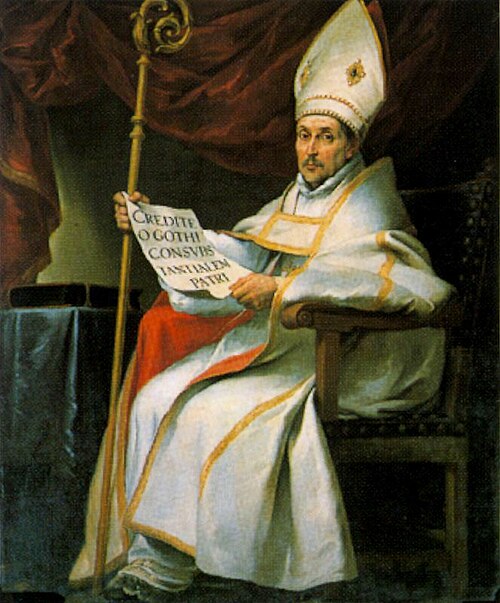
Saint
Leander of Seville
Bishop of Seville
Bishop of Seville who labored for the conversion of the Visigothic kings Hermenegild and Reccared; died about 600.
- Feast
- February 27old style March 12
- Reposed
- 6006th century
- Place
- Seville
- Order
- Hierarchs
Life
Saint Leander, hierarch, was bishop of Seville and laboured for the passage of the Visigothic kings Hermenegild and Reccared to the Orthodox faith. He fell asleep in 600 or 601. He is commemorated on 27 February and on 13 March.
His family
Leander, brother of Isidore and of Saint Florentina, belonged to a distinguished Hispano-Roman family of Cartagena. Their father, Severian, was a citizen and perhaps a ruler of the city. The family held firmly to the Orthodox faith, like most of the Romanized inhabitants, while the Visigothic nobles and kings were Arians. Around 554 they moved to Seville. Leander and Isidore both became bishops of Seville, Florentina abbess of forty convents and a thousand nuns, and the third brother, Fulgentius, bishop of Astigi. All four are regarded as saints.
The bishop
Around 576 Leander became a monk, and in 579 he was chosen bishop of Seville. In the meantime he founded a famous school, which became a center of learning. He helped Princess Ingund to bring her husband, Hermenegild, eldest son of King Liuvigild, to the Orthodox faith, and he supported the new convert when he went to war with his father. After the revolt was defeated, Liuvigild banished him and Leander stayed in Byzantium between 579 and 582, where he wrote works against Arianism and formed a friendship with the future Pope Gregory the Great, then the pope’s envoy at the Byzantine court; some of their letters survive. In 585 Liuvigild put Hermenegild to death, and after the king’s death, in 589, Leander had a share in the conversion of Reccared, his successor, and had great influence over him.
The council of Toledo
Leander introduced the recitation of the Creed of Nicaea at the Divine Liturgy, to strengthen the faith of the people against Arianism. In 589 he convoked the Third Council of Toledo, in which Visigothic Spain renounced Arianism, and delivered the closing sermon, which his brother Isidore called a homily on the triumph of the Church and the conversion of the Goths. On his return he convened a synod in Seville and worked further to root out the remains of Arianism.
His writings
Only two works remain from him, a monastic rule written for his sister and a homily. Isidore wrote of his brother that he shone as much by his virtues as by his learning and that through his faith and zeal the Gothic people were turned from Arianism to the Orthodox faith.
Commemorated the same day February 27
 Procopius of DecapolisVenerableFeb 27
 Thalelaeus the WeeperVenerable · Syrian hermitFeb 27
 Titus of the Kiev CavesVenerable · Priest of the Kiev CavesFeb 27
 Titus the SoldierVenerable · Monk of the Kiev CavesFeb 27
 Stephen of ConstantinopleVenerableFeb 27
- Jacob the SyrianVenerable · Hermit of SyriaFeb 27
 Michael MarkovMartyr · Church readerFeb 27
- Gelasius of HeliopolisMartyrFeb 27
- AbundantiusSaintFeb 27
- Abundius of Pietra MontecorvinaSaintFeb 27
- Aelfnoth of StoweMartyrFeb 27
- AntigonusMartyrFeb 27